
1. A Human Story
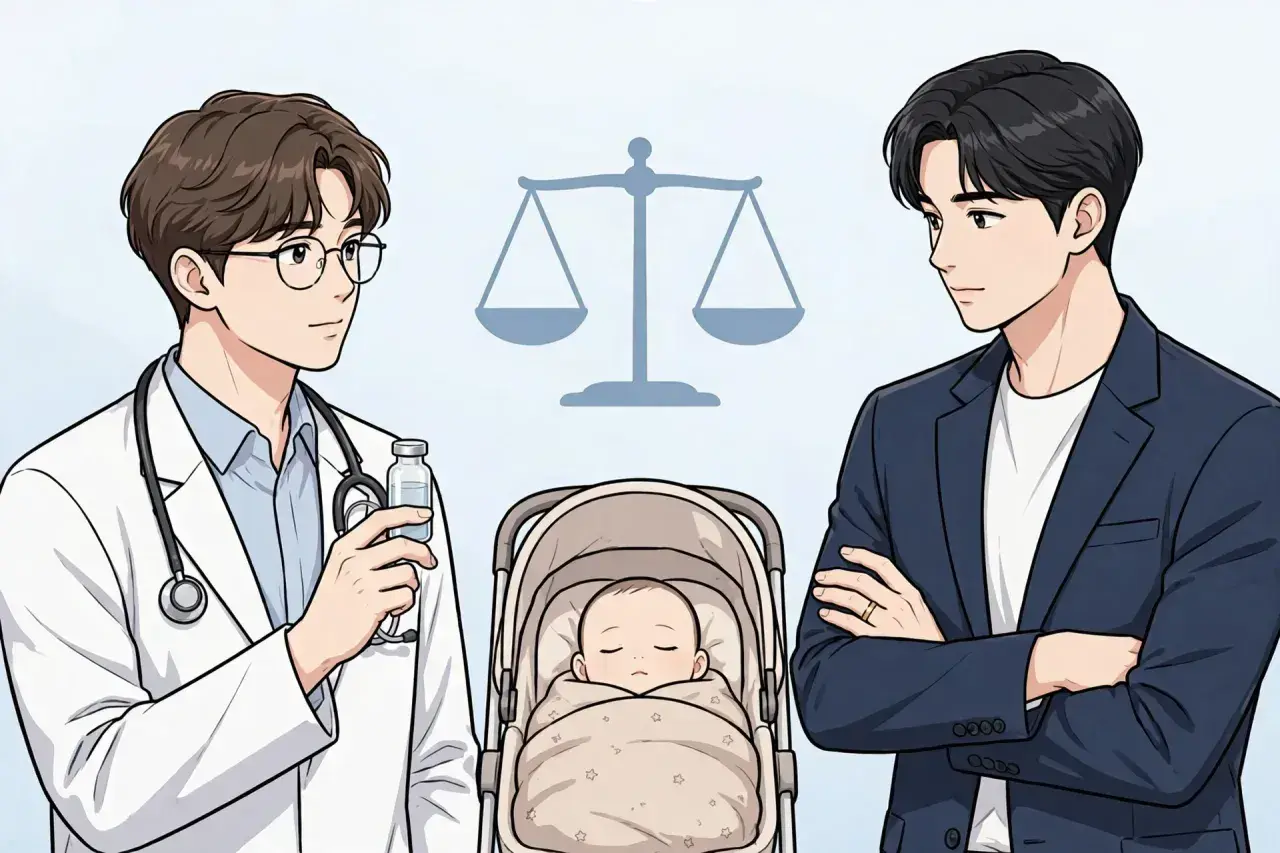
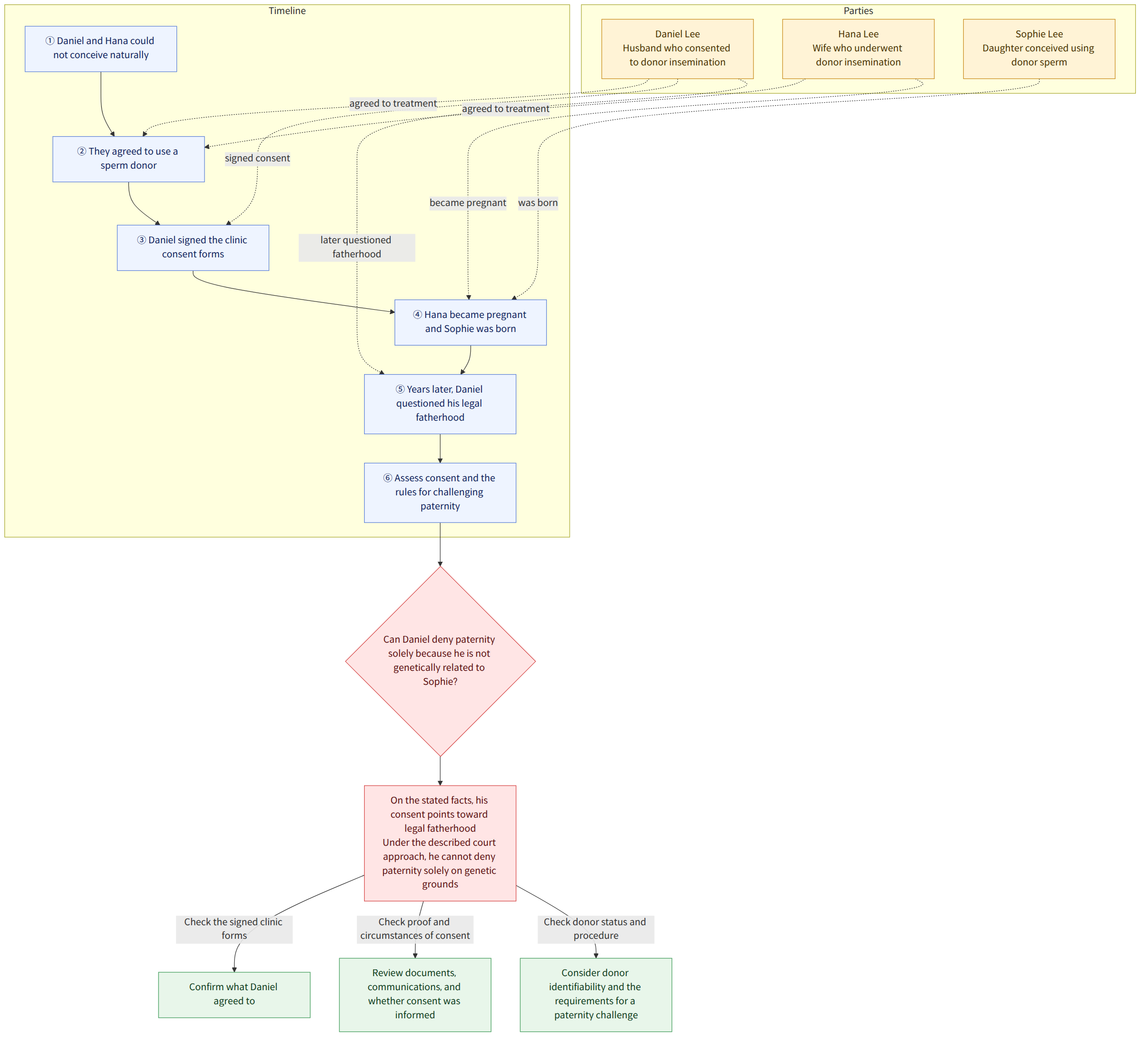
When Daniel Lee and his wife, Hana, learned that they could not conceive naturally, the decision to seek fertility treatment took months of difficult conversations. They eventually agreed to use a sperm donor. Daniel signed the clinic’s consent forms, and Hana became pregnant. Their daughter, Sophie, was born into a family that, at first, seemed to have found its way forward.
Years later, after the marriage began to unravel, Daniel told Hana that he could no longer think of Sophie as his child because they had no genetic connection. He wondered whether he could ask a Korean court to remove his name as her father. Hana, meanwhile, feared that the agreement they had made at the clinic would not protect Sophie’s place in the family.
2. The Legal Question
When a child is conceived through artificial insemination using sperm from a donor, is the mother’s husband legally presumed to be the father—and can he later deny paternity? The answer depends importantly on whether he consented to the treatment.
3. What Korean Law Says
Korean civil legislation does not contain a comprehensive, express set of rules specifically governing every form of artificial insemination. The issue has therefore been addressed through existing parentage rules and judicial interpretation.
The central distinction is whose sperm was used and whether the husband consented. A child conceived using the husband’s sperm is treated differently from a child conceived using a donor’s sperm.
The main principles are:
- Insemination using the husband’s sperm: The child’s conception involves medical assistance rather than natural sexual intercourse, but that difference does not ordinarily alter the legal parent-child relationship. If the child is born during marriage, the husband is generally presumed to be the father under Article 844 of the Civil Act.
- Insemination using donor sperm with the husband’s consent: A Korean family court has held that the child is treated as a child born within the marriage and presumed to be the husband’s child. Under that approach, the husband cannot later use a paternity-denial action simply because he is not the child’s genetic father.
- Donor insemination without the husband’s consent: The marital presumption may still arise, but the husband may be able to challenge it through the legally prescribed paternity-denial process. Whether he can do so depends on the facts and applicable procedural requirements.
- Anonymous donors: The court’s reasoning concerning donor insemination assumes that the donor is not identifiable in a way that would permit the child to pursue a parentage claim against him. The ruling described the donor as not knowing the later destination of the sperm.
A related rule may matter when a couple is living together without having registered their marriage. Under Article 855(2) of the Civil Act, a child born outside marriage may become a child born within marriage through legitimation if the parents later marry, where the relevant legal conditions are met.
Consent is not merely a personal detail. In donor-conception disputes, proof that the husband agreed to the procedure can determine whether he may later contest legal fatherhood.
4. How Korean Courts Approach This
Korean courts have approached assisted conception by asking whether the legal relationship should follow genetics alone or also reflect the choices the adults made before the child was conceived. In the donor-insemination context, a family court has treated the husband’s informed consent as a significant basis for recognizing him as the child’s legal father.
The reasoning is practical as well as legal: where a husband agreed to donor treatment, allowing him to disown the child later solely because the donor supplied the sperm could undermine the child’s family status and the reliance created by that agreement. The court has therefore distinguished a consenting husband from one who did not agree to the procedure.
Because the Civil Act has no comprehensive provision expressly addressing all forms of assisted reproduction, the details of a particular dispute can matter. Documents, communications, the circumstances of consent, and the procedural rules for challenging parentage may all be important. The judicial approach described here should not be mistaken for a rule that every fertility-treatment dispute will have the same outcome.
5. Applying the Law to the Case
Daniel’s situation turns on several steps.
- Identify the method of conception. Sophie was conceived through artificial insemination using donor sperm, not Daniel’s sperm. The ordinary rule for insemination using a husband’s sperm does not resolve the issue by itself.
- Determine whether Daniel consented. Daniel signed the clinic’s donor-treatment consent forms before the procedure. If those documents accurately record his agreement, they are strong evidence that he consented. Other communications and the treatment records could help establish the context.
- Apply the marital presumption and the consent rule. Because Sophie was born during the marriage, the general marital presumption is relevant. More specifically, the family-court approach to donor insemination treats a husband who consented to the procedure as the child’s legal father.
- Consider whether Daniel can later deny paternity. On these facts, Daniel’s argument that Sophie is not genetically related to him would not, by itself, allow him to undo the legal relationship. Under the court’s approach, a husband who consented to donor insemination is barred from denying paternity on that ground.
- Keep the non-consent situation separate. If Daniel had not agreed to donor insemination, the analysis could be different. The marital presumption might still apply initially, but a paternity-denial action may be available, subject to the applicable procedural requirements and the evidence about what happened.
The key fact is therefore not simply that a donor was involved. It is that Daniel agreed to the use of donor sperm before Sophie was conceived.
If you are dealing with a similar issue, attorney Ji-sun Ahn of Ijun Law Firm can review family registration records, dates of marriage and birth, and any earlier acknowledgment of paternity, test result, or ruling with you. These details can help clarify which options apply to your situation.
6. Conclusion: What Happened, and What Should You Do?
Daniel’s signed consent changes the answer. Under the Korean family-court approach described above, he is treated as Sophie’s legal father, and he cannot disown her merely because he is not genetically related to her. Sophie’s legal status does not depend on Daniel’s later change of heart.
For anyone facing a similar situation:
- Keep clear records of treatment consent, clinic forms, and communications about whether donor sperm would be used.
- Get Korean legal advice early if consent is disputed or a paternity challenge is being considered; parentage actions can involve strict procedural requirements.
- Prioritize the child’s legal security. Do not assume that genetic testing alone determines legal parentage when a child was conceived through assisted reproduction.

















