

1. A Human Story
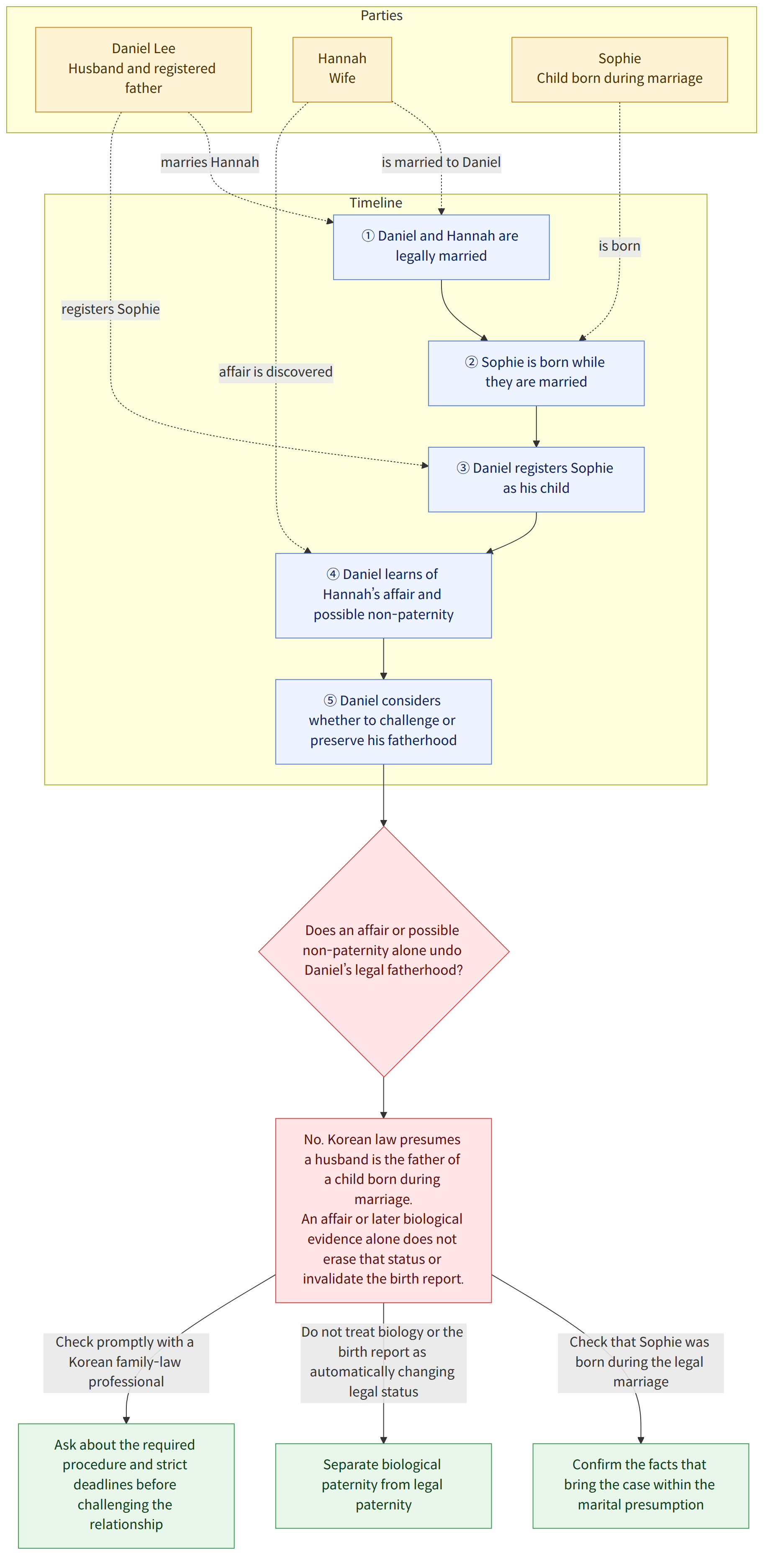
When Daniel Lee first held his daughter Sophie, he thought the hardest part of fatherhood would be sleepless nights. He and his wife, Hannah, were legally married, and Sophie was born while they were still together. Daniel registered her as his child and spent the next several years packing school lunches, soothing fevers, and watching her learn to ride a bicycle.
Then Daniel discovered that Hannah had had an affair, and that Sophie might have been conceived with another man. The news unsettled everything he thought he knew about his family. But it did not change what he felt for Sophie: she was the child he had raised, and he wanted to remain her father. He began to wonder whether the birth registration he had made was legally valid at all.
2. The Legal Question
If a child is born to a legally married couple during their marriage, is the husband’s birth registration valid when he later learns that the child may not be biologically his—and wants to preserve their relationship?
3. What Korean Law Says
Korean law distinguishes between the biological fact of motherhood and the legal determination of fatherhood. Childbirth ordinarily establishes who the mother is. Paternity, by contrast, may not be apparent from birth alone. To give children a stable legal status and reduce prolonged uncertainty, the Civil Act creates a presumption of paternity for children born within marriage.
Under Article 844 of the Korean Civil Act, a child conceived by a wife during marriage is presumed to be the child of her husband.
That presumption has important consequences:
- When a child is born to a legally married couple during their marriage, the husband is treated as the child’s legal father under the statutory rule.
- A later discovery of an affair, or evidence that the husband is not the biological father, does not by itself erase that legal status.
- The birth report does not create the presumption on its own; rather, the law supplies the presumption, and the report is consistent with it.
- A person seeking to challenge the presumed parent-child relationship generally must use the appropriate legal procedure. Applicable rules and deadlines can be strict, so the issue should be checked promptly with a Korean family-law professional.
The key distinction is between biological paternity and legal paternity. They often coincide, but Korean law does not treat a biological test as an automatic substitute for the process required to alter a child’s legal status.
4. How Korean Courts Approach This
Korean courts generally treat the marital presumption as a rule about legal stability, not merely a guess about genetics. It helps ensure that a child has a legally identifiable father and protects the child from uncertainty arising whenever adults dispute biological parentage.
A claim that a husband is not the biological father does not, by itself, dissolve the legal relationship created by the statutory presumption. The relationship must be addressed through the legally recognized process.
This approach does not mean that biology is irrelevant. It means that biological evidence and legal status are separate questions. Courts consider challenges within the framework set by family law, including the applicable procedure and time limits. In exceptional situations—such as circumstances showing that conception by the husband was objectively impossible—different legal questions may arise. But an affair alone does not automatically make the presumption disappear.
5. Applying the Law to the Case
Daniel’s situation can be assessed in several steps.
- Sophie was born during a legal marriage. Daniel and Hannah were married when Sophie was born. That places the case within the ordinary rule in Article 844.
- The law therefore presumes Daniel is her father. The presumption applies even if Daniel later learns that Hannah had an affair. The affair may raise a question about biological paternity, but it does not itself undo the legal relationship.
- Daniel’s birth report was valid. He registered Sophie as his child in circumstances where Korean law already presumed her to be his child. The report was not rendered invalid by what he learned later.
- Daniel’s wish to remain Sophie’s father is compatible with her existing legal status. If he does not seek to challenge the relationship, the presumption is not automatically removed just because he has learned about the affair. His continuing bond with Sophie is also consistent with the legal stability the rule is meant to protect.
- A decision to challenge would require more than a private conclusion about biology. Daniel should not assume that a DNA result, a conversation with Hannah, or a change in family circumstances will automatically amend official records. Any attempt to alter the legal relationship should be assessed under the relevant procedure and deadlines. The precise options can depend on the facts and on who is seeking the change.
On the facts given, there is no indication that Daniel and Hannah’s marriage had ended or that some exceptional circumstance prevents the ordinary marital presumption from applying. The straightforward legal result is therefore that Sophie is presumed to be Daniel’s child, and his birth registration is valid.
If you are dealing with a similar issue, attorney Ji-sun Ahn of Ijun Law Firm can review the family registration, the marriage, separation and birth dates relevant to the parentage dispute, and any prior court records with you. These details can help clarify which options apply to your situation.
6. Conclusion: What Happened, and What Should You Do?
Daniel’s registration of Sophie was legally valid. Because Sophie was born while Daniel and Hannah were legally married, Korean law presumes that she is Daniel’s child. His later discovery of Hannah’s affair may have changed his understanding of Sophie’s biological origins, but it did not automatically change her legal status. Daniel can continue to raise Sophie as his daughter without first taking steps to disprove the presumption.
For anyone facing a similar situation:
- Separate biology from legal status. A suspected or confirmed biological discrepancy does not automatically alter a child’s legal parentage.
- Do not delay if you are considering a challenge. Family-law procedures may have strict deadlines, and the date that starts a deadline may not be the date you discovered the affair.
- Get advice before changing records or making formal declarations. A Korean family-law lawyer can explain the available procedures and help protect the child’s legal and emotional stability.

















