
1. A Human Story
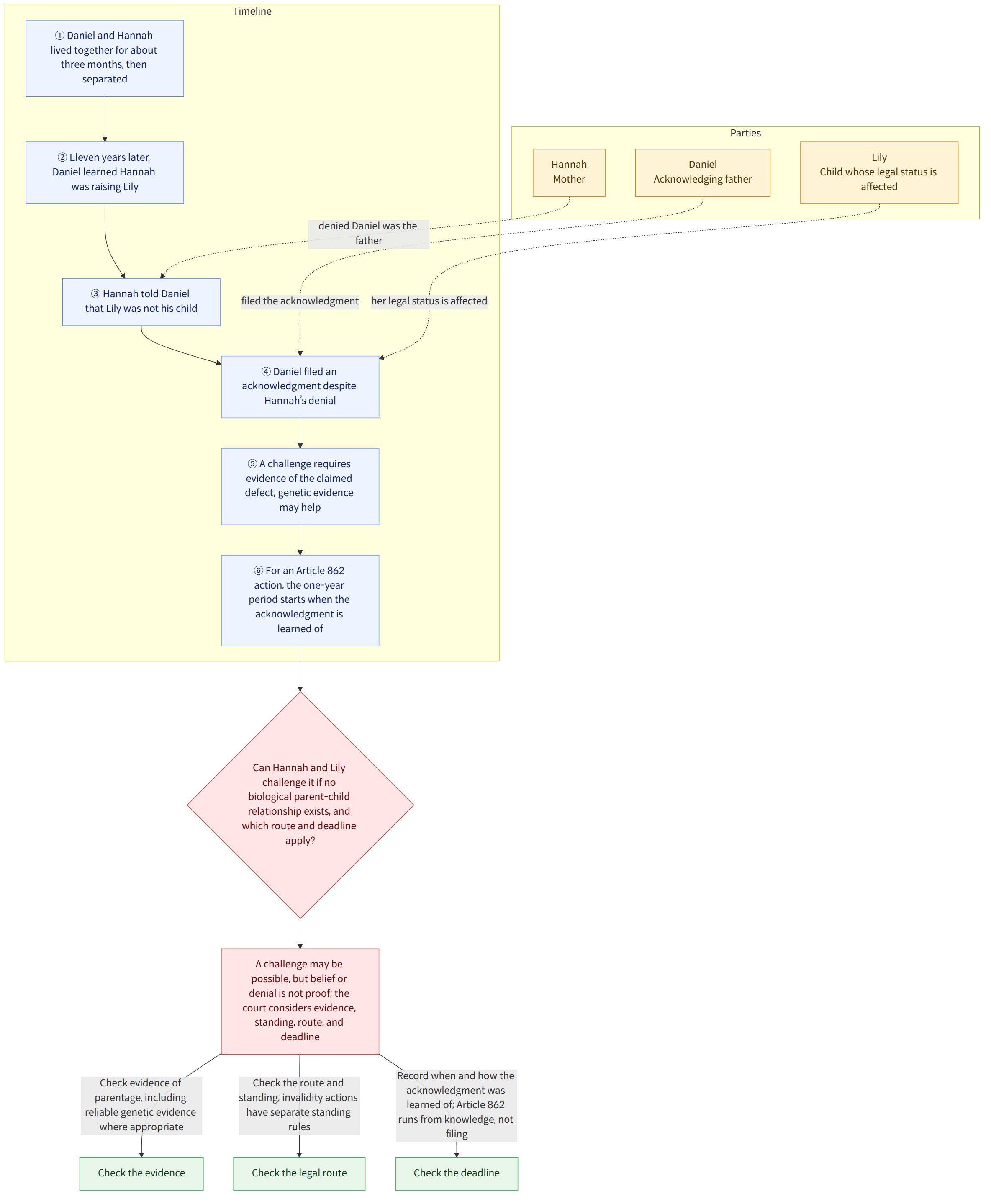
Daniel and Hannah lived together for about three months, then separated. They lost touch. Daniel still thought about Hannah, but neither knew how the other’s life had unfolded.
Eleven years later, Daniel heard that Hannah was raising Lily, her eleven-year-old daughter, on her own. He went to see them. Hannah told him Lily was not his child. Daniel, convinced otherwise, filed an acknowledgment of paternity for Lily. For Hannah and Lily, an act Daniel saw as an expression of belief suddenly carried legal consequences.
2. The Legal Question
Can Hannah and Lily challenge Daniel’s acknowledgment if he is not Lily’s biological father—and what legal routes and deadlines apply?
3. What Korean Law Says
Korean law recognizes more than one way to contest an acknowledgment. The appropriate route depends on the reason it is said to be invalid and on who brings the case.
In substance, an acknowledgment may be invalid if there is no biological parent-child relationship, if it was made without the acknowledging person’s intention, or if that person lacked the capacity to understand the act when it was made.
An action to declare the acknowledgment invalid
Under the Family Litigation Act, an action seeking a declaration that an acknowledgment is invalid may be brought by the relevant parties, their legal representatives, or relatives within the fourth degree. The rules appear in Articles 28 and 23.
For Daniel and Lily, the key question would be whether a parent-child relationship exists. The fact that Daniel deliberately filed the acknowledgment does not, by itself, establish that Lily is his child.
An action disputing the acknowledgment
The Civil Act provides another route. Under Article 862, the child or an interested person may bring an action disputing an acknowledgment within one year from the day they learned that the acknowledgment had been made.
The one-year period runs from learning of the acknowledgment—not necessarily from the date it was filed. A person who may need to challenge it should record when and how they found out.
If a father or mother has died, Article 864 provides a special route: an action may be brought against the public prosecutor within two years from the day the claimant learned of that parent’s death.
These routes should not be confused. The one-year period is specified for the action disputing the acknowledgment. The action seeking a declaration of invalidity has its own rules about who may bring it. Anyone considering either route should act promptly and obtain advice about the applicable procedure.
4. How Korean Courts Approach This
Korean courts treat legal parentage as a matter with serious consequences for both the child and the adults involved. A filed acknowledgment therefore cannot be undone simply because the adults disagree about it. The court must consider whether a legally recognized parent-child relationship exists and whether a ground for invalidity has been established.
A person’s conviction that a child is theirs is not a substitute for proof of parentage. Equally, a denial by the other parent is an allegation, not a court finding.
Courts generally examine the evidence relevant to the asserted ground. In a dispute about biological parentage, reliable genetic testing may be important. The court may also consider the circumstances of the acknowledgment and the evidence about when the child or an interested person learned it had been made. The legal route and deadline matter as well as the underlying facts.
5. Applying the Law to the Case
The analysis for Hannah and Lily proceeds in several steps.
- Identify the claimed defect. Hannah says Daniel is not Lily’s biological father. If that is true, the acknowledgment may be invalid because the parent-child relationship on which it rests does not exist. Daniel’s sincere belief does not settle the question.
- Establish the facts. The court would need evidence, not merely the former couple’s competing assertions. Reliable evidence of parentage, including genetic evidence where appropriate, could help resolve whether Daniel is Lily’s biological father.
- Choose a legal route. They may seek an action to declare the acknowledgment invalid. Lily is a party whose legal status is directly affected. Hannah may be able to act as Lily’s legal representative while Lily is a minor, and the applicable standing rules must be observed. The Civil Act’s action disputing an acknowledgment is also available to the child or an interested person.
- Check the deadline for the challenge action. If Hannah or Lily knew that Daniel had filed the acknowledgment, the one-year period under Article 862 would run from the date of that knowledge. They should not wait while assuming that the family’s long separation or Daniel’s late return changes the deadline.
- Separate parentage from other grounds. On the stated facts, Daniel intentionally filed the acknowledgment and there is no suggestion that he lacked capacity. Those grounds may not fit. But the alleged absence of a biological relationship is a distinct basis for challenging it.
If Daniel were to die, the special rule in Article 864 may become relevant, with its two-year period running from learning of his death. That is not the central issue while he is alive, but it illustrates why the timing and legal route should be assessed carefully.
If you are dealing with a similar issue, attorney Ji-sun Ahn of Ijun Law Firm can review family registration records, dates of marriage and birth, and any earlier acknowledgment of paternity, test result, or ruling with you. These details can help clarify which options apply to your situation.
6. Conclusion: What Happened, and What Should You Do?
Assume reliable evidence confirms that Daniel is not Lily’s biological father. In that event, Hannah and Lily have grounds to contest his acknowledgment: they can pursue an action seeking to have it declared invalid, and an eligible claimant may also bring the Civil Act action disputing it within the one-year period. The court—not Daniel’s belief or Hannah’s denial alone—would determine the legal effect after considering the evidence and the proper procedure.
For anyone facing a similar situation:
- Record the date you learned of the acknowledgment. Keep any notice, message, document, or other evidence that helps establish when the one-year period began.
- Preserve evidence about parentage and the filing. Avoid altering or discarding relevant records, and ask a Korean family-law lawyer what evidence and testing are appropriate.
- Get advice promptly about the right action and who may file it. Deadlines and standing rules can determine whether a challenge can proceed.

















