

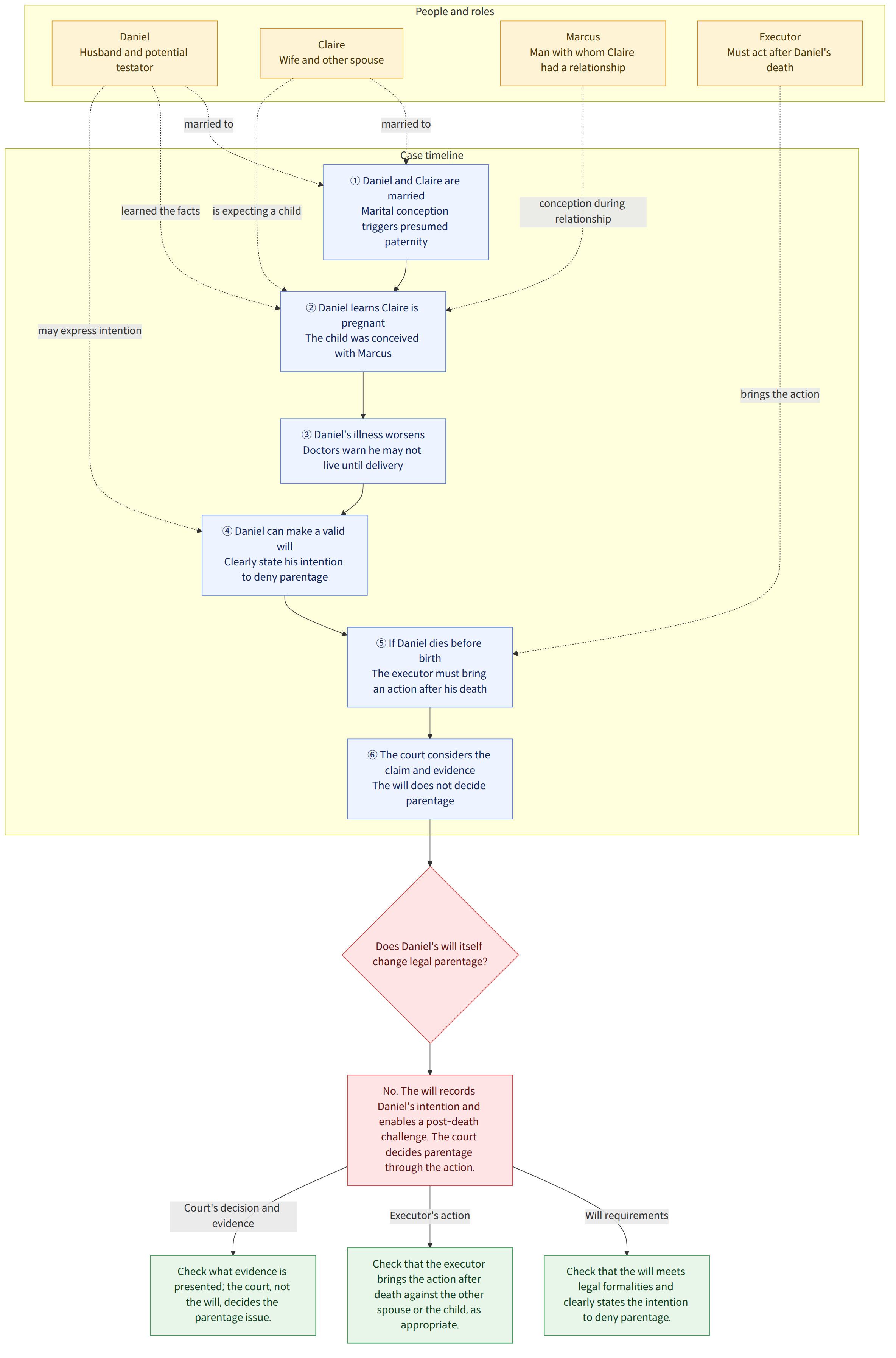
1. A Human Story
Daniel and Claire had been married for years when Daniel learned that Claire was pregnant. He also learned that the child had been conceived during her relationship with another man, Marcus. Daniel wanted to challenge the child’s legal paternity as soon as the baby was born, but a chronic illness he had managed for years suddenly worsened. His doctors warned that he might not live until the delivery.
The question Daniel put to his lawyer was painfully direct: if he died before the baby arrived, could he still make his objection known—and could anyone act on it after his death? He needed more than a private declaration of what he believed. He needed a lawful way to set a legal process in motion even if he could not bring the case himself.
2. The Legal Question
Can a husband who expects to die before a child is born express his intention to deny that the child is his in a will, and what must happen after his death for that challenge to proceed?
3. What Korean Law Says
Korean law generally presumes that a child conceived during a marriage is the husband’s child. That presumption matters: a belief, family agreement, or private statement does not by itself remove the child’s legal status. A denial-of-paternity action is the legal route for challenging it.
Article 850 of the Civil Act provides a way to act when a husband or wife dies before bringing such a case:
If a husband or wife expresses an intention to deny parentage by will, the executor must, after that person’s death, bring an action to deny parentage against the other spouse or the child.
In practical terms, the process has several parts:
- The person must make a legally valid will that clearly expresses the intention to deny parentage.
- The will records that intention; it does not itself decide whether the child is or is not the person’s child.
- After the testator dies, the executor is required to bring the denial-of-paternity action against the other spouse or the child, as the law and circumstances require.
- The court then considers the claim and relevant evidence through the legal process.
The will must satisfy the formal requirements applicable to the type of will used. A casual note or an oral statement should not be assumed to have the legal effect of a valid will.
4. How Korean Courts Approach This
Korean courts treat legal parentage as a matter of status, not simply a question of what the adults privately believe. Where the law presumes a husband’s paternity, that presumption remains in place unless it is addressed through the proper legal procedure.
A will under Article 850 is therefore a bridge to a court case, not a substitute for one. It enables the executor to pursue the challenge after the person who made the will has died. The court—not the will-maker or executor—decides the issue, considering the claim and the evidence presented. Evidence such as genetic testing may be relevant, but the legal question must still be handled through the prescribed action.
A declaration in a will does not, by itself, change a child’s legal parentage. It authorizes the post-death process that can ask a court to decide the matter.
5. Applying the Law to the Case
Daniel’s situation fits the purpose of Article 850. He is married to Claire, and the child she is carrying was conceived during their marriage. The law’s presumption means that Daniel cannot rely only on what he has learned about Claire’s relationship with Marcus to alter the child’s legal status.
First, Daniel can make a will that clearly states his intention to deny that the expected child is his. He must use a form of will that meets Korean legal requirements. Clarity matters: the will should identify the intention to pursue a denial-of-paternity action, rather than leave the executor to guess what Daniel wanted.
Second, the will will not itself establish that Marcus is the child’s father or remove Daniel’s presumed legal relationship to the child. Those are matters for the court to determine in the proper proceeding.
Third, if Daniel dies before the child is born, the executor named or appointed under the applicable rules must act after Daniel’s death. Article 850 places the responsibility to bring the action on the executor. The case would be brought against the other spouse or the child, as appropriate to the circumstances and procedure.
Finally, the court would assess the claim and evidence. Daniel’s written intention would provide the legal basis for the executor to proceed, but the court would still need to resolve the parentage issue. The will is therefore important precisely because Daniel may not survive to file the lawsuit himself—but it is not a guaranteed ruling in his favor.
If you are dealing with a similar issue, attorney Ji-sun Ahn of Ijun Law Firm can review the family registration, the marriage, separation and birth dates relevant to the parentage dispute, and any prior court records with you. These details can help clarify which options apply to your situation.
6. Conclusion: What Happened, and What Should You Do?
Daniel made a legally compliant will stating clearly that he intended to deny paternity of Claire’s expected child. He also ensured that the executor understood the need to bring the action after his death. Daniel died before the baby was born. Afterward, the executor initiated the denial-of-paternity case, allowing a court—not Daniel’s will alone—to determine the child’s legal parentage.
For anyone facing a similar situation:
- Get prompt advice from a Korean family-law lawyer. The will’s form, wording, and the later court procedure all matter.
- Make the intention explicit in a legally valid will. Do not assume that a letter, message, or informal conversation will be enough.
- Prepare the executor to act. Make sure the executor knows where the will is and understands that a court action must follow; the will itself does not change parentage.

















