
1. A Human Story
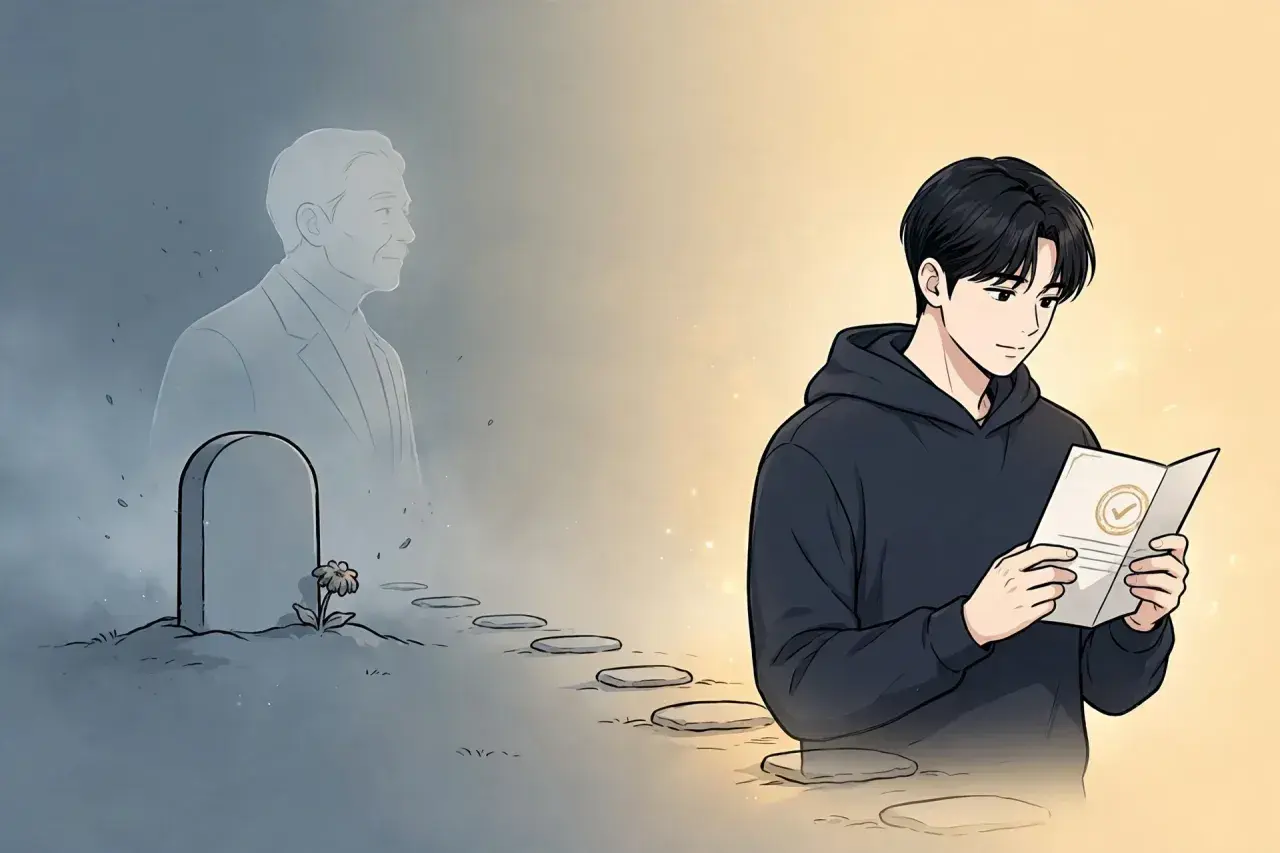
Mina Lee had always known that her mother, Sun-hee, registered her birth alone. The family register listed Sun-hee as her mother, but the space for a father was blank. As a child, Mina learned not to ask too many questions. Years later, her mother finally told her that Daniel Han was her biological father—and that he had recently died.
Mina’s first thought was practical: could she simply ask the local office to add Daniel’s name? She had old photographs, a handful of letters, and her mother’s account. But the clerk explained that a birth record cannot ordinarily be changed just because someone claims a biological connection. Mina would need to establish the legal relationship first.
2. The Legal Question
Can a person born outside marriage have the deceased biological father added to their Korean family register after his death—and, if so, what legal steps and deadlines apply?
3. What Korean Law Says
Under Korean law, a biological connection and a legal parent-child relationship are not always the same thing. For a child born outside marriage, the relationship with the biological father is not automatically created at birth. It is generally established when the father formally recognizes the child, or when a court grants a claim for recognition.
A father’s recognition is a formal legal act. Without recognition or a court judgment establishing it, biological paternity alone does not ordinarily make the father legally recorded as the child’s parent.
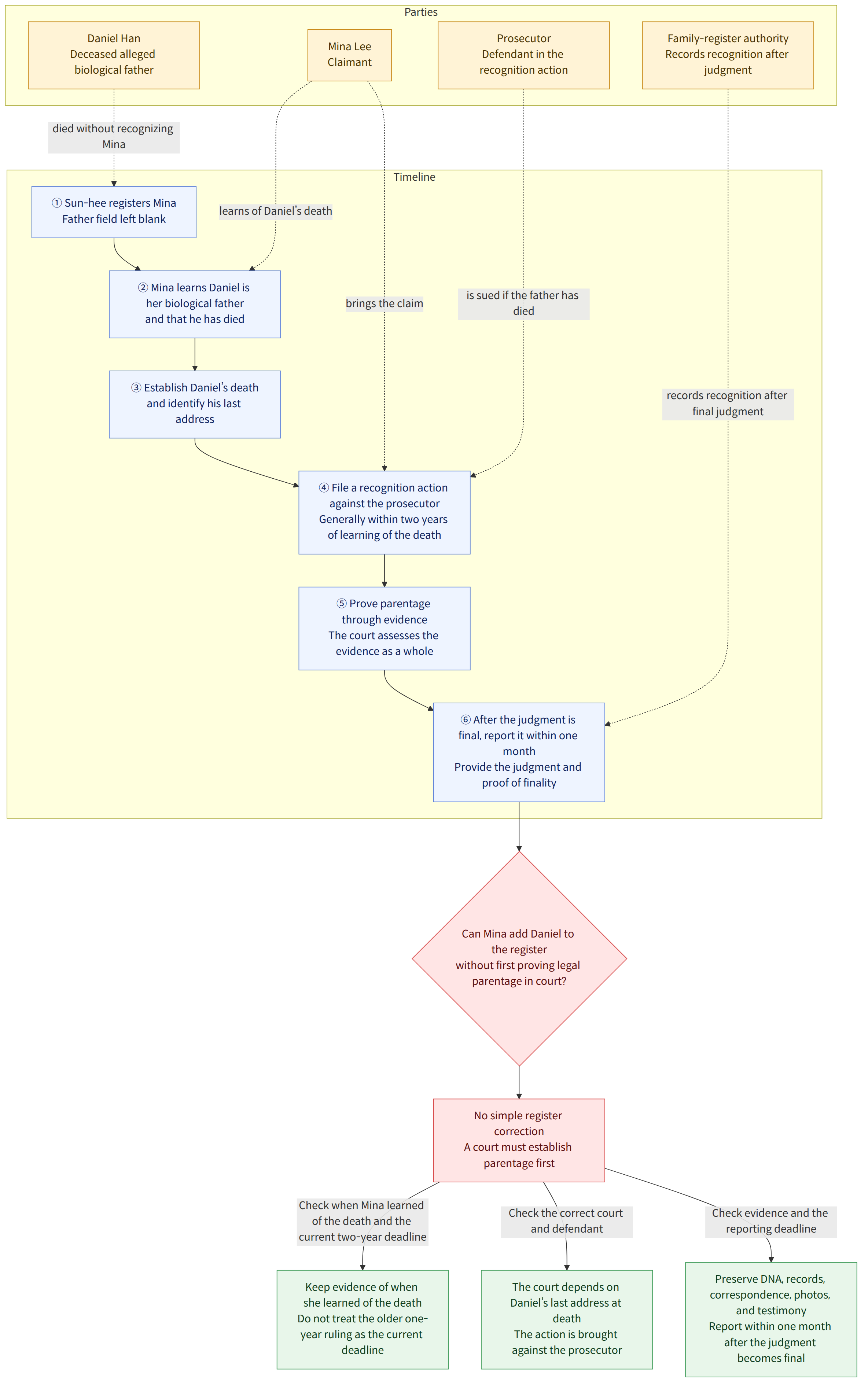
The Civil Act provides for recognition and for a court action when recognition has not been made. If the father is alive, the claim is brought against him. If he has died, the claim is brought against the prosecutor. The case belongs in the court with jurisdiction over the father’s last address at the time of death.
The main steps are:
- Establish that the alleged father has died and identify his last address. These facts determine the proper procedure and court.
- File a recognition action against the prosecutor. Under the current rule described here, the action generally must be brought within two years after the claimant learns of the father’s death.
- Prove the claimed parent-child relationship. Evidence may include DNA testing, family or personal records, correspondence, photographs, and testimony. The court assesses the evidence as a whole.
- After the judgment becomes final, report it to the family-register authority. The report must be made within one month of the judgment becoming final, with a copy of the judgment and proof that it is final. The register can then record the recognition and the father’s name.
Do not treat the two-year period as a reason to wait. Keep evidence of when you learned of the death, and obtain legal advice promptly about the deadline and the correct court.
A Supreme Court principle also addresses a claimant’s capacity to act. In an older decision interpreting the then-applicable one-year period, the Court explained that the clock did not necessarily begin merely because a child had learned of the parent’s death: the claimant had to have the ability to perform the relevant legal act. The statutory period has since changed. The older ruling is important as a principle about capacity, but it should not be mistaken for the current two-year deadline.
The right to seek recognition is also personal and cannot effectively be surrendered in advance. Even a court-approved settlement clause purporting to waive that right does not make the waiver valid.
4. How Korean Courts Approach This
Korean courts distinguish carefully between a biological assertion and a legally established status. A claimant must bring the proper kind of case; a request to amend a family register is not a substitute for proving parentage when the father never recognized the child.
Courts assess the available evidence rather than relying on one item in isolation. DNA evidence can be important, including testing involving relatives when the alleged father is deceased. The court may also consider the history of the relationship, documents, communications, and witness testimony. The question is whether the evidence establishes the claimed parentage under the applicable legal standard.
Courts also treat recognition as a matter of personal status, not simply a financial bargain between relatives. That is why a person cannot ordinarily sign away the right to seek recognition, even if family members have reached an agreement about doing so.
5. Applying the Law to Mina’s Case
First, Mina cannot obtain the change by asking for a simple correction. Daniel’s name was never entered, and he did not formally recognize her during his lifetime. The registrar cannot decide the disputed question of parentage on the basis of Mina’s account or her mother’s statement alone.
Second, Daniel’s death changes whom Mina must sue, not whether she has a legal route. Because he is deceased, Mina would bring a recognition action against the prosecutor rather than against Daniel. She would file in the court with jurisdiction over Daniel’s last address when he died.
Third, Mina must track the deadline from when she learned of his death. She learned of it only six weeks ago, so she should preserve evidence of that date and act without delay. The relevant period is generally two years from learning of the death. If there is uncertainty about when the period began, or about Mina’s capacity to act at an earlier age, she should obtain advice rather than assume the deadline is either safely distant or already expired.
Fourth, Mina needs evidence the court can evaluate. Her mother’s testimony and the letters may support her account, but she should also ask whether DNA testing is available through Daniel’s relatives and gather any records or communications that connect Daniel to her. No single kind of evidence guarantees success; the court will consider the full picture.
Finally, a favorable judgment must be completed through registration. If the judgment becomes final, Mina must submit the judgment and proof of finality to the appropriate local registrar within one month. The authority can then record the recognition and add Daniel’s name as her father. The court case establishes the legal relationship; the registration step reflects that result in the family register.
If you are dealing with a similar issue, attorney Ji-sun Ahn of Ijun Law Firm can review family registration records, dates of marriage and birth, and any earlier acknowledgment of paternity, test result, or ruling with you. These details can help clarify which options apply to your situation.
6. Conclusion: What Happened, and What Should You Do?
In Mina’s case, she moved quickly, preserved the date she learned of Daniel’s death, and brought the recognition action against the prosecutor in the proper court. The court considered her mother’s testimony, the letters, and DNA evidence from Daniel’s close relatives. Finding the evidence sufficient, it issued a final judgment recognizing Daniel as her father. Mina then reported the judgment within one month, and his name was entered in the father’s section of her family register.
That outcome is not automatic for every claimant: the court must be persuaded by the evidence, and the filing requirements matter. For anyone facing a similar situation:
- Record when you learned of the father’s death and act promptly; the general deadline is two years from that date.
- Gather evidence early, including possible DNA sources, correspondence, records, and witnesses, and file the recognition action against the prosecutor in the court tied to the father’s last address.
- After a final judgment, complete registration within one month by submitting the required court documents to the local family-register authority.

















