1. A Human Story
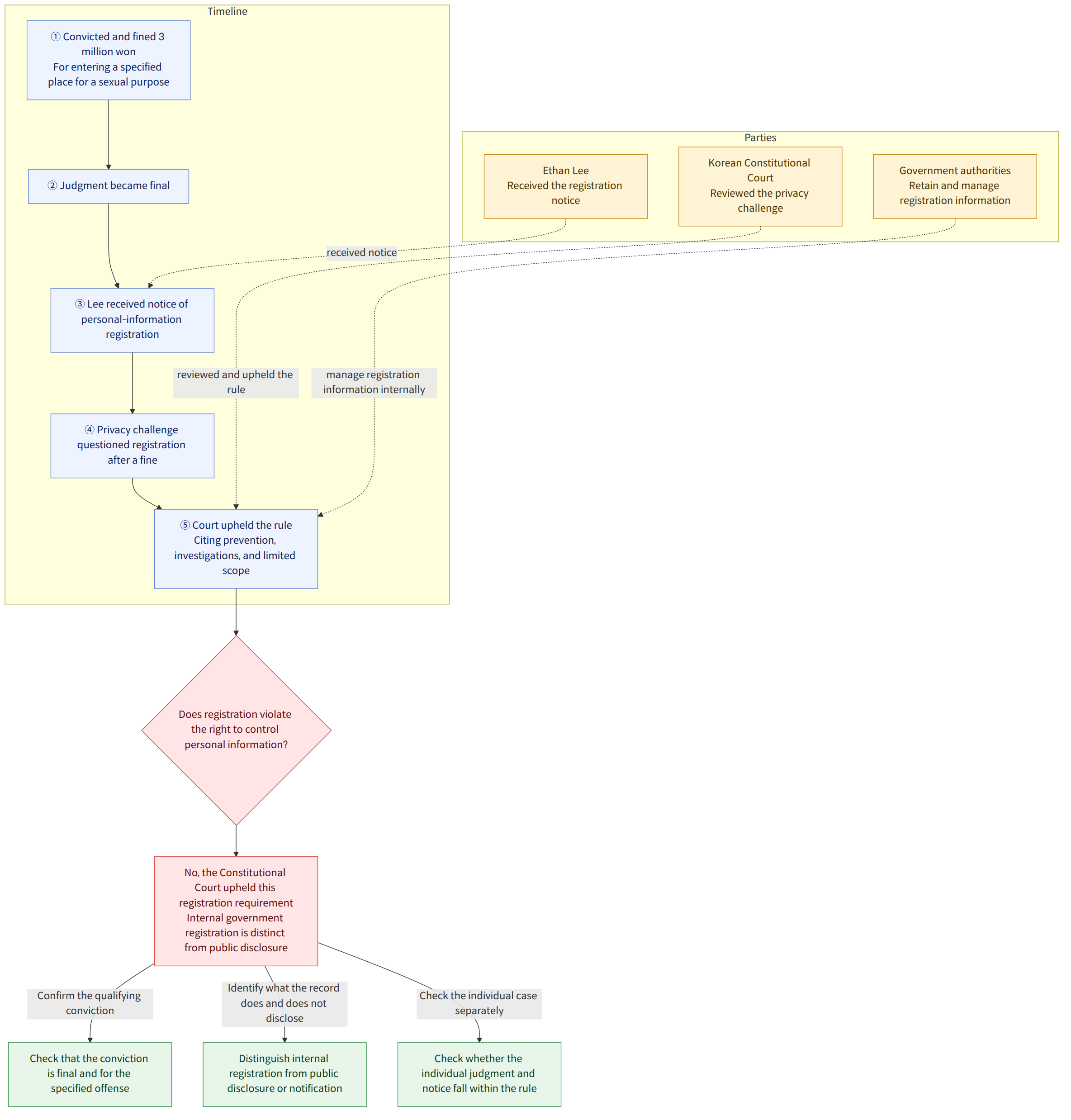
When Ethan Lee opened the official notice, he expected it to confirm the end of a difficult case. A court had imposed a 3 million won fine for entering a public place for a sexual purpose, and the judgment was now final. Instead, the notice told him that the conviction also made him subject to personal-information registration.
Ethan’s first reaction was not about the fine. It was the thought that the government would keep personal details about him because of a criminal conviction. He wondered whether a record held by the state could follow him beyond the punishment the court had imposed—and whether requiring it violated his right to privacy.
2. The Legal Question
Does requiring a person with a final conviction for this offense to register personal information violate the constitutional right to control information about oneself, particularly when the sentence was a fine rather than imprisonment?
3. What Korean Law Says
The legal issue arises under the registration provisions of Korea’s Act on Special Cases Concerning the Punishment, etc. of Sexual Crimes. Under the provision at issue, a person whose qualifying conviction becomes final is treated as a registration subject. The constitutional challenge concerns that registration requirement—not a separate decision to publish the person’s information to the public.
The Constitutional Court’s reasoning rests on the familiar principle that a restriction on a constitutional right must pursue a legitimate purpose and must not go further than needed to serve it. The Court described the registration system this way:
The system aims to prevent repeat sexual offenses and support effective investigations. It involves government authorities retaining and managing information internally, rather than disclosing or notifying the public of a person’s identity. Because the offense applies only to entry into specified places for a sexual purpose, the group subject to registration is limited. The public interest in preventing repeat offenses and protecting society outweighs the restriction on the individual’s right to control personal information.
In practical terms, the key distinctions are:
- Registration is not the same as public disclosure. Registration concerns government retention and management of information; public disclosure or notification is a separate measure with a different and greater impact on privacy.
- The offense covered is limited. The provision concerns entry into certain places, such as public restrooms, for a sexual purpose; it does not apply to every sexual offense or every intrusion.
- The constitutional assessment weighs both sides. The Court considers the public purpose, how closely the measure serves that purpose, how broadly it applies, and the burden it places on the individual.
4. How Korean Courts Approach This
When reviewing a challenge to a statutory restriction on privacy, Korean courts assess whether the measure serves a legitimate public purpose, is reasonably suited to that purpose, limits the right no more than necessary, and maintains a fair balance between public and private interests. This is often described as a proportionality analysis.
For this particular registration requirement, the Constitutional Court has upheld the rule. It treated preventing repeat offenses and assisting investigations as legitimate aims, and regarded internal registration as less intrusive than public disclosure. It also considered the limited scope of the qualifying offense important: the registration rule applies to those convicted of the specified conduct, rather than to an unlimited category of people.
That does not mean every issue about a registration notice is automatically resolved. Whether the rule is constitutional is one question; whether a particular person’s judgment and notice actually fall within the rule is another. The constitutional ruling addresses the first question, not every possible mistake or dispute about an individual record.
5. Applying the Law to Ethan’s Case
First, Ethan’s conviction was final. The registration provision at issue links registration status to a final conviction for the specified offense. On the facts of his situation, that link is the reason he received the notice.
Second, the constitutional objection focuses on the nature of the registration. Ethan fears that the government’s record is equivalent to public exposure. But the Court distinguishes internal retention and management by government authorities from a system that makes a person’s information public or notifies the public. The latter would intrude more directly on privacy; the former is the measure the Court assessed here.
Third, the Court found the measure sufficiently connected to its stated aims. Maintaining information about qualifying offenders was considered a suitable means of supporting prevention and investigation. The Court also relied on the limited category of conduct covered by the offense when it concluded that the registration rule was not broader than necessary.
Finally, the Court weighed Ethan’s privacy interest against the public interest in preventing repeat sexual offenses and protecting society. It concluded that the public interest outweighed the burden imposed by internal registration. So Ethan’s argument—that registration itself violates his constitutional right to control personal information—would face a directly relevant constitutional ruling that rejects that claim.
If Ethan wants to understand what the notice requires of him, the most useful starting point is the exact wording of the final judgment and the registration notice. A review of those documents can help identify whether the notice accurately reflects the conviction and which obligations it sets out. A reader in Ethan’s position could ask [[lawyer]] to review those documents and explain how the registration rule applies to the specific case.
6. Conclusion: What Happened, and What Should You Do?
Ethan’s constitutional privacy challenge, if based only on the claim that registration itself is an unlawful invasion of personal-information rights, is unlikely to succeed under the Constitutional Court’s ruling. The Court upheld the registration provision, emphasizing its crime-prevention purpose, the limited scope of the offense, and the fact that registration is not the same as public disclosure. That conclusion does not make the details of every notice immune from review: the judgment and the notice still need to match the law and each other.
If you receive a similar notice:
- Compare it with the final judgment. Check that the offense and conviction described in the notice are the ones recorded by the court.
- Read the notice carefully. Identify what information and obligations it actually specifies; do not assume that registration automatically means public disclosure.
- Get advice on the documents, not just the general rule. Ask a qualified adviser to review the judgment and notice if you are unsure whether the registration provision applies to your circumstances.
If you have received a registration notice, you could ask attorney Ji-sun Ahn of Ijun Law Firm to review the notice alongside the final judgment, focusing on whether the offense and resulting obligations described in the notice match the court’s decision.