

A Human Story
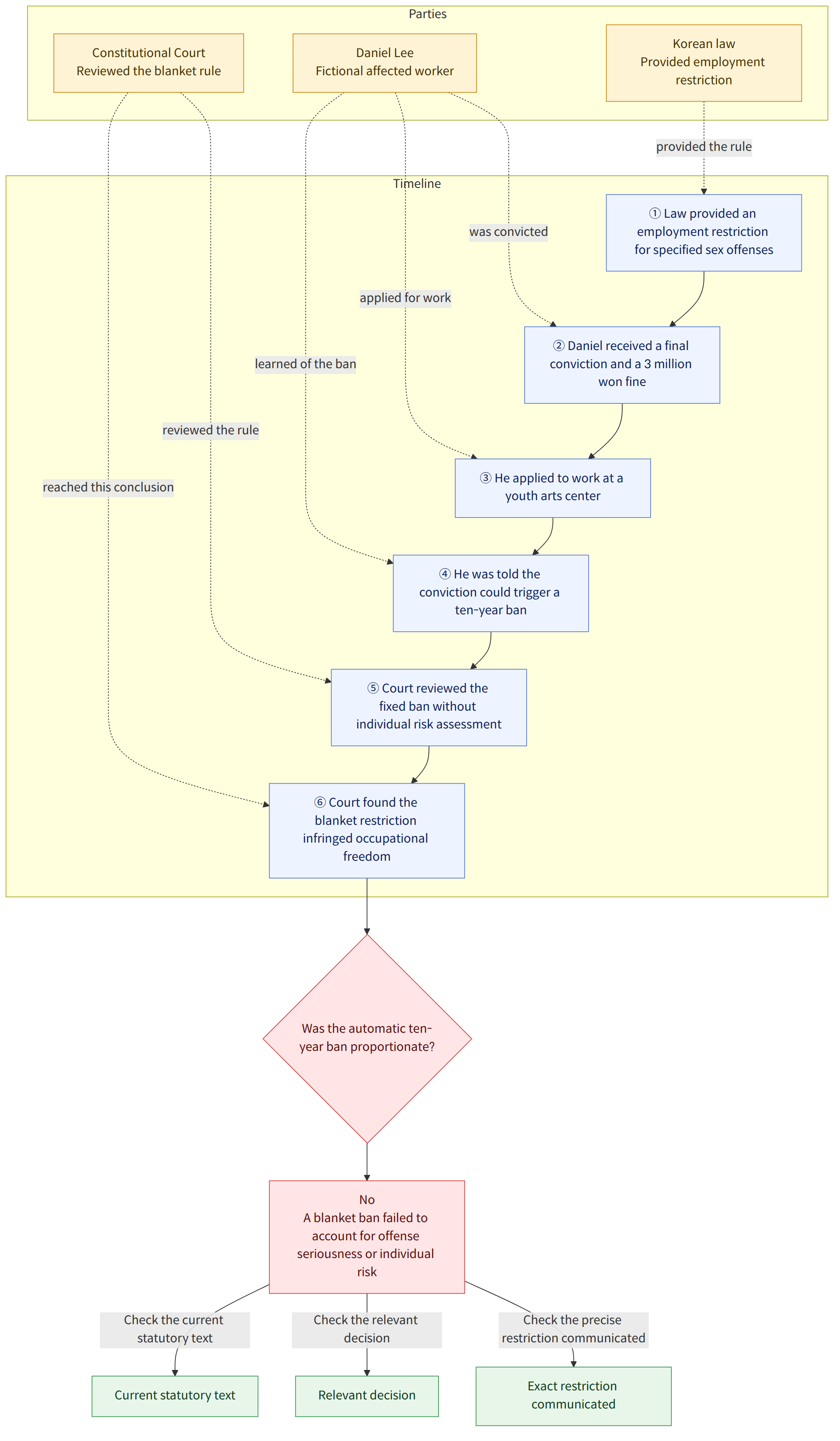
When Daniel Lee received a final judgment imposing a ₩3 million fine, he thought the hardest part was over. His conviction was for entering a public place for a sexual purpose. In his fictional case, there was no physical contact and no identified victim whose sexual autonomy had been directly violated.
Months later, Daniel applied for work at a youth arts center. The hiring process brought an unexpected consequence: because of the conviction, he was told he could be barred from working at child- and youth-related institutions for ten years. The restriction did not appear to turn on the details of his conduct, his record since the offense, or an assessment of whether he posed a continuing risk.
The Legal Question
Can Korea impose a fixed ten-year employment ban on everyone convicted of sexual-purpose trespass in a public place, without considering the seriousness of the individual offense or the person’s risk of reoffending? The constitutional question is whether that blanket restriction goes too far in limiting the freedom to choose one’s occupation.
What Korean Law Says
Korean law has provided for employment restrictions affecting people convicted of specified sex offenses, including sexual-purpose trespass in a public place. The restriction at issue applied to work at child- and youth-related institutions, with medical institutions excluded, and measured the period from the end of execution of the sentence.
The constitutional concern is not that the underlying offense is harmless or should go unpunished. It is that a person’s conviction alone may not justify treating that person as a continuing danger for the same fixed period in every case.
The Constitutional Court concluded that the blanket ten-year restriction infringed the freedom to choose an occupation. Its reasoning centered on proportionality: a restriction on a constitutional right must be appropriately connected to a legitimate protective purpose and must not impose more harm than that purpose requires.
Relevant considerations include:
- The nature and seriousness of the conduct: the offense may occur without an identifiable victim or a direct violation of another person’s sexual autonomy.
- The individual’s risk of reoffending: a conviction by itself does not establish that the person will commit the same kind of offense again.
- The length of the restriction: the rule treated ten years as necessary in every case, without accounting for the possibility that risk may be absent or may diminish sooner.
- The balance of interests: protecting children and young people is vital, but a broad restriction can also impose a serious and lasting barrier to work.
How Korean Courts Approach This
In constitutional review, the central question is not simply whether the state has a legitimate reason to protect children and young people. It does. The court also examines whether the particular means chosen are proportionate to that purpose and whether they unnecessarily burden an individual right.
The Constitutional Court found the blanket approach defective because it treated all convictions of this type alike. It did not distinguish between a serious offense and a relatively minor one, or between a person who presents a continuing risk and one who does not. Nor did it allow for the possibility that any risk could be addressed or could diminish before ten years had passed.
A protective goal does not, by itself, justify a one-size-fits-all restriction. The measure must take account of meaningful differences in the conduct and the person affected.
That constitutional conclusion answers the question about the blanket rule; it does not automatically decide every practical issue that may follow. The effect on a particular person can depend on the current statutory text, the relevant decision, and the precise restriction communicated to the person.
Applying the Law to Daniel’s Case
- The restriction is triggered by a conviction. Daniel’s final conviction and fine place him within the category addressed by the rule. The fine does not make the conviction disappear.
- The rule does not assess Daniel individually. As described, the employment bar would apply because of the offense alone. It would not ask whether his particular conduct was relatively minor or whether evidence showed a continuing risk of reoffending.
- The ten-year period is not tailored to his circumstances. A fixed period assumes that the same restriction is needed for every person throughout the full decade. The Constitutional Court rejected that assumption as a sufficient basis for imposing the burden across the board.
- The constitutional balance favors Daniel against an automatic ban. Protecting young people is a compelling public interest, but a restriction based only on his conviction, without regard to the offense’s gravity or his individual risk, is the type of blanket measure the Court held inconsistent with freedom of occupational choice.
Daniel therefore has a strong constitutional answer to the question he faced: a categorical ten-year ban imposed solely on the basis of this conviction was found to infringe the freedom to choose an occupation. That conclusion does not cancel the fine, erase his criminal record, or guarantee that the youth arts center must hire him. The current law and the specific notice or decision applying it still need to be checked before drawing a conclusion about his eligibility for a particular job.
A person in Daniel’s position could ask attorney Ji-sun Ahn of Ijun Law Firm to review the final judgment, proof of when the fine was paid, and the notice identifying the employment restriction. Those documents can help clarify what rule is being applied and what questions remain about the person’s eligibility.
Conclusion: What Happened, and What Should You Do?
Daniel’s conviction remained, but the constitutional objection to an automatic ten-year employment bar was clear: a rule that treats every person with this conviction as equally risky, regardless of the conduct or individual circumstances, goes too far. His next step would be to establish exactly what restriction is being applied to him and whether it reflects the law currently in force.
For anyone in a similar position:
- Keep the final judgment and records showing when the fine or other sentence was completed; the restriction’s timing may depend on that date.
- Ask for the written notice or decision explaining the employment restriction, and check which law and version it relies on.
- Do not assume that the ruling automatically removes every employment obstacle; verify how it applies to the specific institution and position.
















