1. A Human Story
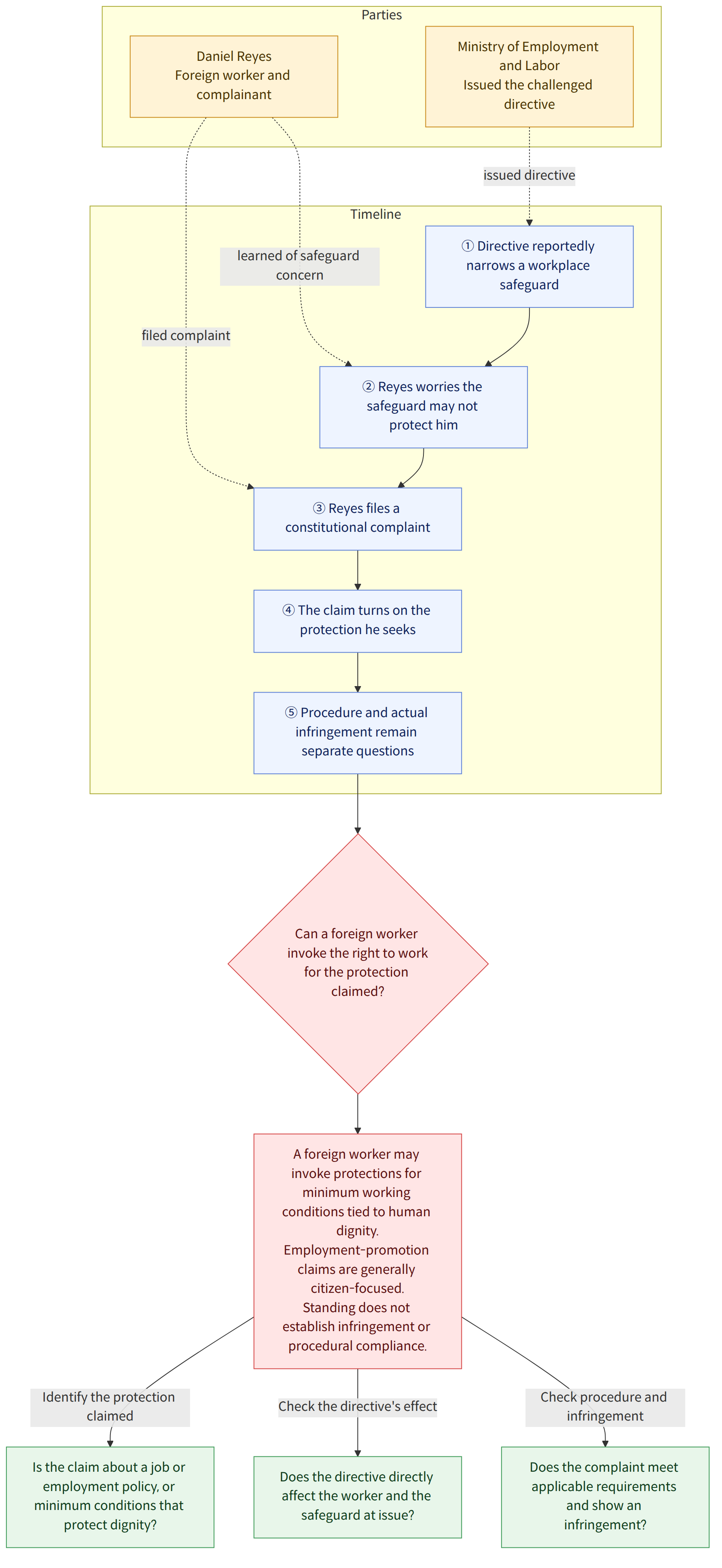
Daniel Reyes, a foreign worker in South Korea, had come to depend on the rules that set the basic terms of his working life. When he learned of a Ministry of Employment and Labor directive that he believed narrowed a workplace safeguard, he worried that the protection he relied on might not apply to him in practice.
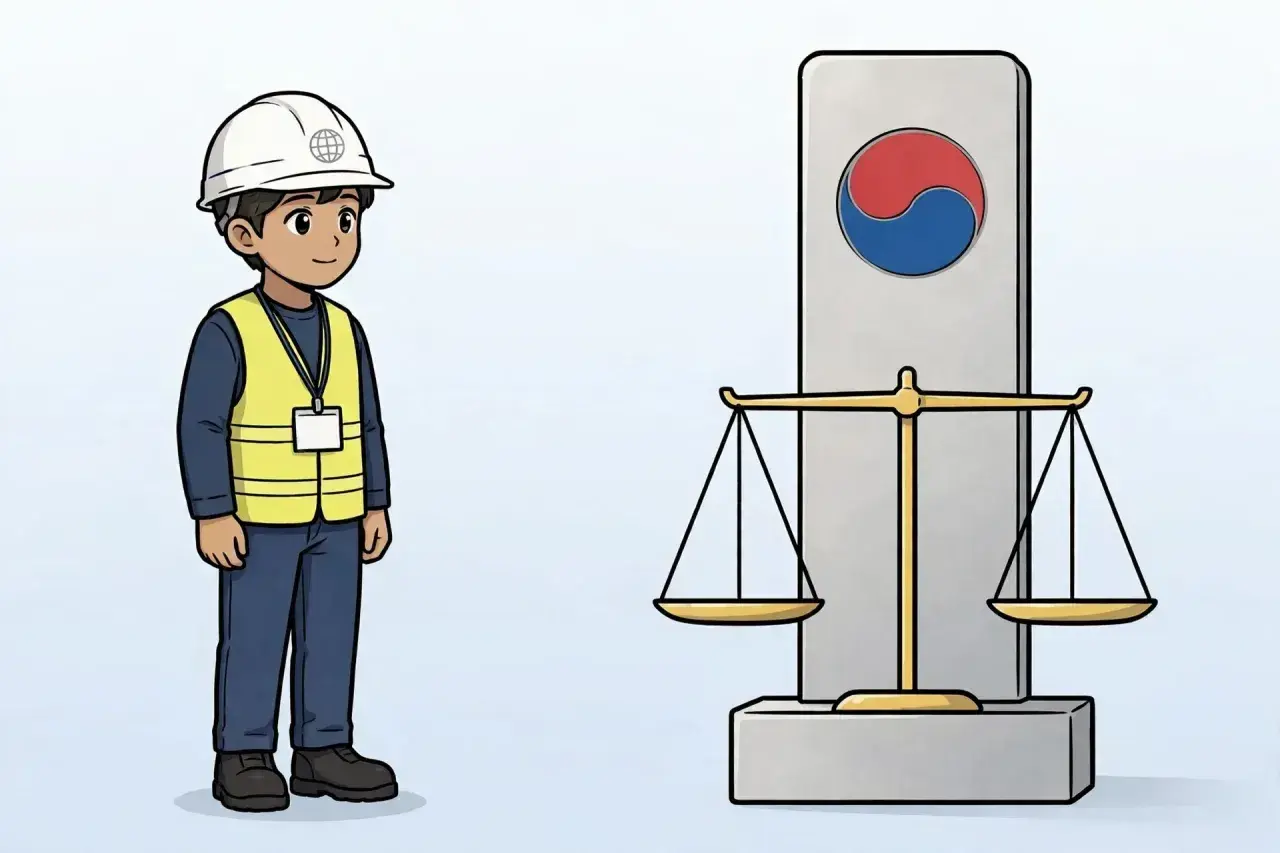
Daniel decided to file a constitutional complaint, arguing that the directive infringed his right to work. His case raised a question larger than the particular rule: could a non-Korean citizen invoke a right that the Constitution describes as belonging to “citizens”? And did it matter whether he was seeking a government-backed opportunity for employment or protection of basic conditions at work?
2. The Legal Question
Can a foreign worker be a rights-holder under Korea’s constitutional guarantee of the right to work when challenging a government labor directive—and does the answer depend on the specific protection being claimed?
3. What Korean Law Says
The Constitution’s wording refers to citizens, but the scope of a constitutional right is not always determined by that wording alone. Korean constitutional law looks at the nature and content of the particular right a person invokes.
“All citizens shall have the right to work. The State shall endeavor to promote the employment of workers …” — Article 32(1) of the Constitution of the Republic of Korea, in English translation.
The Constitution also links working conditions to human dignity:
“Standards of working conditions shall be determined by statute in such a way as to guarantee human dignity.” — Article 32(3) of the Constitution of the Republic of Korea, in English translation.
These provisions can support different kinds of claims:
- Employment-promotion claims: Asking the state to create jobs or pursue social and economic policies that increase employment is a form of social right. This kind of claim is generally recognized as belonging to Korean citizens.
- Minimum-conditions claims: Seeking basic working conditions that allow workers to secure the necessities of life and be treated with human dignity has a liberty-right dimension as well. A foreign worker may be a constitutional rights-holder for this kind of protection.
- Rights-holder status is not the same as winning: Even if a foreign worker may invoke the right, the complaint must still satisfy procedural rules and establish that the challenged measure infringes the protected interest.
4. How Korean Courts Approach This
Korean constitutional review does not treat the right to work as a single, indivisible promise. The Constitutional Court has distinguished between a demand that the state adopt employment-creation policies and a demand for minimum working conditions that protect a worker’s dignity.
The central inquiry is what the person is asking the Constitution to protect: a social and economic policy benefit, or a basic condition of work necessary to preserve human dignity.
The first is generally understood as a social entitlement allocated to citizens. The second has a connection to individual freedom and dignity that can extend to foreign workers. This distinction does not mean every labor rule applies identically in every context, or that any challenge by a foreign worker will succeed. It means that nationality alone does not automatically bar a foreign worker from asserting the constitutional interest in minimum working conditions.
A constitutional complaint also involves procedural questions, including whether the government measure directly affects the complainant and whether the filing meets the applicable requirements. Those questions are separate from whether a foreign worker can be a rights-holder in principle.
5. Applying the Law to Daniel’s Case
The outcome depends first on the substance of Daniel’s argument, not merely on the label “right to work.”
- Identify the protection he seeks. If Daniel is asking the state to adopt a broad employment policy or to guarantee him a job, his claim is principally a demand for employment promotion. As a foreign national, he would generally not be treated as the holder of that citizen-focused social right.
- Ask whether the directive affects a minimum condition of work. Daniel says the directive narrows a workplace safeguard. If the safeguard concerns basic conditions needed to protect workers’ dignity and secure their livelihood, his claim falls on the other side of the constitutional line: the liberty-right aspect of the right to work.
- Recognize his potential standing as a rights-holder. On that understanding, Daniel’s foreign nationality would not by itself prevent him from invoking the constitutional protection. He may be a rights-holder in relation to the minimum-condition claim.
- Examine the alleged infringement separately. Daniel must still show that the directive affects him in the required way and that it actually compromises the protected minimum. The fact that a worker can invoke a right does not establish that the directive is unconstitutional.
The facts available do not describe the directive’s detailed operation or the particular safeguard at issue. It would therefore be premature to say that Daniel has proved a constitutional violation. But if his complaint genuinely concerns a minimum working condition tied to human dignity, the threshold answer to his central question is yes: a foreign worker can be a rights-holder for that purpose.
If you are dealing with a similar issue, attorney Ji-sun Ahn of Ijun Law Firm can review your employment contract, records of the incidents or complaints, and any requests for interpretation or other assistance with you. These details can help clarify which options apply to your situation.
6. Conclusion: What Happened, and What Should You Do?
Daniel’s complaint should not be rejected solely because he is a foreign national. If he is challenging the directive because it undermines a basic working condition connected to human dignity, Korean constitutional principles allow him to invoke that aspect of the right to work. If, instead, he is asking the state to provide jobs through general employment policy, that claim falls within a social right generally reserved to citizens. Whether Daniel ultimately wins depends on the directive’s actual effects and the procedural requirements for a constitutional complaint.
For workers in a similar position:
- Describe the concrete working condition at stake. Explain how the rule affects wages, hours, safety, or another basic protection, rather than relying only on the broad phrase “right to work.”
- Keep evidence of the rule’s practical effect. Save the directive, workplace records, employer communications, and documents showing how the measure affects you.
- Get advice promptly on procedure. Constitutional complaints have specific filing requirements and deadlines; consult a qualified Korean legal professional or worker-support organization before filing.