
1 — A Human Story
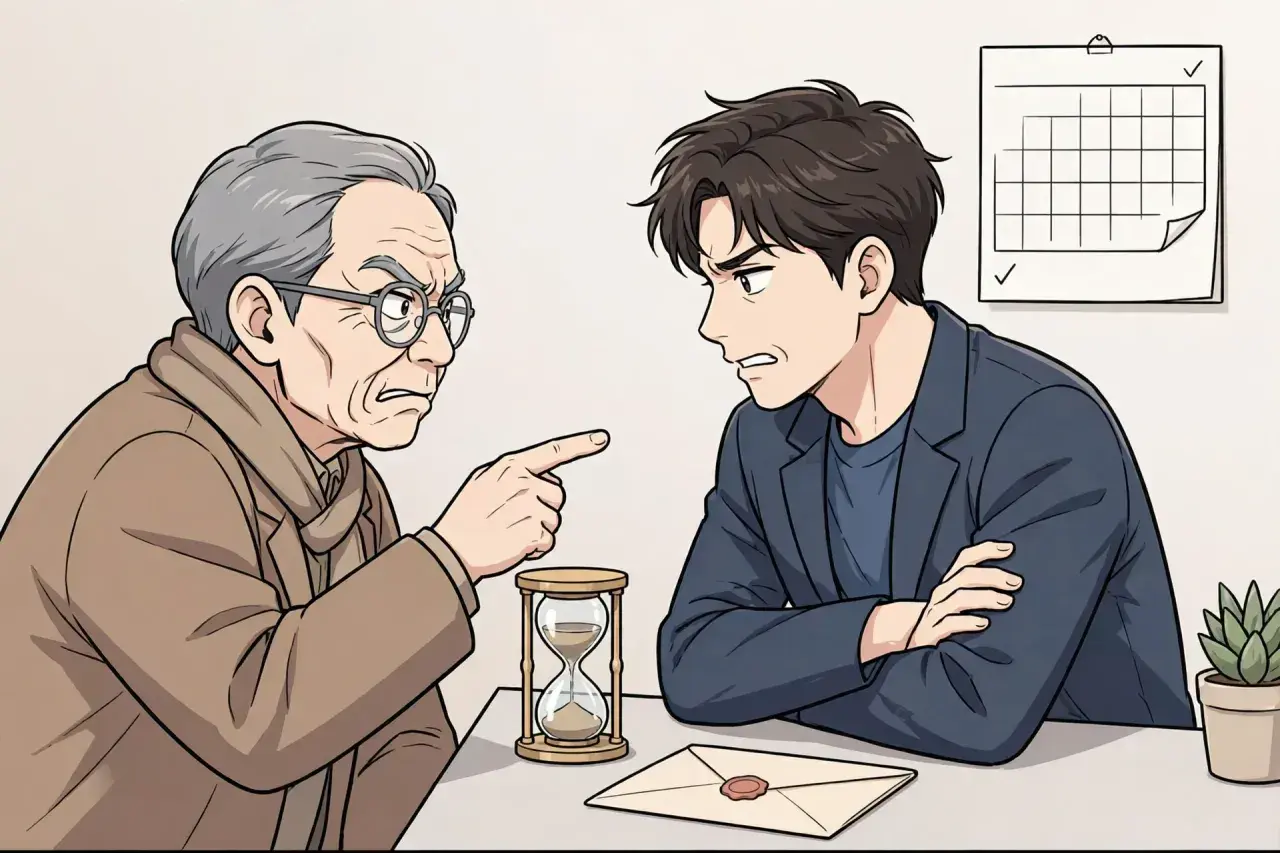
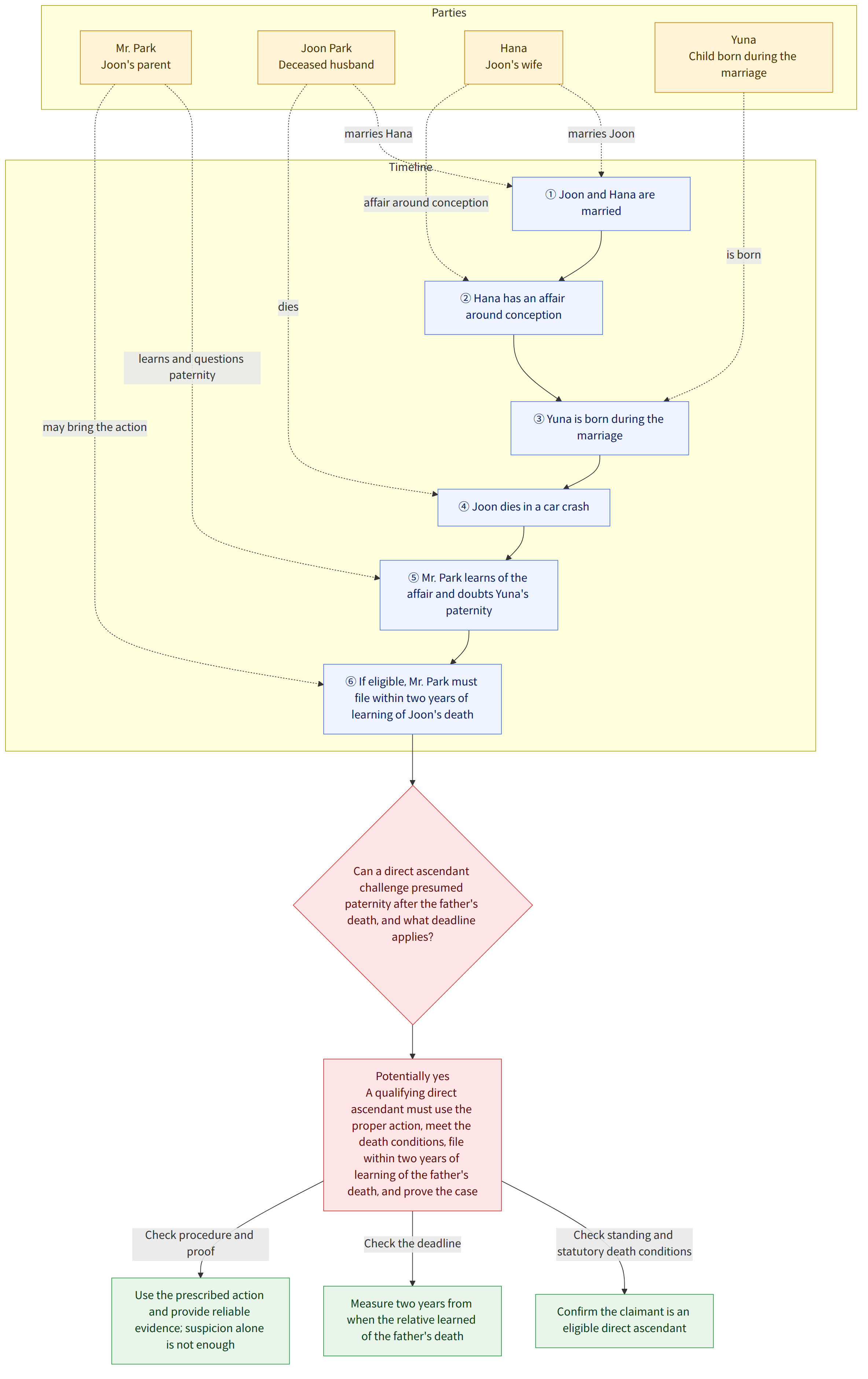
When Joon Park died in a car crash, his father, Mr. Park, was left with grief and a growing unease about the family estate. Joon had been married to Hana when their daughter, Yuna, was born. For years, the family treated Yuna as Joon’s child. Joon himself never questioned it.
After Joon’s death, Mr. Park learned that Hana had had an affair around the time Yuna was conceived. He came to believe that Yuna was not biologically related to his son, and feared she would inherit Joon’s property as his daughter. But the affair had happened a decade earlier, and the man who could ordinarily have challenged the child’s paternity—Joon—was no longer alive.
Mr. Park’s question was not simply whether Yuna shared Joon’s DNA. It was whether Korean law gave a grandfather the right to challenge the child’s legal status after his son’s death, and how quickly he had to act.
2 — The Legal Question
Can a deceased father’s parent bring a lawsuit to deny the deceased man’s legally presumed paternity of a child born during his marriage—and, if so, what deadline applies?
3 — What Korean Law Says
Korean law generally presumes that a child born to a woman during her marriage is the child of her husband. This presumption creates a legal relationship; it does not depend on whether a DNA test would show a biological connection.
Civil Act Article 844 provides, in general, that a child conceived during a marriage is presumed to be the husband’s child.
To remove that legal presumption, the husband may bring a paternity-denial action against the child. The ordinary time limit is two years from when he learns that the child is not his biologically.
Under Civil Act Articles 846 and 847, the husband may challenge the presumption by filing an action against the child within the applicable two-year period.
The law also provides a route for certain close relatives if the husband dies. A direct ascendant, such as a parent, may bring the action in the circumstances set out in Article 851.
Civil Act Article 851 allows a father’s or mother’s direct ascendants or descendants to bring a paternity-denial action when the statutory conditions concerning the parent’s death are met. The action must be filed within two years from the date the relative learns of that death.
For a grandfather in Mr. Park’s position, the key points are:
- He must be the deceased father’s direct ascendant—for example, his parent.
- He must bring the legally prescribed action against the child; a private declaration or a request made only during inheritance discussions is not enough.
- He must meet the applicable two-year deadline measured from learning of his son’s death under the rule described above.
- He must prove the basis for denying paternity. Suspicion or an account of an affair, by itself, does not erase the legal presumption.
4 — How Korean Courts Approach This
Korean courts treat the marital presumption as a rule about legal status, not merely a convenient assumption about biology. Until it is set aside through the proper legal process, a child born within the circumstances covered by Article 844 is treated as the husband’s child, with the legal consequences that follow—including potential inheritance rights.
Courts also take the statutory time limits and the right to bring the action seriously. A relative cannot simply step into the deceased person’s place because the family disputes the child’s parentage. The claimant must fall within the category authorized by law, use the correct procedure, and bring the case on time.
The central issues are therefore not just whether the parties are biologically related, but also whether the claimant has legal standing, whether the action is timely, and whether the evidence is sufficient to overcome the presumption.
Evidence may include reliable genetic testing and other relevant material. The court evaluates the proof in the context of the case; a family allegation is not a substitute for evidence.
5 — Applying the Law to the Case
First, Yuna has legal status as Joon’s child unless that status is successfully challenged. She was born while Joon and Hana were married. On the facts described, the marital presumption applies even if Mr. Park believes Joon was not her biological father.
Second, Joon’s death does not necessarily end the possibility of a challenge. Mr. Park is Joon’s parent and therefore a direct ascendant. Article 851 provides a route for a qualifying relative to bring the action when the statutory conditions concerning the parent’s death are satisfied.
Third, the deadline is critical. Under the rule applicable to this situation, Mr. Park must file within two years from learning that Joon has died. The fact that the suspected affair took place ten years earlier does not, by itself, mean that Mr. Park’s deadline began ten years ago. He should not, however, delay while the family investigates or negotiates over the estate.
Fourth, Mr. Park must prove the claim in court. His account that Hana had an affair may explain why he is concerned, but it does not alone establish that Joon was not Yuna’s father. He should gather admissible evidence, including any available genetic evidence, and obtain legal advice about the proper way to present it. Because the action concerns a child’s legal status, the child must be properly represented in the proceedings.
Finally, the inheritance question follows the status question. If the court denies Joon’s paternity, Yuna’s claim to inherit from him as his child may be affected. But Mr. Park cannot achieve that result simply by objecting to her share of the estate; he must first succeed in the paternity-denial action.
If you are dealing with a similar issue, attorney Ji-sun Ahn of Ijun Law Firm can review family registration records, dates of marriage and birth, and any earlier acknowledgment of paternity, test result, or ruling with you. These details can help clarify which options apply to your situation.
6 — Conclusion: What Happened, and What Should You Do?
Mr. Park may bring a paternity-denial action as Joon’s direct ascendant, provided the statutory conditions are met and he files within two years of learning of Joon’s death. He will still need convincing evidence: the family’s suspicion about Hana’s affair is not enough on its own. If he files on time and proves that Joon was not Yuna’s father, the court may remove the legal presumption, which could alter Yuna’s position as an heir. If he misses the deadline or cannot prove the claim, Yuna’s legal status as Joon’s child remains in place for this purpose.
If you face a similar situation:
- Record the key dates immediately, especially when you learned of the death, and seek advice before the two-year period expires.
- Preserve relevant evidence and ask a Korean family-law attorney how genetic testing and other proof can properly be used in court.
- Use the formal legal process rather than trying to settle paternity or inheritance rights through family pressure or informal agreements.

















