

1. A Human Story
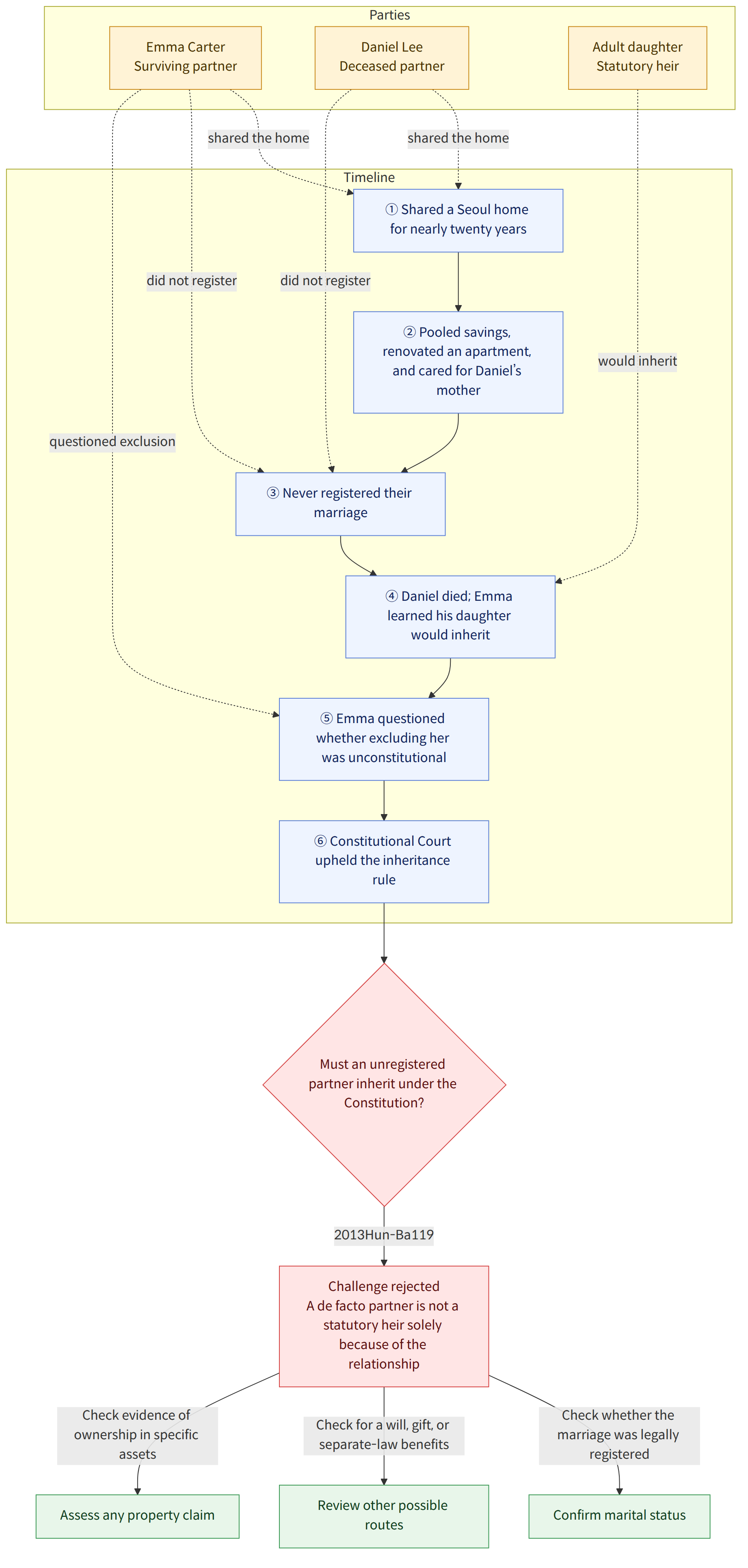
For nearly twenty years, Emma Carter and Daniel Lee shared a home in Seoul. They pooled savings, renovated a small apartment, and took turns caring for Daniel’s mother. Friends and neighbors regarded them as a married couple. They never registered their marriage, believing that their commitment to each other mattered more than paperwork.
Then Daniel died unexpectedly. As Emma tried to settle his affairs, she learned that his adult daughter from an earlier relationship would inherit under Korean law. Emma had helped build and maintain the couple’s life, but the law did not recognize her as Daniel’s spouse for inheritance purposes. She wondered whether excluding her was not only unfair, but unconstitutional.
2. The Legal Question
Can Korea’s Constitution require that an unregistered partner inherit from a deceased partner, particularly when the survivor contributed substantially to the couple’s shared life and property? Or may the law reserve spousal inheritance rights to couples whose marriage was legally registered?
3. What Korean Law Says
The central rule is in Article 1003(1) of the Korean Civil Act. It gives the deceased person’s spouse a place in the line of inheritance: the spouse inherits alongside certain descendants or ascendants, or inherits alone if there are no such heirs. In this context, “spouse” means a legally registered spouse, not a partner in a de facto marriage.
Under Civil Act Article 1003(1), the deceased’s spouse inherits jointly with heirs in the relevant first or second order, or alone if there are no such heirs. The provision does not include an unregistered de facto spouse as a statutory heir.
A couple may live together as spouses and be understood socially as married, but that does not by itself create the legal status required for inheritance. The distinction matters because inheritance affects not only the surviving partner and the deceased, but also children, creditors, and other people dealing with the estate.
The Constitutional Court considered whether excluding a de facto spouse violates property rights, equality, or the Constitution’s protection of marriage and family life. In its 2014 decision, 2013Hun-Ba119, the Court rejected the constitutional challenge. It reasoned that:
- A clear, objective way to identify heirs helps prevent disputes and allows an estate to be settled promptly.
- Inheritance can affect third parties and commercial dealings, so legal certainty and uniform rules carry particular weight.
- Couples can register their marriage if they want the legal consequences of marriage, including spousal inheritance.
- A partner may, in appropriate circumstances, receive property through a gift or a will, or qualify for benefits under separate laws such as employment or national pension legislation.
The ruling does not mean that a surviving partner can never claim anything connected to property acquired during the relationship. It means that the relationship alone does not confer the status of an heir. A claim that a particular asset already belonged, wholly or partly, to the survivor is a different question and depends on evidence and the applicable legal rules.
4. How Korean Courts Approach This
Korean courts have treated inheritance as an area where bright lines are especially important. Heirs must be identifiable by rules that can be applied consistently, often while an estate is being administered and third parties are waiting to know who may act for it. A test based on the length, closeness, or public recognition of a relationship could invite difficult disputes after one partner has died and can no longer explain the couple’s intentions.
The Constitutional Court held that excluding de facto spouses from statutory inheritance serves legitimate goals: preventing inheritance disputes, settling legal relationships promptly, and protecting the security of transactions. It also concluded that the distinction did not violate the surviving partner’s property rights or equality rights, or the constitutional provision protecting marriage and family life.
The Court’s 2014 decision was unanimous. A supplementary opinion nevertheless recognized a serious concern: when a de facto relationship ends through death, the survivor may be left without either inheritance rights or the kind of property-division remedy that may be available when the relationship ends during both partners’ lives. That observation was not a ruling that the survivor should inherit under the existing law. It pointed instead to a possible need for legislative reform.
5. Applying the Law to the Case
Emma’s situation is emotionally compelling, but the legal analysis turns on several distinct questions.
- Was Emma Daniel’s legally registered spouse? No. Their long relationship and shared household do not, on their own, make Emma a spouse for purposes of Article 1003(1).
- Does her contribution automatically make her an heir? No. Helping pay for renovations, household costs, or caregiving does not convert a de facto partner into a statutory heir. The inheritance rule does not depend on how much the survivor contributed to the relationship.
- Can she challenge the rule as unconstitutional? She could explore the available constitutional procedure with a lawyer, but the central argument has already been rejected by the Constitutional Court. In 2014, the Court found that the rule’s goals of clarity, prompt settlement, and transactional security justified the distinction. It also rejected the claimed violations of property rights and equality. On materially similar facts, Emma’s prospects of obtaining a ruling that invalidates the rule would therefore be very low.
- Could Emma have a separate claim concerning particular property? Possibly, but that would not be inheritance merely under another name. If Emma can establish that she owned a share of an asset, or has another legally recognized claim, that issue would need to be assessed separately. Evidence such as payment records, title documents, written agreements, and the source of funds may matter. The precise claim and its prospects depend on the facts; simply showing that she contributed to the couple’s life may not establish ownership of a particular asset.
- Was there a will, gift, or applicable statutory benefit? Those possibilities also require separate review. A valid will or completed gift may provide for a partner, and some statutory benefits may extend to a de facto spouse. Their scope and requirements vary, and they do not automatically make the partner an heir to the estate.
The key distinction is between being an heir because of marital status and having an independent right to specific property or benefits. Emma’s constitutional argument is unlikely to succeed, but that does not end the inquiry into whether she has any separate, evidence-based claim.
If you are dealing with a similar issue, attorney Ji-sun Ahn of Ijun Law Firm can review the family or property agreement, records of financial contributions or payments, and any relevant judgment with you. These details can help clarify which options apply to your situation.
6. Conclusion: What Happened, and What Should You Do?
Emma did not inherit from Daniel as his spouse. Under the rule upheld by the Constitutional Court, their unregistered relationship could not itself make her a statutory heir, and a constitutional challenge based on the same arguments was unlikely to change that result. She would still need to review the estate documents and evidence to determine whether she had a separate claim to any property or was entitled to a benefit under another law.
For people in similar relationships, three practical steps can reduce the risk of an outcome like Emma’s:
- Consider registering the marriage if both partners want the legal rights and responsibilities that come with marriage, including inheritance rights.
- Make intentions legally clear in advance. Obtain advice on a valid will, gifts, ownership arrangements, and any relevant beneficiary designations; do not assume that living together creates inheritance rights.
- Keep records of contributions and seek advice promptly after a death. Preserve title documents, payment records, agreements, and benefit information. If considering a constitutional complaint, consult a Korean lawyer immediately about the proper procedure and any filing deadline.

















