
1. A Human Story
For seventeen years, Maya Lee knew that Daniel Park was her biological father. She also knew that he had never acknowledged her legally. Her mother, Sophie, had raised her alone, paying for school uniforms, dental visits, and the ordinary costs that quietly accumulate over a child’s life. Daniel sent money only occasionally, and the subject of formal recognition was avoided at family gatherings.
That changed when Maya needed official documents for a school program abroad. After a DNA test confirmed the relationship, Daniel voluntarily acknowledged her as his daughter. Sophie then asked him to contribute not only to Maya’s remaining expenses but also to the costs she had carried for years. Daniel agreed that Maya was his child, but questioned whether legal duties could reach back to a time when he had not formally recognized her. The family also needed to decide who would care for Maya while she was still a minor.
2. The Legal Question
When a biological father voluntarily recognizes a child born outside marriage—or a child wins a final court judgment establishing paternity—what changes under Korean law? In particular, does recognition affect support obligations and inheritance from the time of recognition or from the child’s birth, and does it determine who will raise a minor child?
3. What Korean Law Says
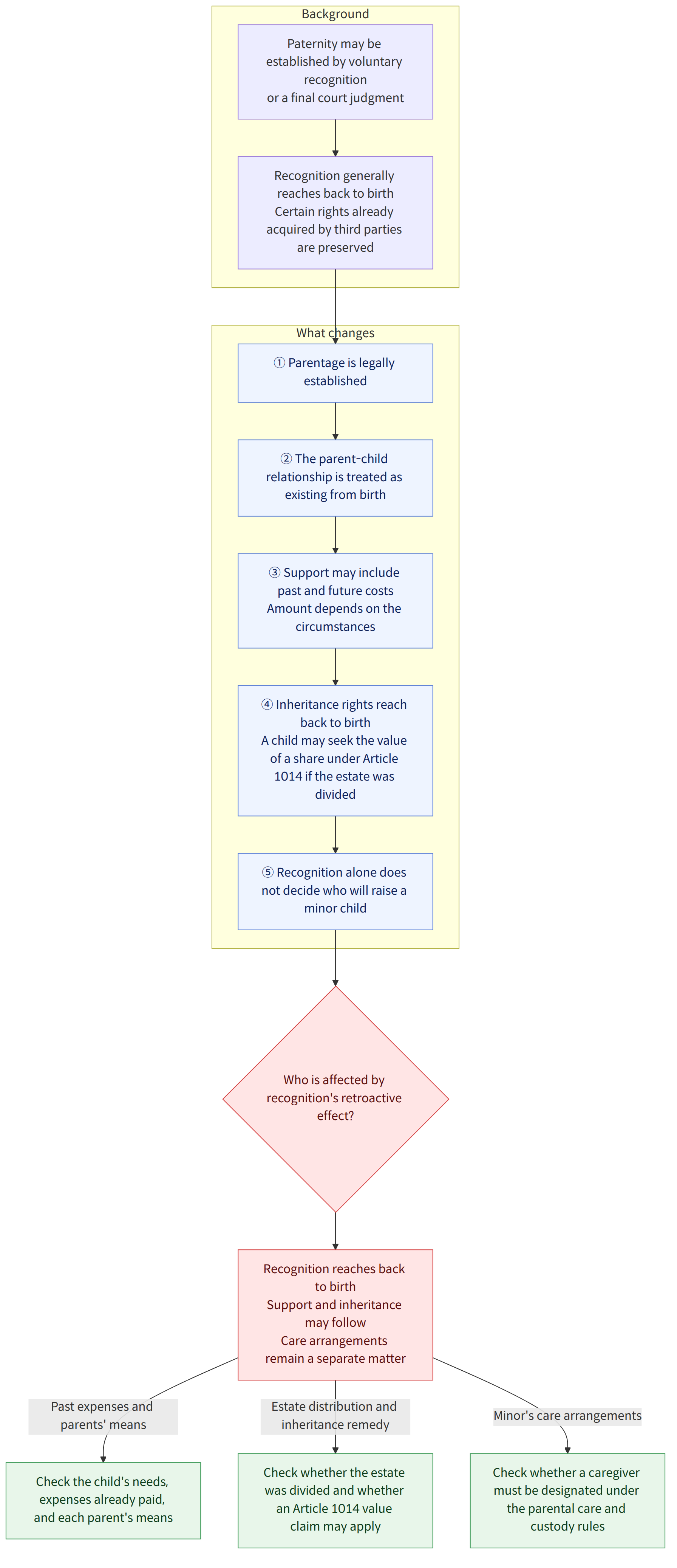
Korean Civil Act Article 860 generally gives recognition retroactive effect: legally, the parent-child relationship is treated as having existed from the child’s birth. The statute preserves certain rights already acquired by third parties, but recognition is not merely a promise to treat the child as family from that day forward.
Recognition generally takes effect from the child’s birth. As a result, the father’s legal duty to support the child is not limited to the period after the recognition was recorded or a judgment became final.
That principle has practical consequences:
- Support: A child’s caregiver may seek contributions for past as well as future child-rearing expenses from the biological father. The precise amount is not automatic; it depends on the circumstances, including the child’s needs and the parents’ respective means.
- Inheritance: A recognized child has inheritance rights from birth. If the estate was already divided before recognition, Civil Act Article 1014 provides a route for the newly recognized child to seek payment of the value of the child’s inheritance share from the other co-heirs, rather than necessarily reopening the distribution in the same way as if recognition had occurred earlier.
- Property received by later-priority heirs: Where people with a lower inheritance priority have already inherited, the fact that they received the property does not, by itself, make them protected third parties against the recognized child’s inheritance claim. The Civil Act’s inheritance-recovery rules may require them to return the relevant share, subject to the facts and applicable limits.
- Care of a minor: Recognition alone does not decide who will raise the child. If the parents are not living together and jointly caring for the minor, the caregiver should be designated under the Civil Act’s rules concerning parental care and custody.
Recognition establishes parentage; it does not automatically settle every family arrangement. Support, inheritance, and the child’s day-to-day care are related consequences, but each may require its own agreement or legal process.
4. How Korean Courts Approach This
Korean courts generally treat recognition as confirming a parent-child relationship that legally reaches back to birth. They therefore do not treat formal recognition as the starting date for every parental obligation. In disputes over child-rearing costs, courts may consider expenses already borne by the caregiving parent as well as the child’s needs going forward. The amount and allocation depend on the evidence and the circumstances of the family.
In inheritance matters, courts distinguish between an estate that has not yet been distributed and one that was distributed before the child’s status was established. If the estate has already been divided, the newly recognized child may pursue the value of the share against co-heirs under Article 1014. Courts also do not automatically treat heirs who received property through a later inheritance priority as protected third parties who can keep it free of the recognized child’s claim.
The underlying approach is practical as well as legal: the law protects the child’s status and share, while the remedy may take account of the fact that property has already changed hands. For a minor child, the child’s welfare and living arrangements remain a separate concern; legal parentage alone does not answer who should provide daily care.
5. Applying the Law to the Case
First, Daniel’s acknowledgment confirms a legal relationship that reaches back to Maya’s birth. Because he voluntarily recognized her, the law does not treat him as having become her father only on the date he signed the acknowledgment. The same basic retroactive effect would follow if Maya had instead obtained a final judgment establishing paternity.
Second, Sophie may seek a contribution for past child-rearing costs. The fact that Daniel was not formally recorded as Maya’s father during those years does not, by itself, erase the support duty. Sophie should be prepared to show the expenses she paid, the periods involved, and relevant information about each parent’s financial circumstances. Any amount would be decided on the facts; the law does not guarantee reimbursement of every expense dollar for dollar.
Third, support for Maya’s remaining years as a minor can also be addressed. Recognition does not mean Daniel must pay an identical sum every month regardless of circumstances. Rather, he is a parent with a legal support obligation, and the parents can agree on a reasonable contribution or ask a court to resolve the dispute.
Fourth, the adults must make a distinct arrangement for Maya’s care. Since Maya is still a minor and her parents do not live together, Daniel’s recognition does not automatically make him her caregiver or displace Sophie. They should agree on who will care for her and, if they cannot agree, seek a formal determination under the rules governing parental care and custody.
Finally, recognition gives Maya inheritance status from birth. If Daniel later dies, Maya may inherit as his child, subject to the ordinary rules governing the estate. If recognition had come only after an estate was already distributed, the analysis would turn on the timing and the people who received it: Article 1014 may permit a claim for the value of her share against co-heirs, while other inheritance-recovery rules may apply where lower-priority heirs took the estate. The details of any such claim would need to be checked against the estate’s history and the relevant deadlines.
If you are dealing with a similar issue, attorney Ji-sun Ahn of Ijun Law Firm can review the paternity ruling, the estate inventory and division records, and records of any payments or transfers predating the ruling with you. These details can help clarify which options apply to your situation.
6. Conclusion: What Happened, and What Should You Do?
Daniel’s acknowledgment changed Maya’s legal position from birth, not merely from the day he signed. He could not reject the principle of past support simply because he had delayed formal recognition. Sophie could seek a fair contribution toward the years she had supported Maya, and the parents needed to settle who would care for Maya until adulthood. Maya also acquired inheritance rights as Daniel’s child, although any future estate dispute would depend on whether the property had already been distributed and to whom.
For readers facing a similar situation:
- Keep records: Save proof of parentage, child-related expenses, support payments, and relevant financial information.
- Address each issue separately: Acknowledgment or a paternity judgment may establish parentage, but support, custody, and inheritance may require separate agreements or proceedings.
- Get prompt advice about an estate: If recognition occurs after an inheritance has been distributed, consult a Korean family-law professional quickly about the correct claim, the recipients of the property, and any time limits.

















