

1. A Human Story
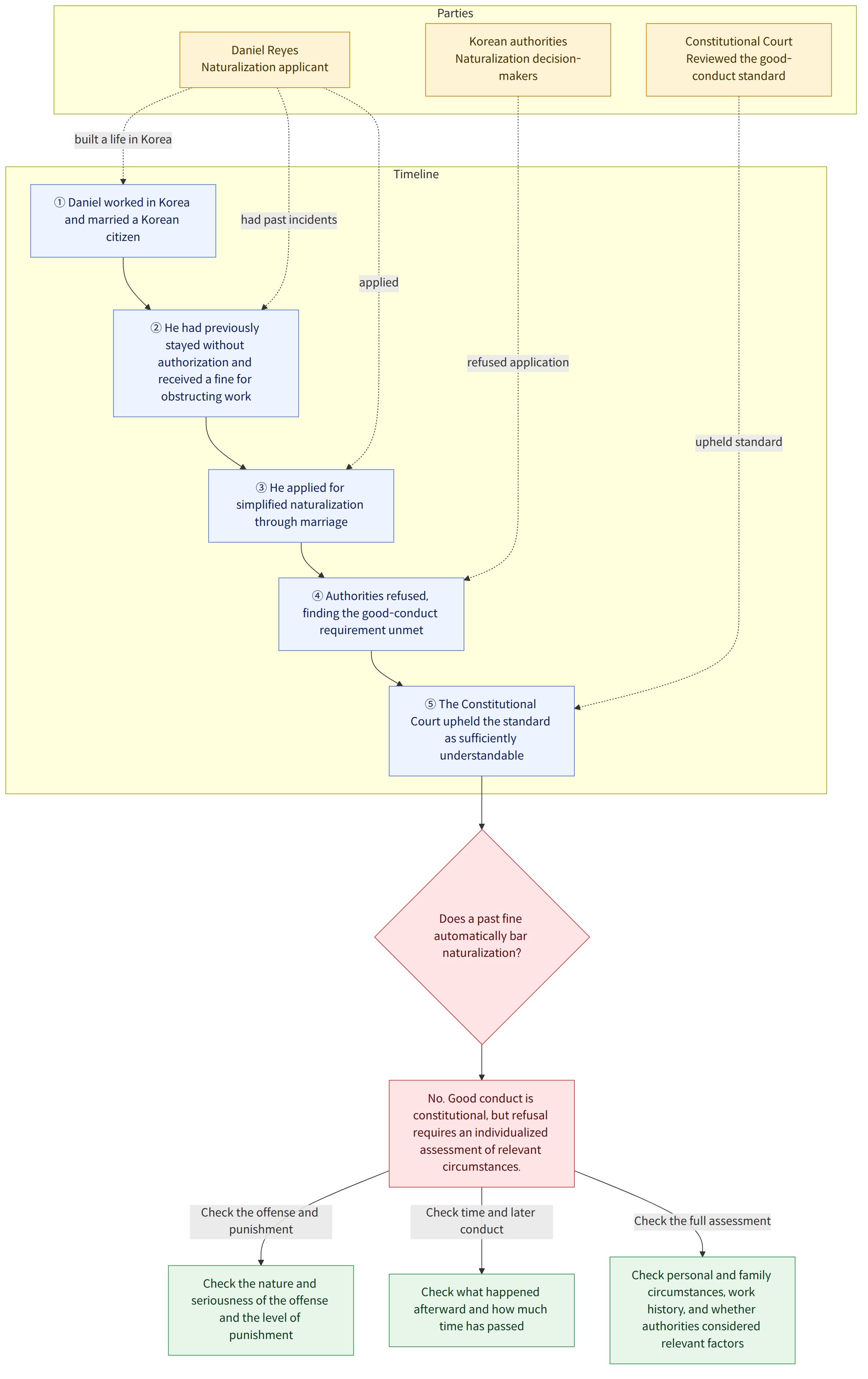
Daniel Reyes had built a life in Korea one careful step at a time. He first came to work, later married Seo-yeon Lee, and began to think of Korea not simply as the place where he earned a living, but as home. When he applied for simplified naturalization through his marriage, he imagined the interview would be the final hurdle.
Instead, the decision was a refusal. Years earlier, Daniel had stayed in Korea without authorization and had been fined for obstructing work at a business. The authorities concluded that he did not meet the requirement that an applicant’s conduct be “good.” Daniel understood that the incidents were in his past, but the decision made him wonder whether a phrase so open to interpretation could lawfully determine his future.
2. The Legal Question
Can Korea constitutionally require a foreign national seeking naturalization to demonstrate “good conduct,” even though the law does not list every act that would disqualify an applicant? And, separately, does a prior fine automatically make naturalization impossible?
3. What Korean Law Says
The Nationality Act sets out requirements for naturalization, including a requirement of good conduct. For an applicant seeking citizenship through a qualifying marriage, the applicable route may be simplified naturalization, but the good-conduct requirement still matters.
The statutory requirement is that an applicant’s conduct be “good.” In substance, the question is whether the applicant has the character and conduct necessary to be accepted as a new member of the Korean community.
The phrase is evaluative rather than mechanical. It does not mean that every person who has ever broken a rule is permanently barred. Nor does the law set out a simple formula in which a particular fine automatically produces refusal. Relevant considerations can include:
- The nature and seriousness of the offense.
- The type and level of punishment imposed.
- The circumstances surrounding the conduct and what happened afterward.
- How much time has passed since the incident.
- The applicant’s personal and family circumstances, work, history, and conduct since then.
The Constitutional Court has rejected the argument that this requirement is too vague to be constitutional. Its reasoning is that naturalization involves admitting someone as a new member of the national community, and that decision necessarily requires a contextual judgment. The law’s meaning can be understood as asking whether the applicant’s character and conduct pose an obstacle to that admission; the factors authorities may consider are also reasonably foreseeable.
An evaluative term is not unconstitutional merely because it leaves room for judgment. The key is whether its meaning can be understood and whether the decision can be made by considering relevant circumstances rather than by applying an unknowable rule.
4. How Korean Courts Approach This
Korean courts recognize that naturalization decisions involve a broad area of governmental discretion. Citizenship is not treated as an automatic entitlement simply because an applicant meets some formal requirements. The state may assess whether an applicant is suitable to join the community, and the good-conduct condition allows it to take account of more than a single event in isolation.
That discretion, however, is not unlimited. A refusal should be based on relevant circumstances and an individual assessment. The existence of a criminal record is an important fact, but it is not necessarily the whole analysis. The offense, its seriousness, the punishment, the applicant’s behavior afterward, and the time elapsed may all matter. Courts can review whether an authority has acted unlawfully, including whether it relied on irrelevant considerations or failed to consider material ones.
The Constitutional Court’s conclusion that the statutory language is constitutional therefore does not mean that every refusal based on “good conduct” is automatically lawful. It means the standard itself is sufficiently understandable to be used in naturalization decisions.
5. Applying the Law to the Case
Daniel’s challenge has two distinct parts, and they should not be confused.
- The challenge to the wording of the law is unlikely to succeed. The Constitutional Court has already reasoned that “good conduct” has an understandable meaning in the naturalization context. The phrase gives the authorities room to assess an applicant’s character and history, but the factors relevant to that assessment are not wholly mysterious. Daniel’s argument that the requirement is unconstitutional simply because it is not a checklist would therefore face a serious obstacle.
- His past conduct is relevant, but not automatically decisive. Daniel’s unlawful stay and workplace obstruction conviction may properly be considered. The authorities may look at what happened, the fines imposed, and the circumstances of both incidents. But the law does not turn a fine into a permanent, automatic bar to citizenship.
- The passage of time and Daniel’s later conduct matter. If Daniel has lived lawfully, worked steadily, supported his family, and avoided further offenses, those facts could weigh in his favor. If the incidents were recent, serious, repeated, or followed by further problems, they could weigh against him. The available facts establish prior misconduct and fines, but do not by themselves resolve the full balance.
- The reason for refusal should be examined closely. If the authority considered Daniel’s record alongside his later conduct and circumstances, a court may be reluctant to substitute its own view for the government’s assessment. If the decision merely treated any prior offense as an automatic disqualification, without considering relevant context, Daniel may have a separate basis to challenge the way discretion was used.
For this fictional case, Daniel’s constitutional challenge fails: the good-conduct condition is not unconstitutional merely because it calls for judgment. His naturalization refusal remains in place on the record described, because the authority considered his unlawful stay and obstruction conviction as part of an individualized assessment. That outcome does not establish that every applicant with a fine must be refused; a fuller record of rehabilitation or a failure to assess relevant circumstances could lead to a different result.
If you are dealing with a similar issue, attorney Ji-sun Ahn of Ijun Law Firm can review the naturalization application, the judgment or notice recording the fine, and evidence of when it was paid with you. These details can help clarify which options apply to your situation.
6. Conclusion: What Happened, and What Should You Do?
Daniel did not win by arguing that the phrase “good conduct” was too vague to be used. The constitutional objection was not enough to overturn the refusal, and, in his case, the decision stood after the authorities weighed his history. But the legal standard is not a lifetime ban triggered by any criminal record: the surrounding facts and what an applicant has done since the incident remain important.
Applicants in a similar position should:
- Get the written decision and reasons. Identify whether the refusal rests on particular incidents and whether the authority explained its assessment of the full record.
- Build evidence of later conduct. Provide records of lawful residence, employment, family ties, community involvement, and rehabilitation where relevant.
- Act promptly on review options. Administrative and court deadlines can be short. Seek qualified Korean legal advice quickly, especially if the decision appears to treat a past fine as automatically disqualifying.

















