1 — A Human Story
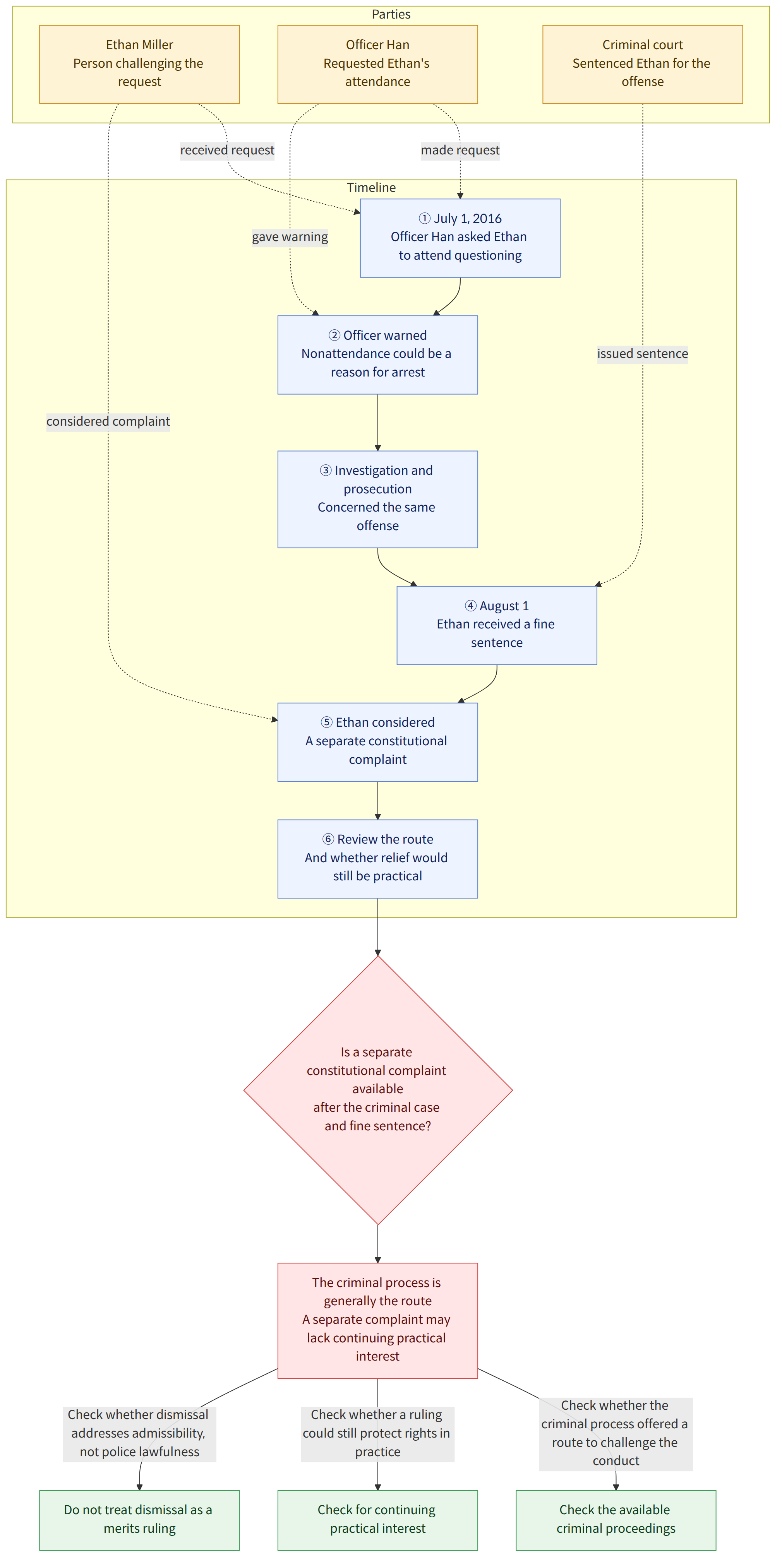
On July 1, 2016, Ethan Miller opened his front door to a police officer, Officer Han. The officer said Ethan was suspected of an offense and asked him to appear at the police station. Ethan heard the warning that refusing to attend could become a reason for arrest. What might have sounded like a request to the officer felt, to Ethan, like a choice made under pressure.
A month later, on August 1, Ethan was sentenced to a fine for the same offense. He then considered challenging Officer Han’s earlier demand directly before the Constitutional Court. His question was not simply whether the encounter had been fair. It was whether a separate constitutional case could still provide a remedy after the criminal case had moved forward and ended in a fine.
2 — The Legal Question
Can a person bring a constitutional complaint against a police officer’s request to appear for questioning when the related investigation and prosecution can be challenged through the criminal proceedings—and, after a fine sentence, is there still a practical legal interest in contesting that earlier request?
3 — What Korean Law Says
A constitutional complaint is not a general appeal against every act by a public official. It is a way to seek constitutional review of a government action that allegedly infringes fundamental rights, but its availability depends on whether another legal process can provide relief.
Where a person’s rights can be protected through the relevant criminal trial, the investigation or prosecution connected with that trial is generally not treated as a separate matter for a constitutional complaint.
In practical terms, the key points are:
- The criminal process matters. If the challenged police action is part of an investigation that leads to prosecution, objections to the investigation or prosecution can generally be raised through the criminal proceedings.
- A constitutional complaint is not a substitute for that process. A person usually cannot bypass an available judicial route by asking the Constitutional Court to review the same matter separately.
- There must still be a live reason for a ruling. A complaint also needs a continuing interest in protecting the complainant’s rights. If later events mean that a decision would no longer provide meaningful relief, the complaint may fail on that ground.
A warning that nonattendance could be a reason for arrest should not be confused with an automatic arrest. The legal effect of the officer’s words depends on the circumstances and the relevant procedures; the warning alone does not establish that an arrest has occurred or that it is inevitable.
4 — How Korean Courts Approach This
Korean courts and the Constitutional Court generally distinguish between a claim that belongs in an existing legal process and one that can properly be brought as an independent constitutional complaint. When the questioned conduct is connected to an investigation and prosecution, the criminal case is ordinarily the route through which a person may contest the relevant treatment and seek protection of their rights.
The courts also examine whether a ruling would still have practical value. A complaint is not kept alive merely because the person disagrees with something that happened earlier. If the criminal case has proceeded to judgment and a separate decision about the earlier attendance request would no longer protect the person’s rights in a meaningful way, the required interest in obtaining constitutional review may be absent.
A dismissal as inadmissible addresses whether the complaint may be heard in that form. It does not, by itself, decide that the police conduct was lawful.
5 — Applying the Law to Ethan’s Case
First, identify what Ethan is challenging. He wants the Constitutional Court to review Officer Han’s July 1 request that he appear at the police station, including the warning about possible arrest if he did not attend.
Second, consider the route through the criminal case. Ethan was investigated and later sentenced for the same offense. Under the general approach to constitutional complaints, complaints about investigative or prosecutorial conduct connected to a criminal case are ordinarily addressed through that case, rather than through a separate constitutional proceeding.
Third, consider whether a separate ruling would still protect him. On August 1, Ethan received a fine sentence. In the circumstances described, a later ruling about the earlier attendance request would no longer provide a practical remedy for him. That weakens—or removes—the required interest in obtaining a constitutional decision.
Finally, distinguish the result from a ruling on the merits. If Ethan filed a constitutional complaint against the attendance request, it would likely be dismissed as inadmissible. That outcome would not establish that every police request to attend is proper, or that the warning he received was lawful. It would mean that this complaint, pursued separately and after the case had reached a fine sentence, was not an available route to a substantive ruling.
If you have an attendance notice, a record of the officer’s warning, or a criminal-court decision, attorney Ji-sun Ahn of Ijun Law Firm could review those documents and the sequence of events to help you understand which legal process may still be available.
6 — Conclusion: What Happened, and What Should You Do?
Ethan’s proposed constitutional complaint would likely be dismissed as inadmissible: the criminal proceedings provided the relevant route for challenging investigation-related matters, and after the fine sentence there was no longer a practical interest in a separate ruling on the earlier request. The decision would be about the proper forum and the continuing need for relief—not a declaration that Officer Han’s conduct was necessarily lawful.
For readers facing a similar situation:
- Keep any written attendance request, messages, call records, and notes of what the officer said, including the date and the exact wording of any warning.
- If the matter is still part of an active criminal case, raise concerns about the investigation through the appropriate criminal-process channels rather than assuming a separate constitutional complaint is available.
- Before filing, check both whether another legal remedy applies and whether a decision could still provide practical relief in your circumstances.