

1. A Human Story
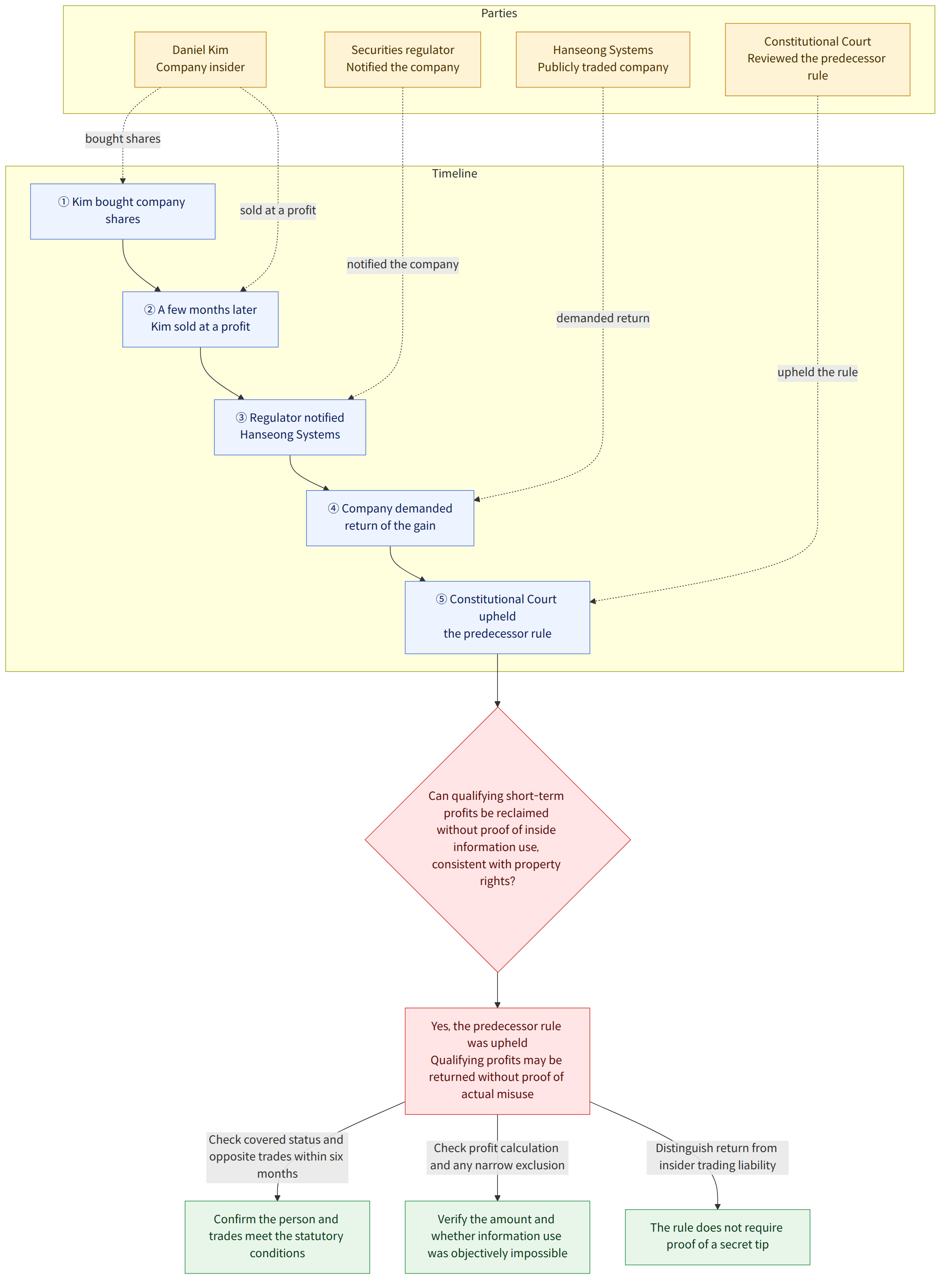
Daniel Kim had spent years as a finance executive at Hanseong Systems, a publicly traded company. One spring, he bought shares in the company through his personal brokerage account. A few months later, needing cash for a family expense, he sold them at a profit. He had not seen an earnings forecast, heard a merger rumor, or received a tip. To him, it was an ordinary investment decision.
The letter that arrived later did not treat it as ordinary. After the securities regulator notified Hanseong, the company demanded that Daniel return the gain. Daniel was stunned: how could he be made to give up money when he had not traded on a secret? He considered challenging the rule itself, arguing that it unfairly took property from people who had done nothing wrong.
2. The Legal Question
Can Korean law require a company insider to return profits from certain short-term stock trades even when no one proves that the insider used confidential information—and does that requirement violate the constitutional right to property?
3. What Korean Law Says
The Capital Markets Act contains a short-swing profit return rule. In broad terms, it applies to specified insiders of listed companies, including covered officers, employees, and major shareholders, who make opposite trades in the company’s securities within a six-month period and earn a profit. The company may seek the qualifying profit back.
The rule is not the same as a finding of insider trading. Insider-trading liability generally turns on the misuse of material nonpublic information. The short-swing rule instead uses a defined category of insiders, transactions, and time period as a safeguard against the risk—and appearance—of trading with an informational advantage.
The return obligation does not generally depend on proving that the insider actually used inside information. Its focus is whether the person and transactions fall within the statutory rule.
Key points include:
- Covered person: The trader must belong to a category of insider covered by the statute and related rules.
- Qualifying trades: The transactions must meet the legal conditions for opposite trades in the relevant securities within six months.
- Profit: The amount sought must be calculated under the applicable statutory method; it is not simply whatever figure the company asserts.
- Possible limits: A transaction may fall outside the rule where, given its nature, the use of inside information was objectively impossible. The precise circumstances matter.
The Constitutional Court considered a challenge to the predecessor of the current rule and upheld it. The Court found that protecting ordinary investors and maintaining confidence in a fair securities market were legitimate public purposes. It also concluded that requiring the return of certain short-term profits could deter improper trading and reassure investors that insiders were not gaining an unfair advantage.
The Court reasoned that requiring proof of actual use of inside information could make the rule ineffective: such use is often difficult to establish, and the rule is intended to address both the risk of abuse and the loss of investor confidence.
The Court also viewed the burden as limited. The rule does not ban insiders from all share trading; it requires the return of qualifying profits from trades within a limited period. And it can be interpreted not to apply where the transaction type objectively leaves no possibility of using inside information.
4. How Korean Courts Approach This
Korean courts generally distinguish this statutory return obligation from punishment for proven misconduct. The central question is usually not whether the insider had a guilty state of mind or actually relied on confidential information. It is whether the statutory conditions for return have been met.
In its constitutional review, the Constitutional Court applied a proportionality analysis: whether the rule serves a legitimate aim, whether it is suitable to advance that aim, whether it goes further than necessary, and whether the public benefit is balanced against the burden on the individual. The Court accepted that preventing suspected informational advantages and sustaining investor confidence justified a rule that did not require proof of actual misuse.
That does not mean every demand succeeds automatically. A dispute may still turn on whether the person was covered, whether the trades were within the six-month window, whether the transactions were of the required kind, whether a narrow exclusion applies, or whether the profit was correctly worked out. Those are questions about applying the statute to the facts—not necessarily grounds for declaring the statute unconstitutional.
5. Applying the Law to the Case
Daniel’s situation illustrates why the constitutional objection is difficult, while also showing where a practical defense may remain.
- His role matters. Daniel was an executive of a listed company. If that role placed him within the statute’s covered categories during the relevant period, the first condition is likely satisfied.
- The timing and direction of the trades matter. He bought shares and then sold them at a profit a few months later. If those were qualifying opposite trades completed within six months, the core transaction condition may also be met.
- His lack of inside information may not defeat the claim. Daniel’s account—that he never received or used confidential information—may be entirely true. But the constitutional rule does not make actual use a necessary condition for return. The law treats certain short-term trades by insiders as carrying a risk that is difficult to police after the fact, and seeks to protect market confidence as well as prevent actual abuse.
- The company must still establish the statutory claim. Daniel can check whether he was legally covered on the relevant dates, whether the securities and transactions qualify, and whether the six-month period has been calculated correctly. He can also scrutinize the profit calculation and raise any fact-specific argument that the transaction was objectively incapable of involving inside information.
- A broad constitutional challenge is unlikely to succeed. The Constitutional Court has already upheld the predecessor rule on the basis that it serves important public interests, is limited to qualifying short-term trades, and does not require insiders to stop trading altogether. That reasoning makes an argument that the rule is unconstitutional simply because it does not require proof of actual insider dealing a steep uphill climb.
If you are dealing with a similar issue, attorney Ji-sun Ahn of Ijun Law Firm can review the dates, the underlying agreement or decision, and records that show the circumstances of this case with you. These details can help clarify which options apply to your situation.
6. Conclusion: What Happened, and What Should You Do?
Daniel’s constitutional challenge did not erase the company’s claim. On the assumed facts—that he was a covered executive, made qualifying opposite trades within six months, and earned a profit—the company could seek the statutory return even though he had not used inside information. The constitutional objection alone was unlikely to prevent recovery. Daniel’s strongest remaining course was to examine whether each legal condition was actually met and whether Hanseong had calculated the recoverable amount correctly.
For readers facing a similar demand:
- Preserve the records: Keep trade confirmations, brokerage statements, company notices, and documents showing when you became or ceased to be a covered insider.
- Check the calculation and coverage: Get advice on the six-month period, the types of trades included, the statutory profit method, and any potentially applicable exclusion before accepting the amount demanded.
- Act promptly: Observe response and court deadlines, and seek Korean legal advice early. A claim that you did not use inside information may not be enough by itself, but careful review of the statutory elements can still matter.

















