

1. A Human Story
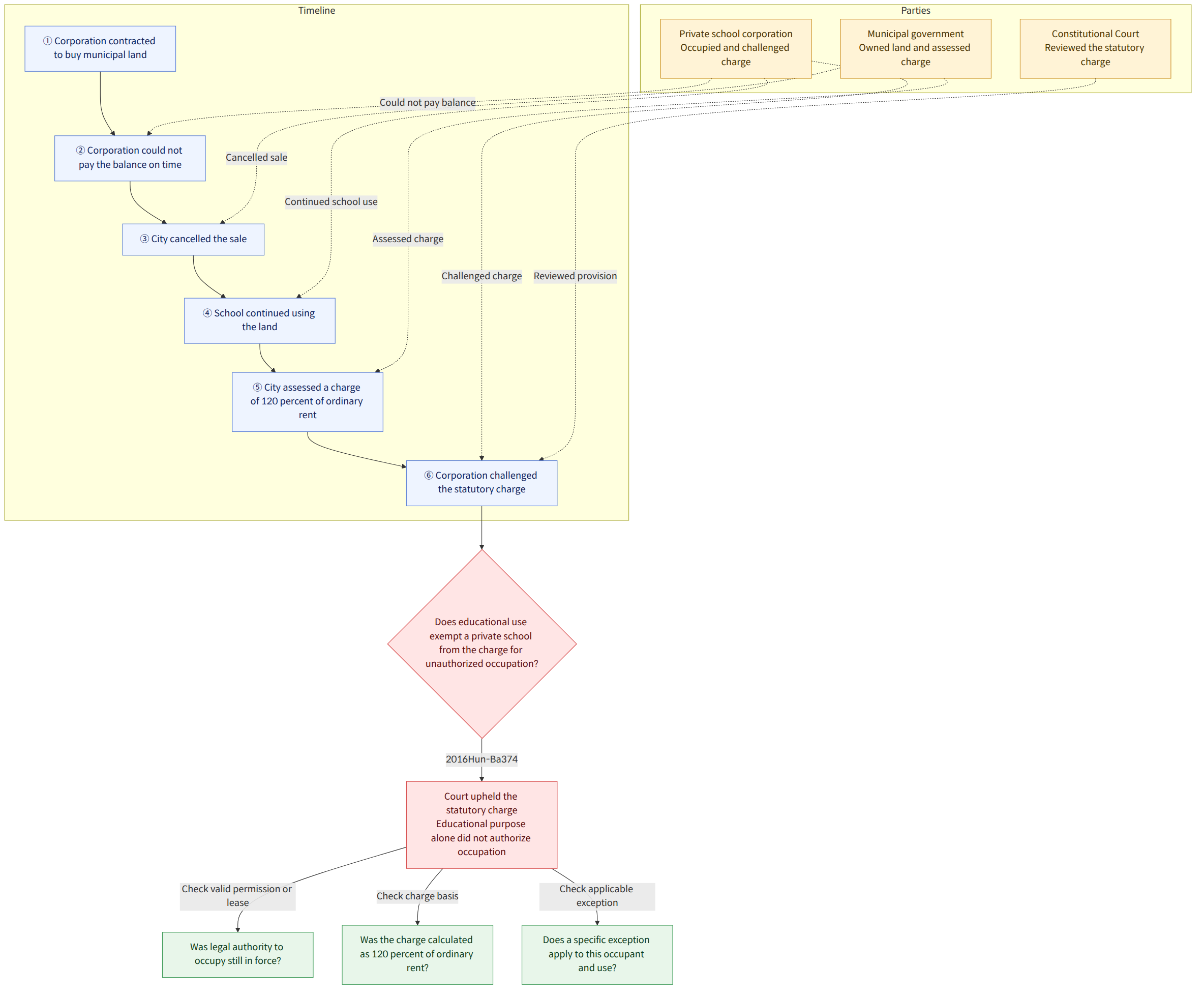
For years, Daniel Park had imagined a modest middle school rising on a quiet parcel owned by his city. He had established a nonprofit school corporation and signed a contract to buy the land. The plan was simple: build classrooms, open the school, and serve local children. But the corporation could not pay the remaining purchase price on time. The city cancelled the sale.
The school was already operating, and moving its students seemed impossible. Daniel kept using the land while the corporation tried to find a way forward. The lessons continued, but the legal basis for occupying the property had ended with the cancelled contract. Then the city sent a bill: not merely for the equivalent of rent, but for a statutory charge calculated at 120 percent of the ordinary rental amount. Daniel accepted that the city could seek payment for the land’s use. What felt punitive, he argued, was the additional amount—and the fact that the land had been used to educate children.
2. The Legal Question
Can a local government impose a charge above ordinary rent when a private school corporation remains on municipal land after its purchase contract has been cancelled, even if the land is being used to provide education rather than for private profit?
3. What Korean Law Says
Korea’s Public Property and Commodity Management Act establishes formal routes for using local-government property. Depending on the category of property, a person generally needs either permission to use it or a lease agreement. A cancelled purchase contract does not, by itself, preserve the former buyer’s right to occupy the land.
Public property is not available for continued use simply because an occupant once had a contract or is putting the property to a socially valuable purpose. The required permission or lease must remain in force.
When property is occupied without the required authority, Article 81(1) provides for a restitution charge—a statutory payment that includes an amount beyond the ordinary usage fee or rent. In the situation described here, the local government assessed the charge at 120 percent of the rental amount. Its purpose is not only to recover the value of the use, but also to encourage people to obtain lawful permission or a lease before occupying public property.
The Constitutional Court considered the constitutionality of this provision in 2016Hun-Ba374. It accepted that adding a statutory amount to the equivalent of rent can be a suitable way to protect and manage public property, provided the amount is not excessive.
The Court also addressed the argument that compulsory education should change the result. Under Article 31(3) of the Constitution, compulsory education is free. In the Court’s view, that principle shifts the cost of compulsory education away from individual families and onto the community as a whole. It does not automatically transfer to local governments expenses that the law assigns to a school corporation.
The key points are:
- A valid right to occupy matters. The occupant must have the required permit, lease, or other legal authority.
- Unauthorised occupation can cost more than ordinary rent. The statutory charge is intended both to recover value and to deter occupation without permission.
- A public-serving purpose is not an automatic exemption. A private school’s educational work does not, by itself, turn its occupation into authorised use.
- Specific statutory exceptions are limited. The Court distinguished a private school corporation from cases in which the state or another local government directly uses public property for public, common, or qualifying nonprofit purposes.
4. How Korean Courts Approach This
Korean courts and the Constitutional Court generally treat public-property rules as a framework for orderly stewardship, not as ordinary landlord-tenant rules that can be set aside whenever an occupant’s purpose seems worthy. Public property must be managed under procedures that allow the government to control its use and collect the applicable fees.
The constitutional guarantee of free compulsory education does not mean that every cost associated with operating a school must ultimately be borne by a local government. Nor does an educational purpose alone place a private school within an exception created for direct public use of public property.
In the constitutional challenge decided in 2016Hun-Ba374, the Court rejected the claim that imposing the same statutory charge on public-minded and profit-seeking unauthorised occupants necessarily violated equality. It reasoned that the relevant distinction was not simply whether an occupant’s aim was socially beneficial. A private school, even one entrusted with compulsory education, retains a degree of independence in its operation and is not the same as a government body directly using property for public purposes.
That does not mean every individual assessment is beyond challenge. A school corporation may still dispute whether it occupied the land during the period claimed, whether it had a valid legal basis for any part of that period, or whether the amount was calculated correctly. But a claim based only on the school’s educational mission faces a substantial obstacle.
5. Applying the Law to the Case
First, the purchase contract ended. Once Daniel’s corporation failed to pay the balance and the city cancelled the sale, the corporation could no longer rely on that contract as its authority to occupy the parcel. The fact that negotiations or hopes of completing the purchase continued would not, without more, restore the right to use the land.
Second, the school continued to occupy the property. The school’s need to keep classes running explains Daniel’s decision, but it does not replace the permit or lease required under public-property law. Unless the corporation had obtained a separate, valid authorisation, the continued use was unauthorised.
Third, the city could seek more than the ordinary rental value. Daniel was willing to pay an amount equivalent to rent, but Article 81(1) allows an additional statutory charge for unauthorised occupation. The Constitutional Court has found that this structure can serve a legitimate purpose: encouraging people to secure lawful rights in advance and helping local governments protect and manage public assets.
Fourth, the school’s purpose does not create an automatic exemption. The land was used to educate children, a public benefit of great importance. But the corporation was a private school operator, not the city or another government body directly using the land. Under the Court’s reasoning, the constitutional promise of free compulsory education does not require the municipality to absorb costs that the law places on the school corporation.
Finally, the amount and procedure still matter. The constitutional ruling does not establish that every bill issued by a local government is correct. Daniel’s corporation could examine the assessment’s dates, the applicable rental basis, the rate used, any payments already made, and whether the city followed the required procedure. If the assessment was excessive or legally flawed, those issues could provide grounds to challenge it. But the claim that the charge should disappear simply because the school served children would not, on its own, be enough.
If you are dealing with a similar issue, attorney Ji-sun Ahn of Ijun Law Firm can review the land register, agreements or permits affecting the property, and the dates when rights were registered or changed with you. These details can help clarify which options apply to your situation.
6. Conclusion: What Happened, and What Should You Do?
Daniel’s corporation could not avoid the statutory charge merely by showing that it kept the school open for the benefit of students. In principle, the city could charge more than ordinary rent for the period of unauthorised occupation. The Constitutional Court’s ruling makes clear that the public importance of education does not automatically exempt a private school corporation from the rules governing municipal land.
That conclusion does not excuse an inaccurate assessment. Daniel should verify the calculation and the dates, and he should pursue any available challenge if the city misapplied the law. For anyone in a similar position:
- Get written permission or a lease before using public land. Do not assume a pending purchase, negotiation, or past agreement gives you a continuing right to occupy it.
- If the underlying contract ends, act immediately. Ask the local government about a temporary permit or lease, and make a practical plan to vacate if permission is refused.
- Check any assessment carefully. Review the occupation period, rental basis, rate, and notice procedure, and seek Korean legal advice promptly about applicable challenge deadlines.

















