

1. A Human Story
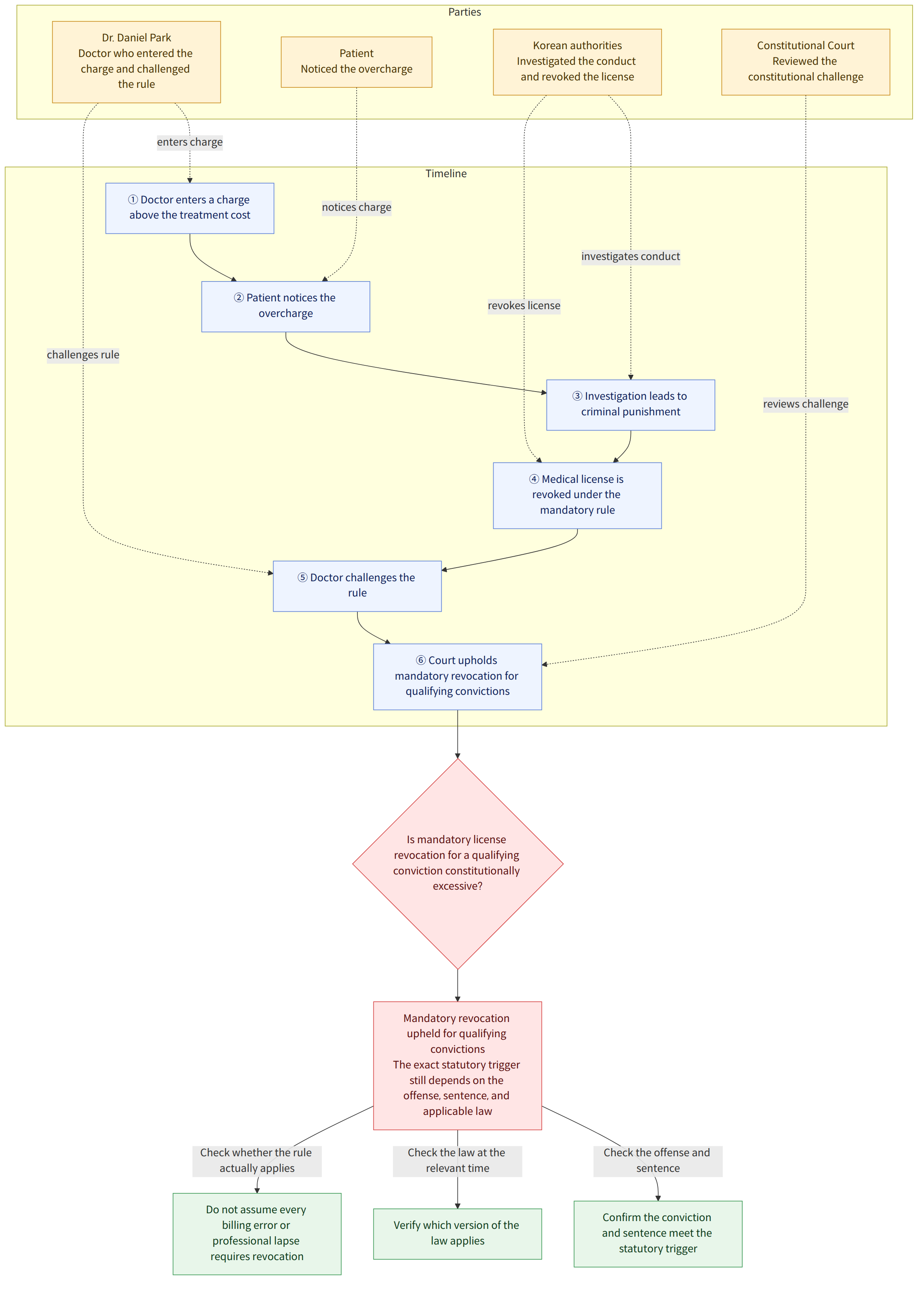
When Dr. Daniel Park finished treating a patient at his neighborhood clinic, he entered a charge that was a little higher than the amount the patient should have paid. It was not a large sum, and Daniel told himself it was an administrative mistake—one that could be corrected if anyone noticed.
The patient did notice. An investigation followed, and Daniel was criminally punished for the billing conduct. Then came a second, more devastating consequence: his medical license was revoked. He accepted that he had done wrong, but could a modest overcharge justifiably end his career? Daniel challenged the rule, arguing that automatic revocation went too far.
2. The Legal Question
When a doctor is criminally punished for a qualifying medical-related offense, may Korean law require the doctor’s license to be revoked without allowing the health authorities to weigh the individual circumstances? Or does that consequence unfairly restrict the doctor’s right to work, violate equality, or upset the constitutional division of powers?
3. What Korean Law Says
Korean law provides for license revocation in specified circumstances involving criminal punishment for medical-related conduct. The consequence is not necessarily triggered by every billing error or every professional lapse: the offense, the sentence, and the version of the law that applies must all be examined. Where the statutory conditions are met, however, the rule considered by the Constitutional Court required revocation rather than leaving the decision to the health ministry’s discretion.
In substance, the rule at issue required a medical license to be revoked when a medical professional received a qualifying criminal sentence for a specified medical-related offense. The exact statutory trigger must be checked against the law in force at the relevant time.
The main constitutional principles are these:
- Proportionality: A restriction on a person’s rights must pursue a legitimate aim, be reasonably connected to that aim, and not impose a burden excessive in relation to the public benefit.
- Occupational freedom: Losing a medical license severely limits a person’s ability to pursue a chosen profession. But that freedom may be restricted to protect patients and public confidence in medical care.
- Separation of powers: The legislature may set mandatory consequences in a statute. The fact that an administrative agency has no discretion in an individual case does not, by itself, mean that the legislature has taken over the agency’s constitutional role.
- Equality: A claim of unequal treatment ordinarily requires two genuinely distinct groups that can be compared under a relevant standard. A difference that arises merely because time passes may not establish two separate groups.
The constitutional question is not simply whether revocation is harsh for the individual. It is whether the burden, viewed against the public purpose of protecting trust in medical professionals, is constitutionally excessive.
4. How Korean Courts Approach This
Korea’s Constitutional Court has generally accepted that criminal conduct by a medical professional can damage more than the relationship between that doctor and one patient. The public may lose confidence in the profession as a whole, and the legislature may treat that loss of trust as a matter of public concern.
On that reasoning, the Court has upheld mandatory license revocation for specified medical-related convictions against challenges based on proportionality and occupational freedom. It has considered the seriousness of the professional consequence alongside the public interest in trustworthy medical care, and has concluded that the restriction is not automatically excessive merely because it can end a doctor’s career.
The Court has also rejected the idea that a mandatory rule necessarily violates separation of powers. Setting the legal consequences of a conviction is ordinarily a legislative choice; an administrative authority’s lack of discretion under that rule does not, without more, show that the legislature has exercised executive power.
Finally, the Court has treated an argument based on the passage of a probation period with care. A person whose probation period has not yet expired may later become someone whose period has expired. Because these are stages in the situation of the same group over time, the difference alone may not establish the two distinct, mutually exclusive groups needed for an equality claim.
5. Applying the Law to the Case
Daniel’s case turns on more than the amount of the overcharge. The legal analysis proceeds in several steps.
- Identify the offense and the applicable law. The first question is whether Daniel’s conduct resulted in a conviction for an offense covered by the license-revocation rule. A billing dispute, an accounting mistake, and a qualifying criminal offense are not automatically the same thing. The precise conviction and the law in force at the time matter.
- Confirm the sentence and statutory trigger. The rule applies only if the required conditions are met. Daniel must check the final criminal judgment and the relevant statute to establish whether his sentence falls within the category that calls for revocation. The fact that he was punished, without more, does not establish that every possible license consequence follows.
- Consider proportionality. Daniel can argue that the overcharge was limited and that losing his profession is a severe penalty. But the constitutional approach also considers the public interest: patients must be able to trust medical professionals, including in their handling of fees and other dealings with patients. Under the Court’s established reasoning, the severity of the individual impact does not alone make the rule unconstitutional.
- Assess the challenge to administrative discretion. If the statute leaves the health authority no choice once the legal conditions are satisfied, Daniel may feel that the decision-maker has ignored his personal circumstances. But the constitutional objection is unlikely to succeed on that basis alone. The legislature may define a mandatory consequence in advance, provided it is acting within its lawmaking role.
- Test any equality argument. If Daniel compares doctors whose probation periods have ended with doctors whose periods are still running, the Court’s approach treats the difference as a change over time within one group, rather than necessarily a comparison between two separate groups. That makes an equality challenge based only on that distinction difficult.
The crucial practical point is that the constitutional validity of the general rule and the correct application of that rule to Daniel are different questions. Even where the rule is constitutional, Daniel may still need to examine whether his particular offense, sentence, and timing actually satisfy its requirements.
If you are dealing with a similar issue, attorney Ji-sun Ahn of Ijun Law Firm can review the applicable permit, business records or advertisements, and the legal grounds given by the authority with you. These details can help clarify which options apply to your situation.
6. Conclusion: What Happened, and What Should You Do?
Daniel’s challenge to the mandatory-revocation rule fails under the Constitutional Court’s established approach. The Court regards protection of public confidence in medical professionals as a legitimate purpose and has not considered the loss of occupational freedom, by itself, enough to make the rule unconstitutional. Nor do the separation-of-powers and probation-period arguments ordinarily change that conclusion.
That does not mean every physician who makes a billing error automatically loses a license. Daniel’s license remains revoked in this fictional case because his criminal conviction is assumed to fall within the rule’s specific conditions. If those conditions were not met, the legal basis for revocation would need to be challenged on its own facts.
For anyone facing a similar situation:
- Get the exact criminal judgment and the relevant statutory text. Confirm the offense, sentence, dates, and legal provisions that the revocation decision relies on.
- Act quickly on deadlines. Criminal appeals and challenges to administrative decisions have procedural time limits; do not wait to seek advice from a Korean lawyer familiar with medical licensing matters.
- Preserve the billing record. Keep receipts, patient communications, correction records, and evidence explaining how the charge was entered. These may matter to the criminal case and to whether the statutory conditions for revocation are truly satisfied.

















