
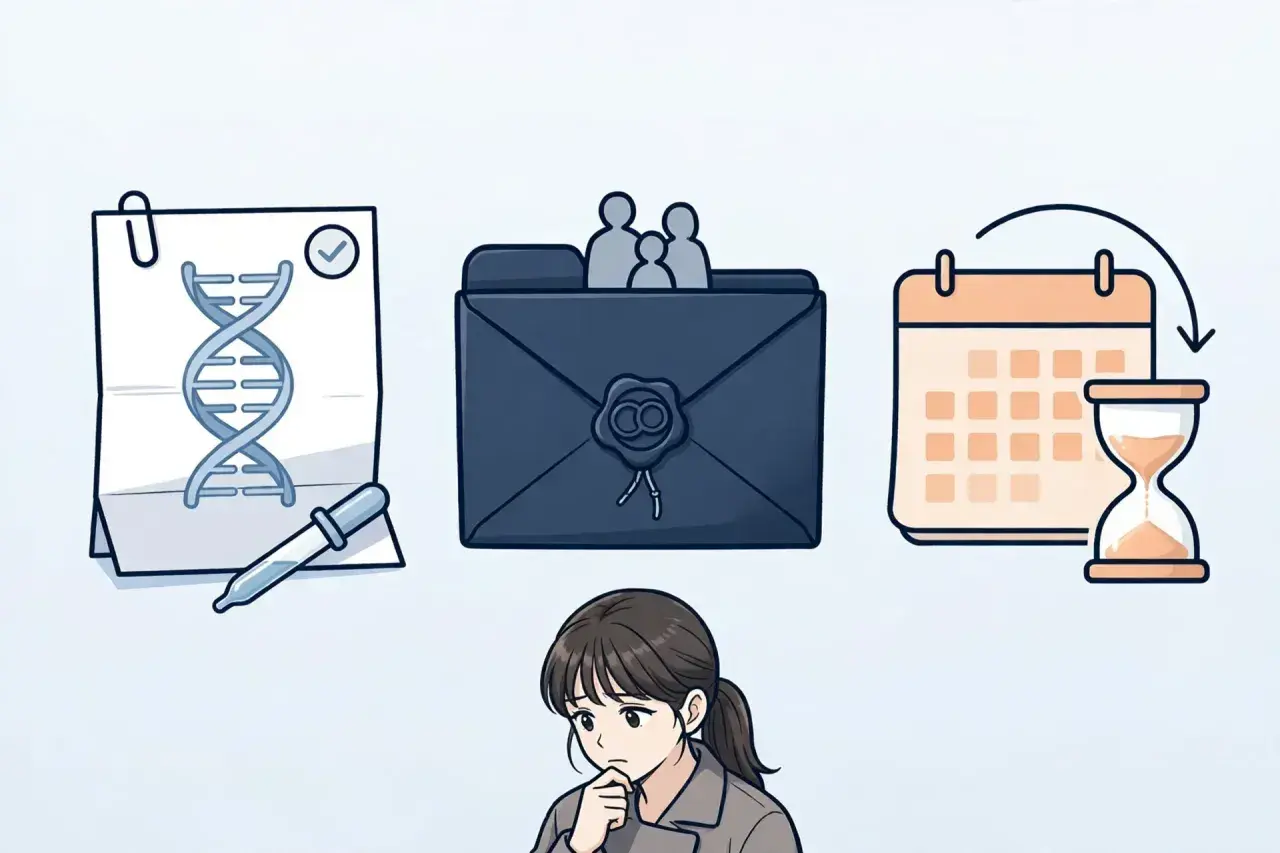
A Human Story
When David Park received the results of a fertility examination, he expected difficult news about his chances of having another child. Instead, the doctor told him that he had azoospermia: no sperm had been found in his semen. David left the clinic thinking about Leo, the son born to him and his wife, Emily, during their marriage. Was Leo biologically his?
The result did not change the family’s legal records, and it did not answer every biological question. But it made David doubt what he had long taken for granted. He wanted a court to establish that Leo was not his child. In Korea, however, a husband cannot simply ask a hospital or registry office to remove a child from the family record. He must use a specific court procedure—and act in time.
The Legal Question
If a child is born while a couple is legally married, can the husband challenge the legal presumption that he is the child’s father after learning that he may be infertile? And what must he do to have the legal parent-child relationship ended?
What Korean Law Says
Korean law distinguishes between a child’s legal status and the question of biological paternity. Under Article 844 of the Civil Act, a child born to a woman during her marriage is presumed to be her husband’s child. That presumption applies even when the husband believes the child may not be biologically related to him.
Civil Act, Article 844: A child conceived during marriage is presumed to be the husband’s child.
To challenge that legal presumption, the husband must bring an action to deny paternity under Articles 846 and 847 of the Civil Act. The action is brought against the child; a medical test or a request to amend a registry, on its own, does not replace the court case.
The key points are:
- There is a presumption to overcome. A child born during the marriage is legally treated as the husband’s child unless the presumption is rebutted through the required process.
- The deadline matters. The husband must file within two years of learning that the child is not his. In a situation like David’s, the medical result may be the event that prompts the question, but the legal deadline is tied to when he learned of the child’s non-paternity. He should get advice promptly rather than assume he can wait.
- The court determines the issue. A diagnosis of azoospermia may be important evidence, but it does not by itself prove that a particular child is not biologically related to the husband. The court can assess the relevant evidence, including genetic testing where appropriate.
- A final judgment leads to a further administrative step. If the family court grants the action and the judgment becomes final, the legal parent-child relationship ends retroactively. The person responsible for the registration must apply to correct the family relationship register within one month of the judgment becoming final, attaching a copy of the judgment and proof that it is final.
Practical warning: Do not treat a medical diagnosis as if it automatically changes legal paternity. The court action and the later registry correction are separate steps.
How Korean Courts Approach This
Korean courts begin with the statutory presumption, not with a private belief about who the biological father is. A child’s legal status does not disappear merely because the husband doubts paternity or obtains a medical result suggesting infertility. The presumption remains in place unless it is challenged through the procedure provided by law.
At the same time, the presumption is not beyond challenge. In a paternity-denial action, the court considers whether the evidence establishes that the husband is not the child’s biological father. A finding of azoospermia can be relevant, but its significance depends on the circumstances and the other evidence. Genetic evidence may help resolve the biological question.
Courts also treat the statutory time limit as important. A husband who believes he has learned that the child is not his should not postpone obtaining legal advice while informally investigating the matter. Nor is an administrative correction of the family register a substitute for a final court judgment where the legal presumption must first be rebutted.
Applying the Law to the Case
David’s situation calls for several distinct steps.
- Leo is presumed to be David’s child. Because Leo was born while David and Emily were legally married, Article 844 applies. David’s doubt—and even the fact that he has azoospermia—does not by itself cancel that status.
- The medical result is evidence, not the legal outcome. Azoospermia may support David’s concern, but the diagnosis alone does not necessarily establish when or whether Leo was conceived, or conclusively establish that David is not the biological father. David should preserve the medical records and obtain appropriate advice about what further evidence the court may need.
- David must bring the correct case against Leo. To remove the legal presumption, David must file a paternity-denial action against the child in the family court. He should act within two years of learning that Leo is not his child. In this fictional case, David treats the fertility result as the moment that brings the issue to light and seeks advice immediately rather than risking a dispute over the deadline.
- The court must decide the biological issue. David’s claim cannot succeed simply because he asks for it. The court examines the evidence. Here, after the court considers genetic evidence that excludes David as Leo’s biological father, it grants the action.
- The family register is corrected only after the judgment is final. Once the judgment becomes final, David must ensure that the family relationship register is corrected within one month. He submits the judgment and proof of finality with the correction application.
If you are dealing with a similar issue, attorney Ji-sun Ahn of Ijun Law Firm can review the parentage registration, the test reports and records showing how samples were obtained, and any prior ruling with you. These details can help clarify which options apply to your situation.
Conclusion: What Happened, and What Should You Do?
In this scenario, the court accepts the evidence and grants David’s action. When the judgment becomes final, the legal father-child relationship between David and Leo is treated as having ended retroactively. David then completes the separate registry-correction process within the required month. The fertility result prompted the case, but it was the court judgment—not the diagnosis—that changed Leo’s legal status.
If you face a similar situation:
- Mark the date carefully. The two-year period is tied to learning that the child is not yours. Get prompt legal advice about when the period began in your circumstances.
- Preserve evidence and use the court process. Keep medical records and ask a lawyer about appropriate genetic testing and filing a paternity-denial action against the child.
- Do not stop at the judgment. After it becomes final, apply to correct the family relationship register within one month, with the required judgment documents.

















