

Section 1 — A Human Story
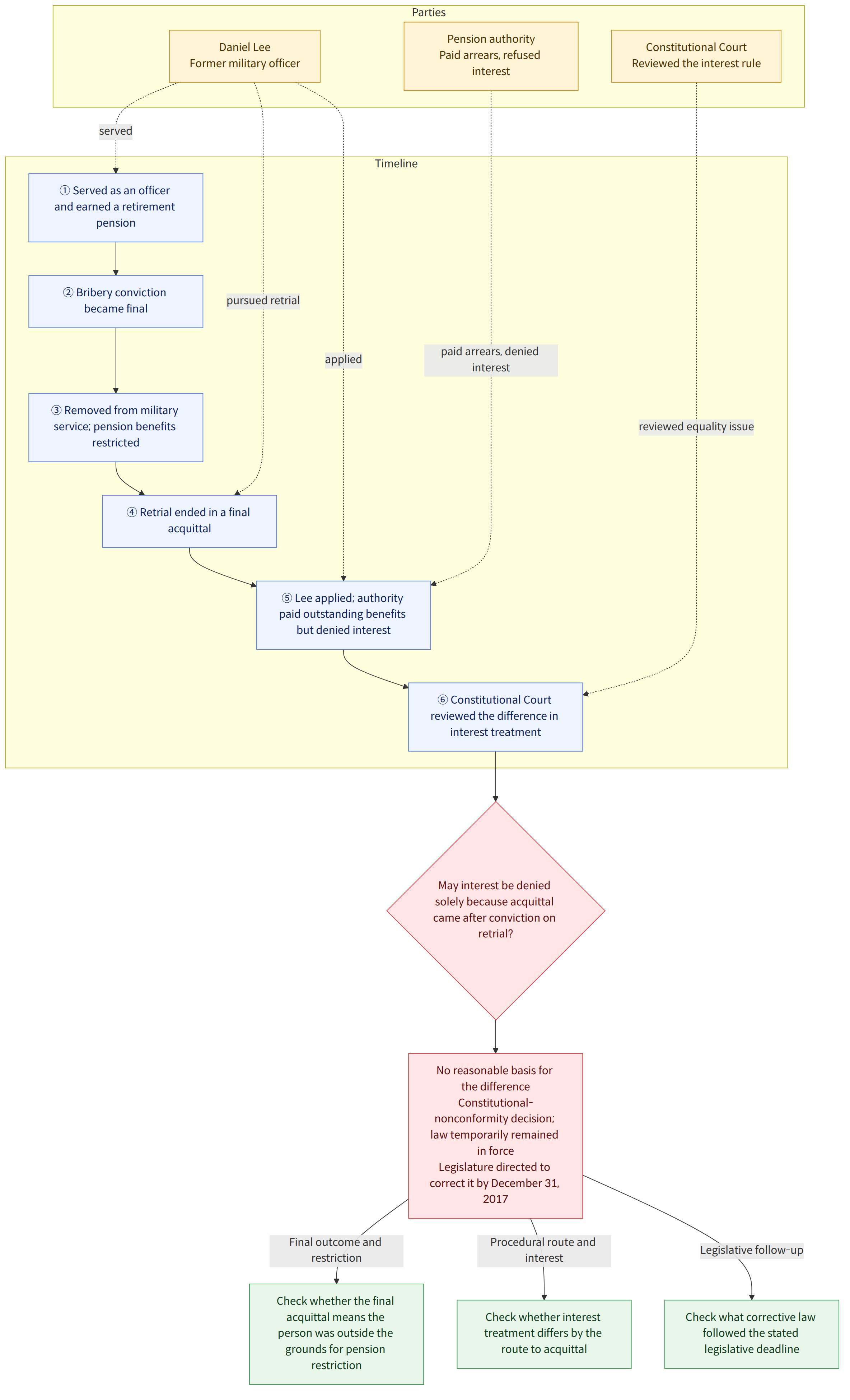
For years, Daniel Lee wore the uniform of a Korean military officer and planned his life around the retirement pension he had earned through service. Then a bribery conviction, arising from events during his service, brought his career to an abrupt end. After the conviction became final, he was removed from the military and his retirement benefits were restricted.
Daniel insisted he had not committed the crime. A retrial eventually ended with a final acquittal. The criminal judgment that had derailed his career was overturned, and he applied for the pension benefits he had been denied. The pension authority agreed to pay the outstanding amount—but refused to add interest. It said the law provided interest in some cases where benefits had been held back during an investigation or pending trial, but not where a person had first been convicted and later acquitted on retrial.
Section 2 — The Legal Question
Once a final acquittal establishes that a former officer was not subject to the pension restriction, may the law pay interest to someone cleared before conviction but deny it to someone cleared only through a retrial? Or does that difference impose unequal treatment without a sound reason?
Section 3 — What Korean Law Says
The Military Pension Act allowed part of certain retirement benefits to be withheld while an investigation or criminal trial was pending over an offense carrying a possible sentence of imprisonment or a more serious penalty. If the reason for restricting benefits later ceased to apply, the remaining amount was to be paid with interest as prescribed by presidential decree.
The difficulty was that the provision addressed benefits withheld while criminal proceedings were still underway. It did not expressly say that interest was payable when a person had already received a final conviction—and had the pension restriction imposed—before a retrial later produced a final acquittal.
In practical terms, the statute recognized interest when a person was provisionally kept from receiving benefits during an unresolved case. It did not expressly extend that same treatment to a person whose benefits had been restricted after conviction, even if a retrial later established that the person should not have been subject to the restriction.
The Constitutional Court considered whether that difference was consistent with the constitutional guarantee of equality. Its reasoning focused on the position of the person ultimately shown not to fall within the grounds for limiting benefits—not merely on the procedural route by which that conclusion was reached.
The Court’s central principle was that, once a person is found not to have been subject to the pension restriction, there is no reasonable basis for treating the person differently merely because the acquittal came through a retrial rather than through an earlier decision not to prosecute or another outcome ending the case before conviction.
The Court did not simply erase the provision from the statute book. It issued a constitutional-nonconformity decision. This is a remedy used when a law is unconstitutional in its existing form, but immediately invalidating it could create a legal vacuum or significant disruption. The law therefore remains temporarily in force while the legislature is given time to correct it.
Section 4 — How Korean Courts Approach This
In equality cases, Korean courts generally ask whether people in materially similar circumstances have been treated differently and, if so, whether there is a reasonable justification for the difference. A difference in procedure or timing does not automatically justify different treatment. The court looks at the purpose of the law and at whether the distinction is genuinely connected to that purpose.
In this pension dispute, the Constitutional Court focused on the final position of the two groups. A person whose case ended without prosecution and a person later acquitted on retrial were alike in an important respect: neither should ultimately have been treated as falling within the grounds for restricting the pension. The Court found no adequate reason to deny interest to one group solely because the criminal process had progressed further before the error was corrected.
The remedy mattered, too. The Court reasoned that simply striking down the provision could also eliminate the rules governing benefit restrictions and interest for people whose investigations or trials were still pending. It therefore left the provision temporarily applicable and directed the legislature to enact a corrective law by December 31, 2017.
Section 5 — Applying the Law to the Case
Daniel’s situation can be assessed in several steps:
- His benefits were restricted following a criminal conviction. This was different from a temporary withholding during an unresolved investigation or trial, which was the situation expressly addressed by the interest provision.
- The conviction did not stand. A final retrial acquittal established that Daniel should not be treated as a person subject to the relevant pension restriction. The fact that this conclusion came later did not change the substance of the outcome.
- The two groups were comparable for the purpose of interest. A person cleared before conviction and Daniel, cleared after a retrial, were both ultimately found not to be subject to the restriction. In either case, the person had been deprived of the use of retirement benefits that should not have been withheld on that basis.
- The procedural distinction did not justify denying Daniel interest. The Constitutional Court concluded that the timing and route of the acquittal did not provide a reasonable ground for paying interest to one person but not the other. Treating them differently violated the constitutional principle of equality.
- But the ruling did not automatically create an immediate payment. Because the Court used a constitutional-nonconformity remedy, rather than an immediate declaration that erased the provision, the statute was to remain temporarily in force while the legislature amended it. The Court’s decision established the constitutional defect, but the precise payment outcome could depend on the corrective legislation and the rules applicable to Daniel’s claim.
If you are dealing with a similar issue, attorney Ji-sun Ahn of Ijun Law Firm can review the provision applied in your case, the ruling or notice you received, and the dates relevant to challenging it with you. These details can help clarify which options apply to your situation.
Section 6 — Conclusion: What Happened, and What Should You Do?
Daniel had a strong constitutional argument: after his final acquittal, he could not reasonably be treated worse than someone cleared before conviction simply because his case took a different procedural path. The Constitutional Court agreed that this distinction lacked a reasonable basis and violated equality. But its ruling did not mean that interest would be deposited automatically as soon as the acquittal became final. The temporary continuation of the law made the governing amendment and the details of each claim important.
For readers in a similar position:
- Keep the key records together: the conviction, final retrial acquittal, pension-restriction decision, benefit calculation, and any written refusal to pay interest.
- Check the law that applies to your dates and claim. The Constitutional Court required corrective legislation, so do not assume that an older statutory wording alone determines your current entitlement.
- Challenge a refusal in writing and promptly. Ask the pension authority to identify the legal basis for denying interest, and seek advice on the available administrative or court appeal route before any filing deadline expires.

















