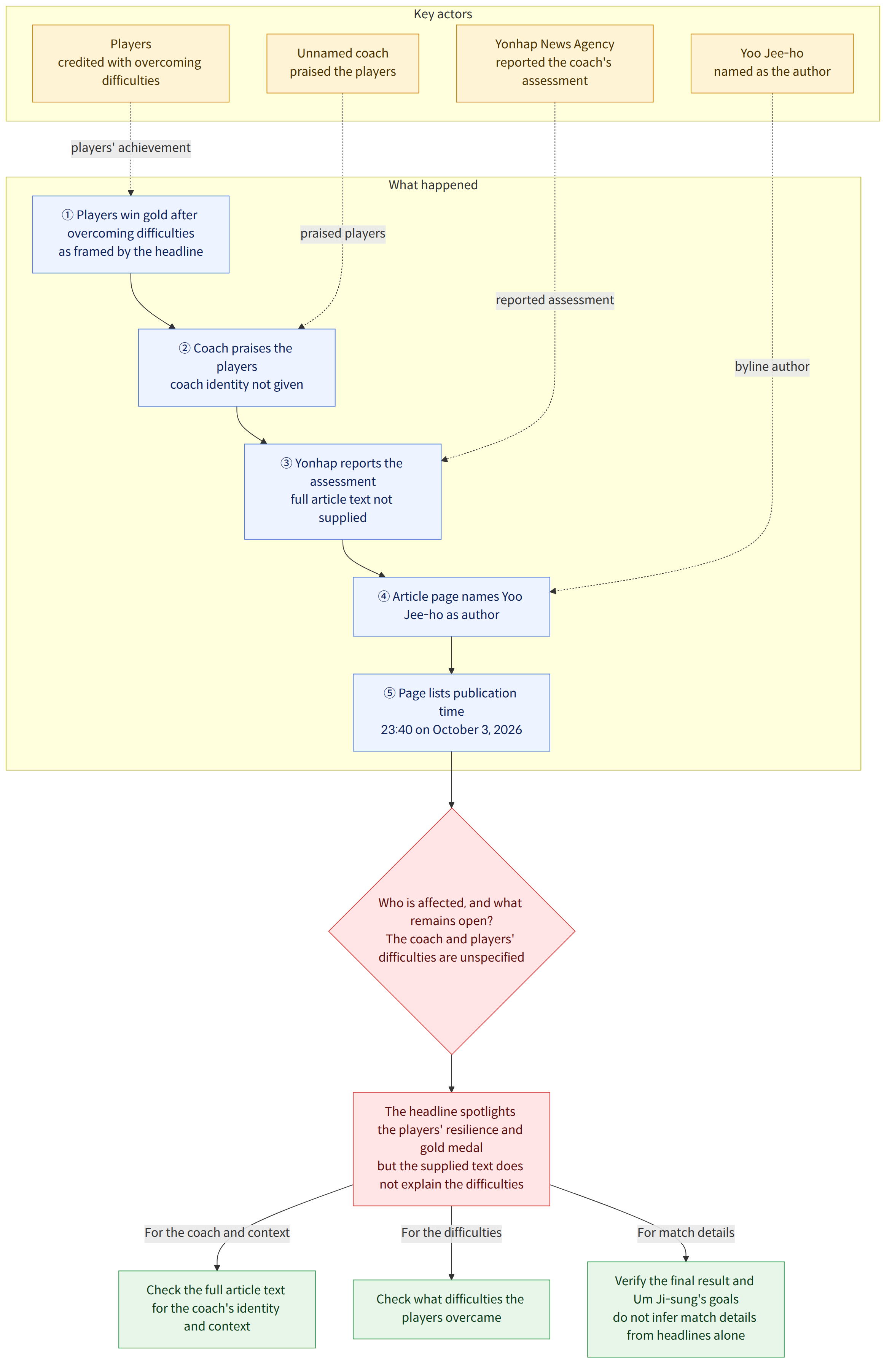
Yonhap News Agency (연합뉴스) reported that a coach praised the players for overcoming difficulties and winning gold in Asian Games football. The article page lists the publication time as 23:40 on October 3, 2026, and names Yoo Jee-ho (유지호) as the author.
The supplied related article headlines also say that South Korea defeated Japan to win its fourth consecutive men’s football gold medal, and that Um Ji-sung scored “bookend goals” that helped lead South Korea to gold. This information comes from separate article headlines and cannot be treated as specific details contained in the article about the coach’s praise.
Background and context
The focus of the story is not so much the result itself as the coach’s recognition that the players overcame difficulties to win. The article headline is framed as crediting the players. However, the supplied original contains no article text beyond the headline and publication information, making it difficult to explain the context of the praise in more detail.
The related headlines provide context about South Korea’s men’s football team beating Japan and winning gold for the fourth consecutive time. Another headline reports that Swansea City’s Um Ji-sung helped the team win gold. However, details not given in the headlines, such as the score or when the goals were scored, cannot be verified.
What this news means
By drawing attention not only to the gold medal but also to the players’ difficulties and how they overcame them, the article can be seen as reporting on the evaluation of the process as well as the achievement. The headline’s wording, which emphasizes the players’ contribution, may reflect a view of the win that does not attribute it solely to one individual’s performance. However, this is an interpretation of what can be read from the headline; the supplied content does not establish what the coach actually said.
For example, readers who had heard only the result may find that the headline also directs their attention to how the players overcame difficulties on the way to winning gold. But since the nature of those difficulties is unknown, specific causes such as injuries, scheduling, or match conditions should not be inferred.
Differences in how the reports presented the story
The supplied material gives two versions of the headline for the same article about the coach’s assessment. At the top of the original, the headline conveys that the coach was proud of the players for overcoming difficulties and winning gold. The article page headline conveys that the coach credited the players for overcoming difficulties and winning gold. Both emphasize the players’ resilience and the gold medal, but the former gives relatively greater prominence to pride, while the latter emphasizes crediting the players.
What is confirmed and what remains unknown
Confirmed facts
- The article is identified as a report related to Asian Games football.
- The headline says a coach praised the players for overcoming difficulties and winning gold.
- The article page lists the publication time as 23:40 on October 3, 2026, and names Yoo Jee-ho as the author.
- A related article headline says South Korea defeated Japan to win its fourth consecutive men’s football gold medal.
What remains unknown
- The supplied article text does not identify the coach or specify the difficulties the players faced.
- The article about the coach’s assessment does not provide specific details such as which team won gold, the final score, or how the match unfolded.
- The supplied related article headline alone does not reveal which specific scoring plays “bookend goals” refers to, when the goals were scored, or what the match result was.
What readers should check
- To identify the coach and understand the context of the assessment, readers should check whether the article contains an explanation in its full text.
- It is worth checking whether the article specifies what difficulties the players overcame.
- When verifying the final result and Um Ji-sung’s goals, readers should not assume details of the match based on the headline alone.
References
- Other coverage consulted: en.yna.co.kr
- Other coverage consulted: en.yna.co.kr