

A Tale of Two Convictions
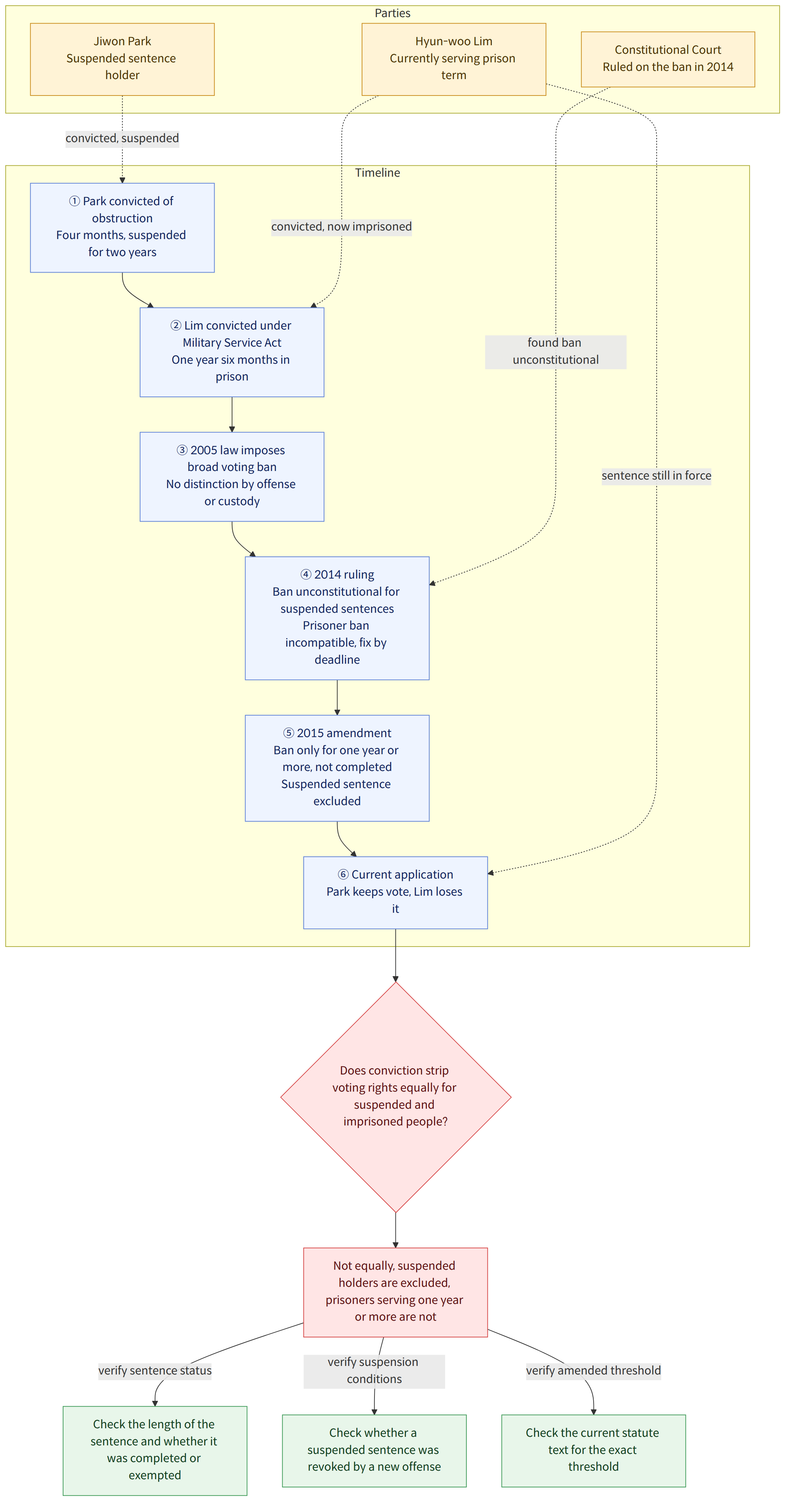
Jiwon Park is a warehouse supervisor in Busan. Five years ago, a dispute at work led to a conviction for obstruction of business. The court gave him four months in prison, suspended for two years. He has kept his record clean since then, pays his taxes, coaches a youth soccer team on weekends, and plans to cast his ballot in the next presidential election for the first time in a decade.
Hyun-woo Lim is a different case. A conviction under the Military Service Act sent him to prison for one year and six months, and he is currently serving that sentence. Like Jiwon, he has heard that he cannot vote in the coming election. He has a mother who will visit him on the day of the vote and a sister who keeps asking whether he can still exercise his rights from behind bars.
The two men were told the same thing by people around them: a criminal conviction means no vote. Yet their situations are not identical. One is living a normal life under a suspended sentence, while the other is physically confined. Are they really subject to the same restriction? The answer depends on a legal history that stretches back to 2005 and is more nuanced than the rumors suggest.
The Legal Question
Does a criminal conviction automatically strip a person of the right to vote in Korea, and if so, does that restriction apply equally to someone on a suspended sentence and someone currently in prison?
What Korean Law Says
The starting point is the Public Official Election Act, which governs who may vote. Under the version in force in 2005, the law denied voting rights to anyone sentenced to a prison term or a term of imprisonment without labor of at least one year... more precisely, anyone sentenced to imprisonment of a certain severity whose sentence had not yet been carried out or completed.
At the same time, the Criminal Act added a separate suspension of public rights for people sentenced to imprisonment with labor, lasting until the sentence was served or waived.
Under the earlier rules, a person sentenced to imprisonment of at least a set threshold lost the right to vote until the sentence was completed or exempted, and a person sentenced to imprisonment with labor lost public voting rights for the same period.
These rules applied in a sweeping way. They did not distinguish between a minor offense and a serious one, and they did not distinguish between someone locked in a cell and someone walking free under a suspended sentence.
The key concepts are easier to understand as a short list:
- Suspended sentence (집행유예): The court announces a prison term but suspends its execution for a set period. If the person commits no new offense during that period, the sentence is never carried out.
- Actual imprisonment (수형자): A person whose sentence is being served in a correctional facility.
- Principle of minimal infringement: A government restriction on a fundamental right must be no broader than necessary to achieve its goal.
- Principle of equality: Similar people should not be treated differently without a reasonable justification.
How Korean Courts Approach This
The Constitutional Court examined these rules in a 2014 case brought by people affected by the restrictions. Its reasoning split between two groups.
For people on suspended sentences, the court found the ban unconstitutional. Its reasoning was direct: these individuals live in society just like everyone else, they are not confined, and the state has little reason to strip their voting rights. A blanket restriction that ignored the seriousness of the crime failed the minimal infringement test and also treated them unequally, violating the principles of universal suffrage and equality.
For prisoners, the court reached a different conclusion. It found that the total ban was too broad and therefore unconstitutional, but it did not strike the rule down outright. Instead, it issued a finding of incompatibility (헌법불합치), meaning the rule was unconstitutional but would remain in effect until the legislature revised it by a deadline. The court reasoned that how to design a constitutional voting rule for prisoners was a policy choice for lawmakers.
The legislature responded with amendments in 2015. The revised Public Official Election Act now removes voting rights only for people sentenced to imprisonment of one year or more whose sentence has not been completed or exempted, and it expressly excludes those serving a suspended sentence. The Criminal Act was also amended to add a proviso allowing other statutes to set their own rules, removing the automatic suspension that had caused the constitutional problem.
Applying the Law to the Case
Let us apply the current framework to each man.
Jiwon Park received a suspended sentence. Under the 2015 amendment, the voting bar does not reach people serving a suspended sentence. The Constitutional Court had already found the blanket restriction on such people unconstitutional. His conviction is final, but because he is within his probation period and not confined, he is not disqualified from voting in the upcoming presidential election. The central fact for him is that his sentence is suspended, not executed.
Hyun-woo Lim is in a different position. His sentence is one year and six months, which exceeds the one-year threshold in the current law. He is currently serving the sentence, so it has not been completed or exempted. Under the amended rule, he falls within the restriction and would not be eligible to vote until his sentence is fully served or exempted. His situation is governed by the amended provision that replaced the earlier total ban.
Two details matter in this analysis. First, the length of the sentence determines whether the restriction applies at all. A sentence below one year would not trigger this particular bar. Second, the timing matters. A person whose sentence has been completed before the election is not disqualified by this rule.
If your situation resembles Hyun-woo Lim's or Jiwon Park's, the most useful document to bring is the final judgment together with any record showing whether the sentence was suspended, its length, and the dates of its start and completion. You could ask attorney Ji-sun Ahn of Ijun Law Firm to review whether the one-year threshold and the status of execution in your records lead to the same conclusion described in this column, and to check how the timing of the election affects your eligibility.
Conclusion: What Happened, and What Should You Do?
Jiwon Park can vote in the next presidential election. His suspended sentence means he is not barred under the current rules, even though his conviction is on record. Hyun-woo Lim cannot vote in that election while his sentence remains unserved, because his one-year-and-six-month term exceeds the statutory threshold and he is still in custody.
Both men were correct to question the rumors they heard, but the rumors blurred two different groups together. The current law separates people by the length of the sentence and by whether the sentence is actually being carried out.
If you are in a similar situation, keep these practical points in mind:
- Check the exact sentence type. A suspended sentence, a fine, and an executed prison term are treated differently. Read the judgment carefully rather than relying on a summary.
- Confirm the length and the dates. The one-year threshold and the completion date of the sentence can decide whether you are eligible on election day.
- Verify with the election authorities before the vote. Voter registration is decided by the official roll, so confirm your status with the National Election Commission well ahead of the deadline.
















