

A Human Story
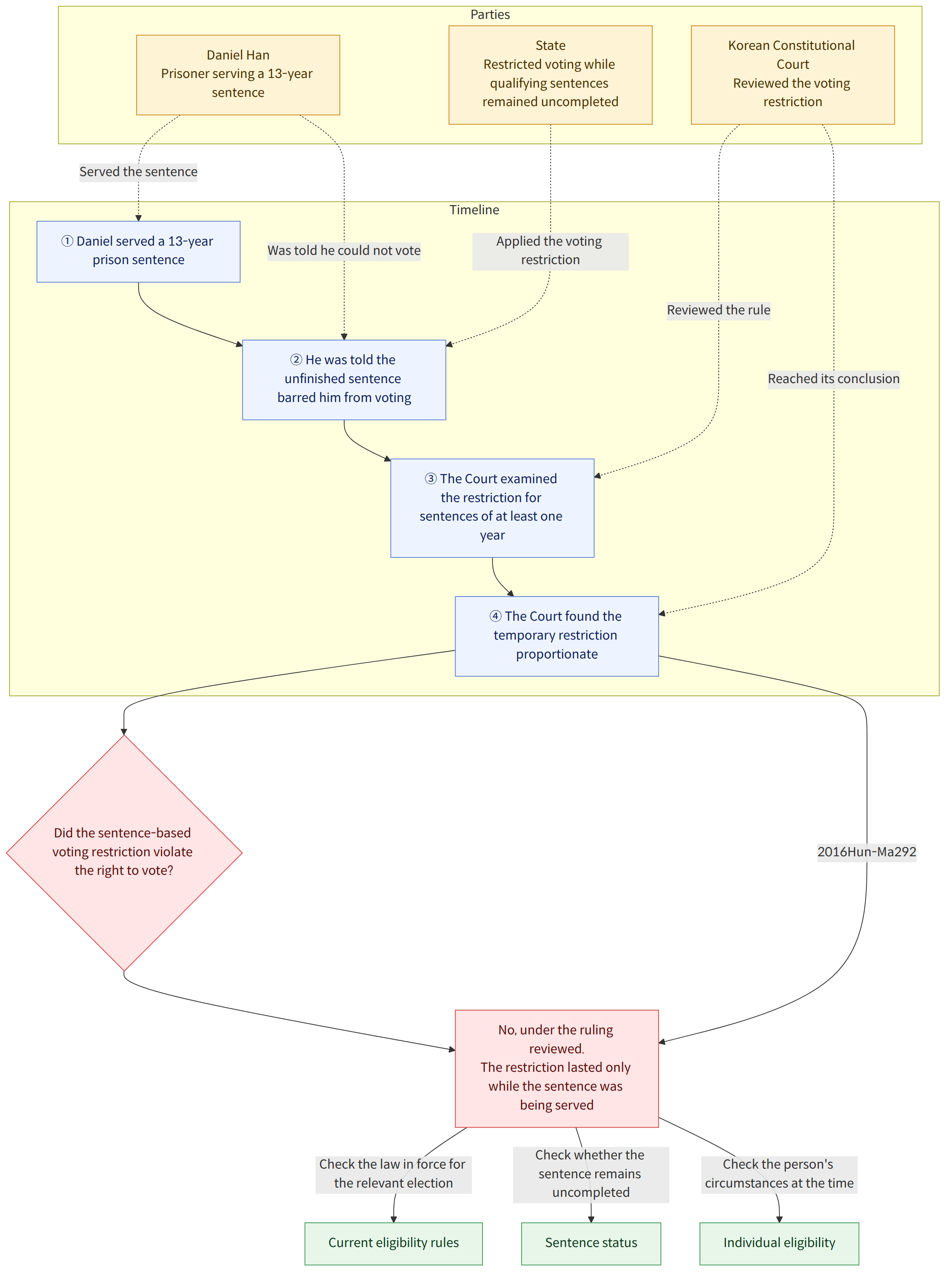
Daniel Han had imagined his next election differently. Serving a 13-year prison sentence, he had followed public debates from behind the prison walls and wanted to cast a ballot. Instead, he was told that his conviction and unfinished sentence meant he could not vote. To Daniel, the restriction felt like losing a voice in the community he still belonged to.
He began asking a constitutional question: could the state lawfully suspend his voting rights simply because he was serving a sentence of more than one year? Daniel did not argue that his conviction should be undone. He wanted to know whether being punished in prison could also mean being excluded from the ballot box until his sentence was over.
The Legal Question
Does barring a person sentenced to at least one year of imprisonment from voting while the sentence remains in force violate the constitutional right to vote?
What Korean Law Says
The provision examined by Korea’s Constitutional Court restricted voting rights for people sentenced to at least one year in prison for as long as their sentence was still being served. The Court considered whether that restriction went too far and unfairly burdened the constitutional right to vote.
The central test was proportionality: whether the restriction served a legitimate public purpose, was reasonably connected to that purpose, and imposed a burden that was not excessive in relation to the public benefit.
The Constitutional Court reasoned that the restriction sought to impose a social and criminal consequence for serious offending and to strengthen respect for the law. It found that the public interest in those aims was not outweighed by the temporary loss of voting rights during the sentence.
The Court’s reasoning turned on several points:
- The sentence threshold: It considered a sentence of at least one year a reasonable marker, in light of sentencing practice, for cases in which the court had found substantial harm to the community.
- The duration of the restriction: Voting rights were restricted only until the sentence was completed, linking the length of the restriction to the criminal sentence.
- Different kinds of crimes: The rule was not limited to intentional crimes or to particular kinds of harm. The Court did not consider that breadth, by itself, an unnecessary restriction.
- Parole: The restriction did not depend on whether a prisoner received parole, which is a discretionary decision made during the sentence. The Court found that this did not make the rule disproportionate.
How Korean Courts Approach This
In constitutional challenges, Korean courts assess not only the importance of the right at stake but also the purpose and design of the restriction. The right to vote is fundamental, so a restriction must be justified rather than treated as automatic or trivial. But a restriction may survive review if the court finds a strong public purpose and a reasonable relationship between that purpose and the limits imposed.
In its decision of May 25, 2017, in case 2016Hun-Ma292, the Constitutional Court applied that approach to the prison-sentence voting restriction. It concluded that the restriction did not violate the right to vote. In particular, it viewed the one-year threshold and the link between the restriction’s duration and the sentence as reasons the measure was not excessive.
That holding did not declare that a person serving a prison sentence permanently loses the right to vote. It addressed a restriction lasting while the relevant sentence remained uncompleted. Nor should a 2017 ruling be taken, without checking, as a complete statement of the rules for every later election: current eligibility depends on the law in force and the individual’s circumstances at the time.
Applying the Law to Daniel’s Case
- Daniel falls within the threshold considered by the Court. His sentence is 13 years, far above the one-year minimum in the restriction that was challenged.
- His sentence has not ended. Because he is still serving it, the restriction’s stated time condition applies to his situation under the rule the Court reviewed.
- The length of the sentence does not make the restriction permanent. Under the Court’s reasoning, the voting restriction lasts with the execution of the sentence; it is not a separate, lifelong removal of the right to vote.
- The constitutional challenge does not succeed on the reasoning in that decision. The Court held that the public aims of imposing a consequence for serious offending and encouraging respect for the law were not outweighed by the temporary loss of the vote. It also rejected the argument that the rule was necessarily excessive because it did not distinguish among crime types or take parole into account.
For a real person facing an election, the precise sentence, its status, and the current election law matter. A review of Daniel’s sentencing judgment and any official notice about his eligibility could help clarify how the applicable rule affects his particular circumstances; a reader can ask [[lawyer]] to review those documents.
If you have a sentencing judgment or an official notice about voting eligibility, attorney Ji-sun Ahn of Ijun Law Firm can review those documents and explain what questions they raise under the law applicable to your circumstances.
Conclusion: What Happened, and What Should You Do?
Under the restriction considered in the 2017 decision, Daniel could not vote while he was still serving his 13-year sentence. His constitutional challenge would not succeed under the Court’s reasoning: it found the temporary restriction proportionate and did not regard it as a violation of the right to vote. That conclusion concerns the rule examined by the Court; Daniel, like anyone else, would need to check the law in force when a particular election takes place.
If you or someone close to you is in a similar position:
- Check the current rule before an election. Do not rely solely on a past court decision; confirm the law and eligibility arrangements applicable to that election.
- Read the sentencing documents carefully. The sentence imposed and whether it is still being served may be central to the eligibility question.
- Keep any official election-related notice. If its explanation seems unclear or conflicts with the sentencing record, seek an individual review of the documents.
















