
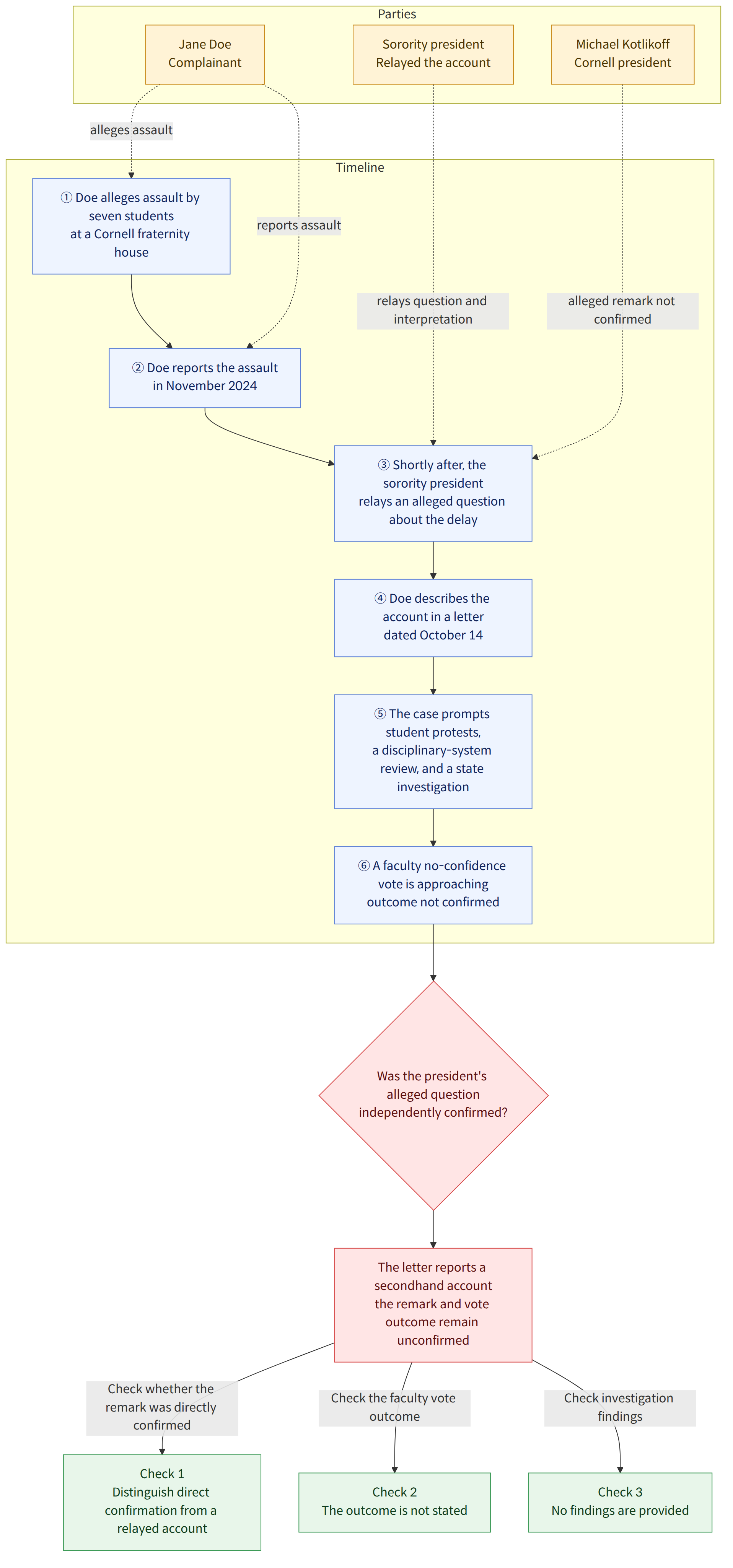
A woman who says she was sexually assaulted by seven students at a fraternity house at Cornell University said she was told that, shortly after she reported the assault, the university president asked why she had waited to report it. The woman, identified in court documents as Jane Doe, described the events in a letter dated October 14. The letter was written as a faculty no-confidence vote against university leadership was approaching and was obtained Tuesday.
Background and context
The woman wrote in the letter about a conversation shortly after she reported being sexually assaulted in November 2024. She did not say that she heard the president’s question directly. According to the woman, the president of her sorority told her that Cornell President Michael Kotlikoff had asked why she delayed reporting the assault.
The woman said the sorority president understood the question as casting doubt on her account. She said the president’s initial response made her feel unsupported and disbelieved. The letter therefore contains, respectively, an account relayed indirectly about the president’s remark, the sorority president’s interpretation of it, and the woman’s feelings.
The case prompted student protests and a review of the university’s disciplinary system, and led to a state-level investigation into the sexual assault allegations. The letter was written amid these repercussions, as a no-confidence vote against faculty leadership was approaching. The information provided, however, does not give the outcome of the vote or the status of the investigation.
What this news means
For members of the university community, the claim matters not only because of how the sexual assault allegations were handled, but also because university leadership’s response to a report can affect trust and procedures. What is established in this case is the woman’s claim and the account relayed to her—not independent confirmation that the president actually asked the question. That is why it is important to distinguish the truth and context of the remark from the report of it.
The fact that the letter emerged as a faculty no-confidence vote was approaching shows how claims about the university’s response to a report can intersect with assessments of its leadership. But it is not known what effect the letter had on the vote or what judgment the faculty made. No findings from the investigation into the sexual assault allegations are provided either, so the claim should not be treated as an established fact or as an investigative conclusion.
For example, if another member of a university community encounters a similar dispute over how a report was handled, they should first distinguish whether a statement by the president or the university was directly confirmed or relayed through someone else. This is a way to understand the chain of reporting in this case accurately, not a basis for prejudging whether the allegations are true.
Related legal and support information
The accompanying legal guide explains general principles under the Korean Criminal Act (형법) and the Act on Special Cases Concerning the Punishment of Sexual Crimes (성폭력처벌법). Whether offenses such as rape or indecent assault have occurred is assessed by considering the specific circumstances as a whole, including the manner of the act, the victim’s condition, the relationship between the parties, and the surrounding circumstances. The guide also cautions that the conclusion in one case does not automatically apply to another.
Because this guide concerns Korean law, it should not be treated as an explanation of the laws or procedures applicable to the Cornell University case in the United States. Nor can the guide establish whether the allegations in this case are true or what legal determination has been made. It can be referred to here for the general caution that allegations, confirmed facts, and legal findings should be distinguished when discussing sexual assault allegations.
What is confirmed and what remains unknown
Confirmed facts
- Jane Doe alleged that she was sexually assaulted by seven students at a fraternity house at Cornell University.
- In a letter dated October 14, the woman wrote that shortly after reporting the assault in November 2024, she heard an account of a question from the university president.
- The account of the president’s question came from the woman, who said the sorority president understood it as casting doubt on her account.
- The case led to student protests, a review of the university’s disciplinary system, and a state-level investigation.
What remains unknown
- Whether President Kotlikoff actually asked why the woman had waited to report the assault, and what position he has taken on the claim.
- The outcome of the faculty no-confidence vote.
- The findings of the state-level investigation into the sexual assault allegations.
What readers should check
- When reading coverage, check whether the president’s remark was directly confirmed or was relayed through the woman.
- Look for follow-up reporting confirming the outcome of the faculty no-confidence vote and the university’s position.
- Check whether the state-level investigation’s findings have been released, while avoiding describing the sexual assault allegations as established fact before those findings are available.