

1. A Human Story
For five years, Daniel Park lived between construction sites abroad, company housing, and video calls home. His employer had sent him to oversee a major infrastructure project overseas. His wife, Hana, remained in South Korea, where they had made their home before he left.
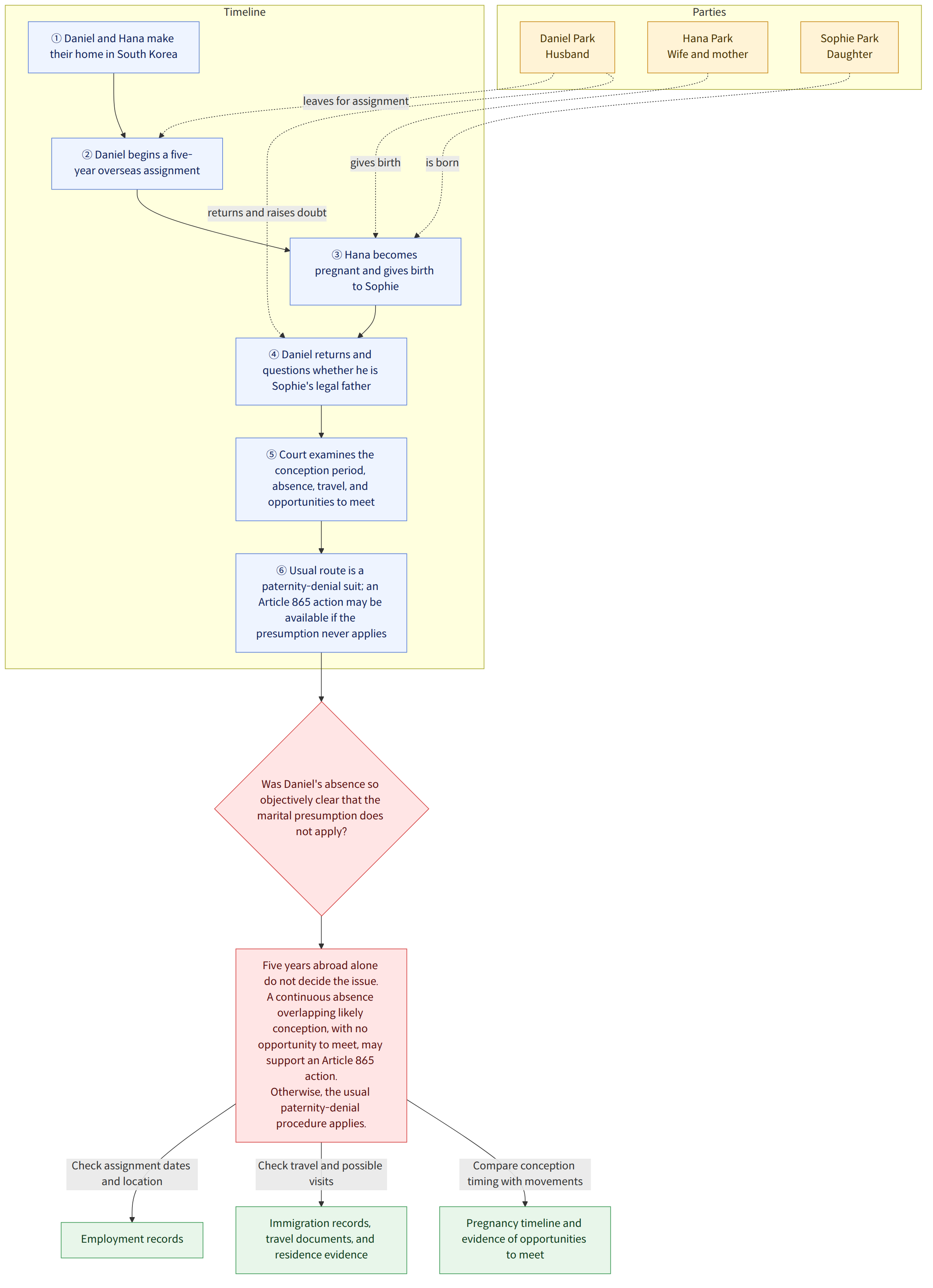
During Daniel’s assignment, Hana became pregnant and gave birth to a daughter, Sophie. Daniel returned to Korea to find a family changed in ways he had not expected. He did not believe Sophie was biologically his, and wanted the law to determine whether he was her legal father. The question was not simply what a DNA test might show. It was which legal procedure he had to use—and whether the law would presume paternity despite his long absence.
2. The Legal Question
When a child is conceived while a couple is married, Korean law ordinarily presumes the husband is the child’s father. But does that presumption still apply when the husband was abroad for years and the spouses did not live together? Or can the husband instead ask a court to confirm that no legal parent-child relationship exists?
3. What Korean Law Says
The starting point is Article 844 of the Korean Civil Act. It establishes a strong presumption of paternity for a child conceived during marriage. The purpose is to provide children with stable family status and to avoid allowing parentage to be challenged casually.
A child conceived by a wife during marriage is generally presumed to be the husband’s child. This is a strong presumption, not one that can ordinarily be overcome by simply presenting contrary evidence in a different kind of lawsuit.
If the presumption applies, the husband generally must bring a lawsuit to deny paternity under Articles 846 and 847 of the Civil Act. He cannot ordinarily avoid that procedure by filing a separate action asking the court to confirm that the parent-child relationship does not exist.
There is, however, a narrow exception. The presumption may not apply where the circumstances make it obvious from the outside that the husband could not have fathered the child—for example, where the spouses were separated for a prolonged period or one spouse was abroad for an extended time and they had no opportunity to be together.
The key distinction is between rebutting a presumption that applies and showing that the circumstances are so clear that the presumption never applies in the first place.
When the exception is established, an action to confirm the nonexistence of a parent-child relationship under Article 865 may be available. That is not an automatic shortcut. The claimant must show facts that place the case within the exceptional category.
Relevant evidence may include:
- Employment records showing the dates and location of the overseas assignment.
- Immigration records, travel documents, and passport stamps.
- Proof of the spouses’ separate residences and the absence of visits during the relevant period.
- A reliable timeline of the pregnancy and the husband’s movements.
4. How Korean Courts Approach This
Korean courts approach the marital presumption cautiously. They generally do not let a husband avoid the paternity-denial procedure merely by asserting that he is not the biological father or by producing evidence that conflicts with the presumption. The law values legal certainty for the child, so the usual route remains the lawsuit specifically designed to deny paternity.
The exception is focused on objective impossibility, not suspicion or marital conflict. A strained relationship, living apart for convenience, or a husband’s claim that he had no contact with his wife may not be enough on its own. The circumstances must make it apparent that the husband could not have conceived the child with his wife during the relevant period.
Courts therefore examine the whole timeline. A long overseas posting can be powerful evidence, but its length alone may not settle the issue if there were return trips, visits, or other opportunities for the spouses to be together. Conversely, a documented, continuous absence that overlaps the likely conception period can support the conclusion that the presumption does not apply.
5. Applying the Law to the Case
Daniel’s situation should be assessed in several steps.
- Was Sophie conceived during the marriage? If so, Article 844’s presumption is the starting point. Daniel cannot bypass the normal procedure simply because he doubts his biological connection to Sophie.
- Was Daniel absent during the relevant period? His five-year assignment is important, but the court would need to know whether it was continuous and whether he returned to Korea or otherwise had an opportunity to be with Hana around the likely time of conception.
- Can the absence be proved objectively? Company deployment records, immigration history, and travel documents could establish where Daniel was. Evidence that he and Hana maintained separate lives and did not meet during the relevant period would strengthen the case.
- Does the evidence make conception by Daniel plainly impossible? If the records show that Daniel was abroad continuously throughout the period in which Sophie could have been conceived, the facts may fit the narrow exception. If the timeline leaves a realistic opportunity for the couple to have been together, the presumption may remain in place.
- Which lawsuit follows? If the court finds that the presumption applies, Daniel generally must use the paternity-denial lawsuit. If the evidence instead establishes that the exceptional circumstances prevent the presumption from applying, an Article 865 action to confirm the nonexistence of the legal parent-child relationship may be available.
That distinction matters. An Article 865 action is not simply a more convenient alternative to the paternity-denial suit. Its availability depends on first establishing that this is one of the rare cases in which the statutory presumption does not attach.
If you are dealing with a similar issue, attorney Ji-sun Ahn of Ijun Law Firm can review the family registration, the marriage, separation and birth dates relevant to the parentage dispute, and any prior court records with you. These details can help clarify which options apply to your situation.
6. Conclusion: What Happened, and What Should You Do?
On the facts as described, Daniel’s five-year overseas assignment and the couple’s lack of cohabitation could place his case within the exception. If he can document that he was continuously abroad during the likely conception period and that he and Hana had no opportunity to be together, he may be able to bring an action under Article 865 to confirm that no legal parent-child relationship exists. If the evidence does not establish that exceptional, objective impossibility, the ordinary paternity-denial procedure remains the required route. The outcome would depend on the proven timeline; the overseas assignment alone does not automatically resolve the case.
For anyone facing a similar situation:
- Build a precise timeline. Establish the likely conception period and compare it with work, travel, and residence records.
- Preserve objective evidence. Keep employer documents, immigration records, tickets, and other reliable proof of where each spouse was.
- Get legal advice before filing. The correct lawsuit depends on whether the paternity presumption applies, and choosing the wrong procedure can prevent the court from deciding the issue on its merits.

















