
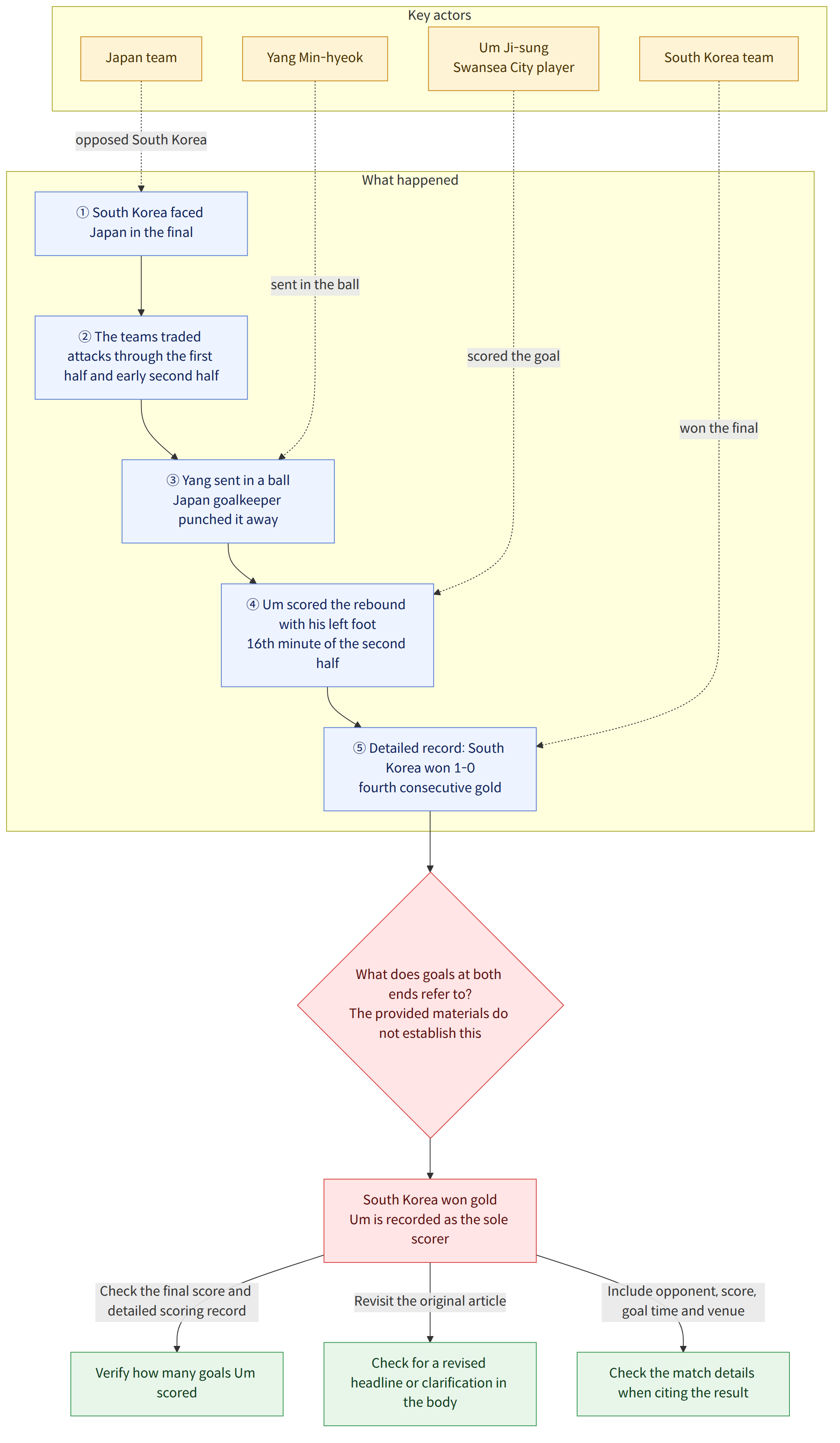
South Korea’s men’s soccer team beat Japan 1-0 to win its fourth consecutive gold medal in the Asian Games final. According to the detailed match report, the goal that decided the game was scored in the 16th minute of the second half by Um Ji-sung, who was identified as a Swansea City player. However, another headline about Um’s performance mentioned “goals at both ends,” which does not match the wording in the detailed record provided.
Background and context
The final was held on October 3, 2026, at Toyota Stadium in Aichi Prefecture, Japan. The match report said South Korea had won the men’s soccer gold medal four consecutive times, beginning with the 2014 Incheon Games. South Korea faced Japan in the final and won.
The detailed report says the teams traded attacks through the first half and into the early part of the second half, until Um’s goal broke the deadlock. In the 16th minute of the second half, Yang Min-hyeok sent a ball in from the flank, the Japanese goalkeeper punched it away, and Um finished the rebound with his left foot. Based on this account, Um’s goal was the only goal of the final and the one that decided the match.
What this news means
For South Korean soccer fans, the result represents both a gold medal and a fourth consecutive men’s soccer title. Um’s performance will be recorded as having decided the final. However, readers who see only the headline may understand that he scored twice, so it is important to distinguish the headline from the detailed match record.
For example, readers trying to understand the match from the headline alone might take the phrase “goals at both ends” to mean that two goals were recorded. But the detailed report provided states that South Korea won 1-0 and that Um scored once, in the 16th minute of the second half. The detailed record alone does not establish what the headline refers to.
Differences in how reports described the match
A headline about Um said he led South Korea to gold with “goals at both ends.” By contrast, a detailed report on the final recorded South Korea’s 1-0 victory and Um’s goal in the 16th minute of the second half. The discrepancy between the two descriptions cannot be resolved from the headlines alone.
Another article’s headline said South Korea beat Japan to win its fourth consecutive men’s soccer gold medal. However, the body of that article was not available beyond its headline, so it cannot provide any further details about the match or its scoring record.
Therefore, the detailed match record currently provided confirms one goal by Um Ji-sung and a 1-0 victory for South Korea. The basis for the headline’s phrase “goals at both ends” cannot be confirmed from the materials provided.
What is confirmed and what remains unknown
Confirmed facts
- Japan was South Korea’s opponent in the final, and the result was a 1-0 victory for South Korea.
- The match was held at Toyota Stadium in Aichi Prefecture, Japan.
- The detailed match report records Um Ji-sung’s goal in the 16th minute of the second half.
- South Korea won the men’s soccer gold medal at the Asian Games for the fourth consecutive time.
- One headline about Um Ji-sung mentions “goals at both ends.”
What remains unknown
- The article text provided does not establish what specific scoring record or context the headline phrase “goals at both ends” refers to.
- It is difficult to assess Um’s role in the match or his contributions apart from his goal based only on the materials provided.
What readers should check
- To verify how many goals Um Ji-sung scored, check not only the headline but also the final score and detailed scoring record.
- If a headline and the report’s account differ, it is advisable to revisit the original article and check whether the headline was revised or whether the body contains additional clarification.
- When citing the basic record of this match, include the opponent, score, time of the goal, and venue to reduce the risk of confusion.
References
- Other coverage consulted: hani.co.kr
- Other coverage consulted: en.yna.co.kr