

1 — A Human Story
Daniel Reed thought the civil dispute was finally behind him. After months of arguments over a failed business arrangement, the court entered judgment for the other party, Michael Park. Daniel’s appeal did not change the result, and the judgment became final. He had expected to bear his own legal expenses. What he had not expected was to hear that he might also have to pay part of Michael’s lawyer’s fees.
The amount unsettled him almost as much as the loss itself. Michael had hired counsel on terms Daniel knew nothing about, and Daniel wondered whether the other side could simply pass its entire bill to him. He began to question whether a rule that makes a losing party contribute to the winner’s legal fees was fair—or even constitutional.
2 — The Legal Question
Can Korean law require a losing party to reimburse some of the successful party’s attorney fees, and does that rule violate the Constitution by being unclear, improperly delegated, unequal, or an obstacle to the right to bring a case to court?
3 — What Korean Law Says
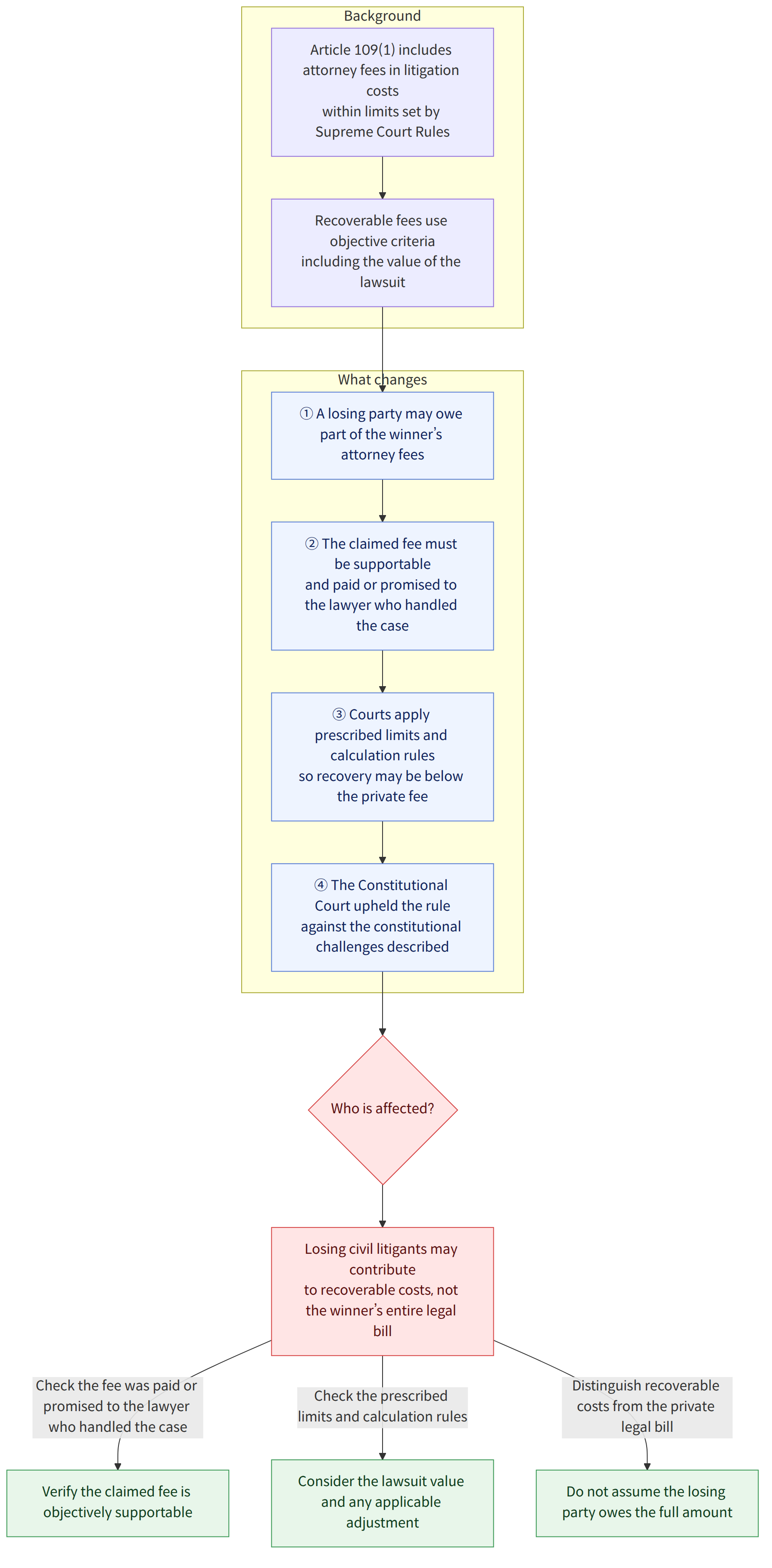
Article 109(1) of the Korean Civil Procedure Act provides for attorney fees to be included in litigation costs, within limits established by Supreme Court Rules. This is a limited cost-shifting system: it does not automatically make the losing party responsible for the winner’s entire legal bill.
Attorney fees paid or to be paid by a party to an attorney may be included in litigation costs, within the limit prescribed by Supreme Court Rules.
The rules governing the recoverable amount use objective measures, including the value of the subject matter of the lawsuit. The amount that can be recovered may therefore be different from what the successful party actually agreed to pay their lawyer.
A few distinctions matter:
- The obligation concerns recoverable litigation costs, not an automatic transfer of every private expense the winning party incurred.
- The claimed fee must be supportable. The relevant amount is the economic consideration the party paid, or agreed to pay, to the lawyer who actually handled the case, and it must be capable of objective substantiation.
- The court applies the prescribed limits and calculation rules. The result can be lower than the fee charged under the client’s private agreement with counsel.
The Constitutional Court has considered whether Article 109(1) violates several constitutional principles. It held that the provision is not too vague: read in context, “fees paid or to be paid” can be understood as the objectively supportable payment promised or made under the attorney-client engagement.
A statutory rule is not unconstitutionally unclear simply because its words require interpretation. The question is whether people and courts can understand its meaning from the text and the legal framework around it.
The Court also rejected the claim that allowing Supreme Court Rules to set the limits was an improper delegation of legislative power. It reasoned that the Constitution’s provisions concerning the Supreme Court’s rule-making authority do not prevent legislation from assigning other matters to Supreme Court Rules.
Nor did the Court find an unconstitutional “blank cheque” to the rule-maker. The statute directs the rules to set a range; the expected framework includes objective criteria, such as the value of the lawsuit, and allows courts to assess the amount in the particular case, including adjustments where appropriate.
4 — How Korean Courts Approach This
Korean courts treat attorney-fee shifting as one component of litigation costs, governed by statutory and regulatory limits. The basic policy is that a party who succeeds in court should be able to recover a prescribed portion of the costs of pursuing or defending the claim. At the same time, the system does not make the losing party liable for any amount the winner and their lawyer chose to agree upon privately.
The Constitutional Court has also acknowledged the concern Daniel felt: the possibility of paying the other side’s costs may discourage some people from filing or defending a legitimate claim. But it concluded that this concern does not, by itself, make the system unconstitutional. The limits on recoverable costs were considered a sufficient safeguard against an unreasonable burden on access to justice.
The Court therefore upheld Article 109(1) against challenges based on clarity, delegation of rule-making authority, equality, and the right to seek a judicial remedy. In practical terms, a constitutional challenge based only on the proposition that the losing party should never have to pay any part of the winner’s attorney fees is unlikely to succeed.
5 — Applying the Law to the Case
Daniel’s situation can be assessed in several steps.
- The judgment is final. Because Daniel lost the civil case and the judgment became final, the question is no longer who won the underlying dispute. The remaining issue is the amount of litigation costs that can properly be recovered.
- The law permits a limited contribution. Michael may seek to include eligible attorney fees in the litigation costs. Article 109 does not, however, mean Daniel automatically owes the full amount Michael paid or promised to pay his lawyer.
- The fee must fit the legal framework. The relevant figure is subject to the Supreme Court Rules and their objective calculation method. The private fee agreement between Michael and his lawyer does not, by itself, determine how much Daniel must reimburse.
- The supporting basis matters. The amount claimed must relate to legal work actually performed and be objectively supportable. Daniel can examine whether the claimed sum has been calculated under the applicable rules and whether the materials supporting it are adequate.
- A constitutional objection is unlikely to erase the obligation. Daniel might argue that the statute is unclear, that the rule-making authority was improperly delegated, or that the cost risk chills access to court. But those are the kinds of objections the Constitutional Court has already rejected in upholding the provision.
So Daniel’s strongest practical response is not to insist that the Constitution categorically forbids any fee contribution. It is to focus on whether the amount sought in his case is correctly calculated and supported under the governing rules.
If you are dealing with a similar issue, attorney Ji-sun Ahn of Ijun Law Firm can review the court notice, any ruling on costs, and documents about legal fees or eligibility for litigation aid with you. These details can help clarify which options apply to your situation.
6 — Conclusion: What Happened, and What Should You Do?
Daniel’s constitutional challenge would be unlikely to overturn the fee-shifting rule. Korean law permits a successful litigant to recover a limited portion of attorney fees as litigation costs, and the Constitutional Court has held that the system is constitutional. But that does not mean Daniel must pay Michael’s entire legal bill. The amount, if recoverable, must be determined under the applicable rules and supported by the relevant evidence.
If you face a similar demand:
- Ask for the formal cost calculation and its legal basis. Check the applicable Supreme Court Rules and how the amount was computed.
- Review the supporting documents. Confirm that the claimed fees relate to the lawyer who actually handled the case and are objectively supported.
- Get advice promptly if the amount seems wrong. A lawyer can help identify calculation or documentation problems; a broad constitutional objection alone is unlikely to remove the statutory obligation.

















