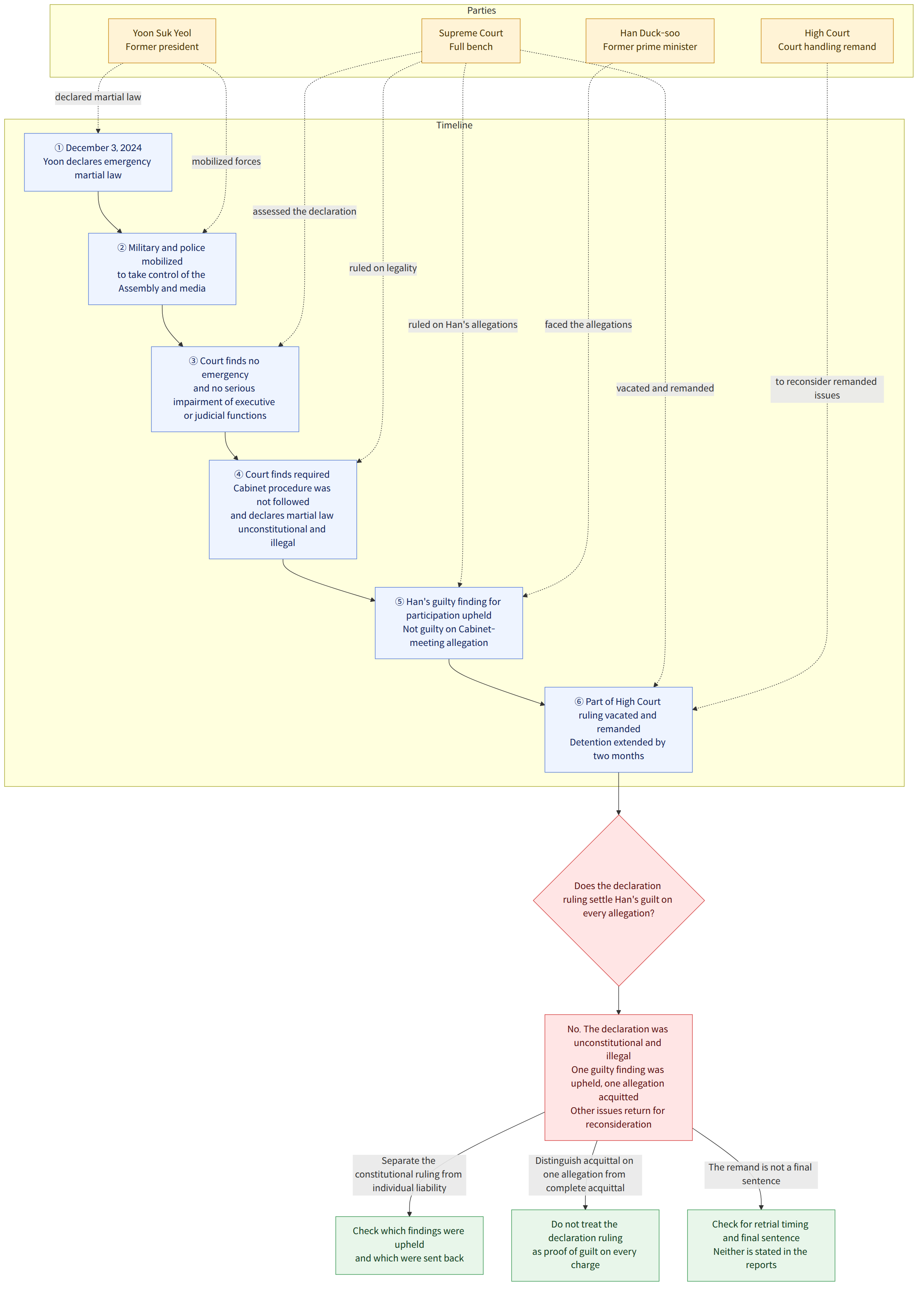
The Supreme Court (대법원) of South Korea issued its first ruling in the insurrection case, 716 days after former President Yoon Suk Yeol declared emergency martial law on December 3, 2024. The full bench ruled that the declaration of martial law was unconstitutional and illegal, while partially vacating and remanding the High Court ruling that sentenced former Prime Minister Han Duck-soo to 15 years in prison. It upheld the guilty finding on the allegation that Han participated in the insurrection after martial law was declared, but found him not guilty of the allegation that he tried to give the declaration procedural legitimacy by convening a Cabinet meeting.
Background and context
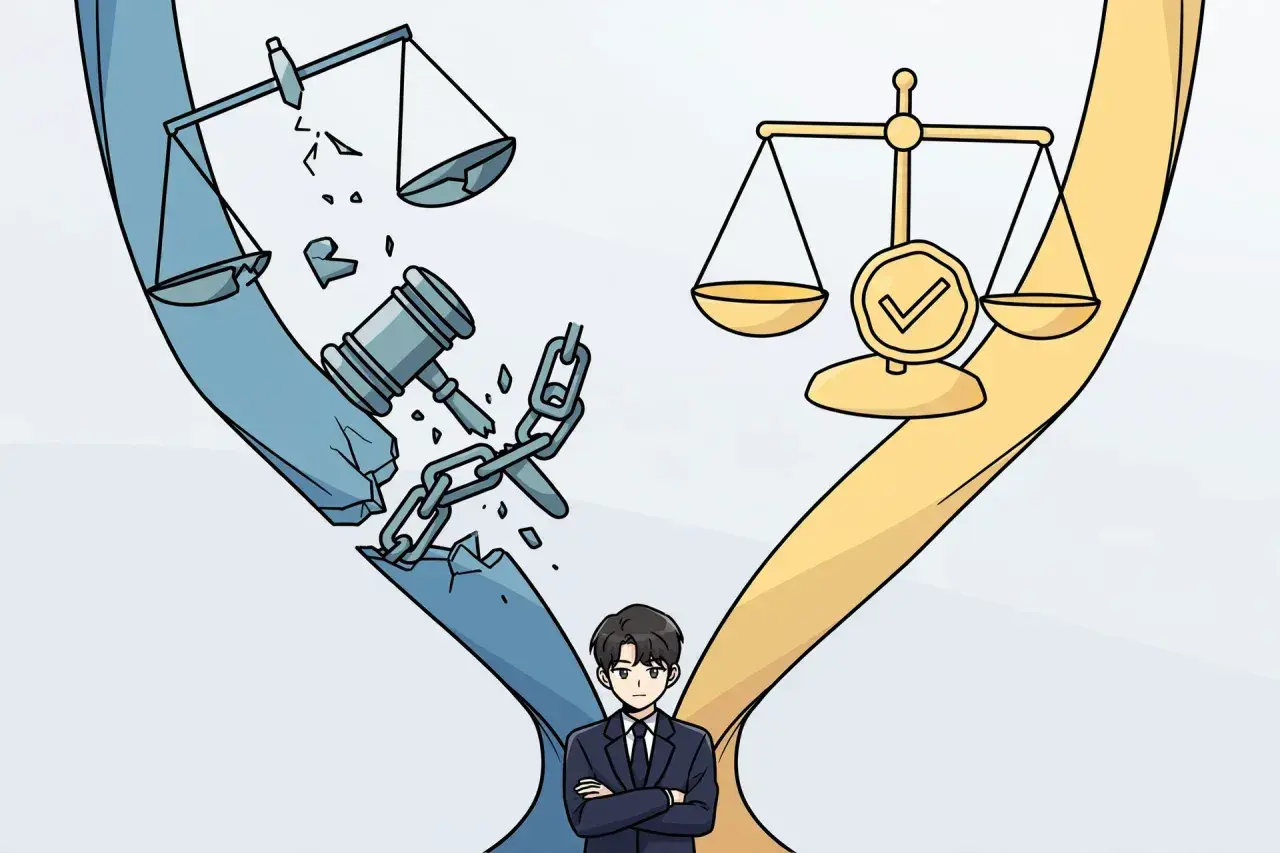
The Supreme Court’s ruling has two distinct strands. One concerns whether the declaration of emergency martial law itself violated the constitutional order and fundamental rights; the other concerns whether Han’s individual actions met the requirements for crimes related to insurrection. A ruling that the declaration of martial law was unconstitutional and illegal does not automatically make Han guilty of every charge against him.
The Supreme Court found that the country was not in a state of emergency at the time and that the functions of the executive and judiciary had not been seriously impaired. It also found that Yoon mobilized the military and police to take control of the National Assembly (국회) and the media, and declared martial law without following the Cabinet procedure required by the Constitution. The court emphasized that acts of insurrection cannot be tolerated under any circumstances within South Korea’s constitutional order.
The conclusions on the charges against Han differed. The Supreme Court upheld the guilty finding on the allegation that he participated in the insurrection after martial law was declared. But it found him not guilty of the allegation that he tried to give the declaration procedural legitimacy by convening a Cabinet meeting, saying it would be difficult to prove that he had the purpose of overthrowing the Constitution. The case therefore returned to the High Court, which had sentenced Han to 15 years in prison. The Supreme Court also extended his detention by two months, so he will remain in custody during the retrial on remand.
What this news means
The ruling shows that the Supreme Court’s assessment of the constitutionality and legality of the martial law declaration is a separate matter from determining what criminal liability can be imposed on a particular individual. The court clarified the constitutional character of the declaration while separately examining whether the purpose required to establish the crime of insurrection had been sufficiently proven for some of Han’s actions. The remand therefore does not amount to a finding that Han is entirely innocent or a final determination of guilt; it sends some findings back for further review.
The High Court must reconsider the issues sent back to it, but the reports available do not say when the retrial on remand will take place or what sentence will ultimately be imposed. The parts of Han’s conviction that were upheld must also be taken into account, so it would be inaccurate to sum up the ruling as either “complete acquittal” or “a final 15-year sentence.”
The political response has added to the conflict surrounding the court’s decision. Democratic Party leader Kim Min-seok said after an emergency party caucus that the party had decided to pursue Chief Justice Jo Hee-dae’s impeachment. The party later formed a committee to pursue impeachment, led by lawmaker Yang Bu-nam. Reports said the committee would review the grounds for impeachment, the introduction of a motion, and the schedule for consideration by the National Assembly. This means that efforts to pursue impeachment have begun; it does not mean that an impeachment motion has been introduced or that the process has been completed.
Kim argued that the partial acquittal ruling and remand in Han’s case could affect other related trials. By contrast, People’s Solidarity for Participatory Democracy issued a statement saying, in effect, that the Supreme Court had used precedent as a constraint and granted a pardon to senior public officials who had betrayed the Constitution and the people. These are the views of a party leader and a civic group, respectively, and should be distinguished from the contents of the Supreme Court’s ruling.
For example, in a case involving multiple acts, as in Han’s, a finding of not guilty on one act does not erase a guilty finding on another. As the Supreme Court did here—upholding the guilty finding on the allegation of participation after the martial law declaration while finding Han not guilty on the allegation concerning the convening of the Cabinet meeting—the court can assess each act and the requirements for each crime separately. That is the key point.
Related legal information and guidance
A guide based on consultation cases from the Korea Legal Aid Corporation (법률구조공단) explains that whether a crime has been committed is assessed in terms of whether the elements of the offense are met (whether the conduct falls within the conditions for a crime set by law), unlawfulness, and culpability. The Supreme Court’s view that it would be difficult to prove a purpose to overthrow the Constitution in connection with the allegation about convening the Cabinet meeting can be understood in relation to the general principle that the elements of a crime must be assessed separately for each act. This is a general explanation of the ruling; the specific legal reasoning and final determination in the case should be understood by reference to the court’s decision.
The guide cautions that conclusions can vary depending on the facts and evidence at the time of the conduct, and that general information alone cannot determine whether a person will be punished in a specific case. When reading the ruling, it is therefore important to distinguish the charges that resulted in acquittal from those for which the guilty finding was upheld, and to check what issues will be reconsidered on remand.
What is confirmed and what is not yet known
Confirmed facts
- The Supreme Court ruled that the declaration of emergency martial law was unconstitutional and illegal. It found that the country was not in a state of emergency at the time and that the functions of the executive and judiciary had not been seriously impaired.
- The guilty finding on the allegation that Han participated in the insurrection after martial law was declared was upheld.
- Han was found not guilty of the allegation that he tried to give the martial law declaration procedural legitimacy by convening a Cabinet meeting, and that part of the case was remanded.
- The Supreme Court extended Han’s detention by two months.
- The Democratic Party formed a committee to pursue the impeachment of Chief Justice Jo Hee-dae, with lawmaker Yang Bu-nam as its head.
What is not yet known
- It has not been confirmed when Han’s retrial on remand will take place or what the final ruling will be.
- Reports do not provide details of the Supreme Court’s ruling on each of the three major charges against former First Lady Kim Keon-hee. What is confirmed is that the lower court’s sentence of four years in prison and a fine of 50 million won was upheld.
- It is not yet known whether efforts to impeach Chief Justice Jo Hee-dae will lead to the introduction of an impeachment motion and consideration by the National Assembly, or when a schedule for those steps might be set.
What readers should check
- In follow-up coverage, check which issues are before the court in the retrial on remand and the schedule for proceedings. Do not treat the parts of the conviction that were upheld and the acquittal on some charges as one and the same.
- Regarding impeachment, distinguish between the formation of the committee, the introduction of an impeachment motion, and consideration by the National Assembly. At the time of the reports, the committee was still reviewing the grounds and schedule.
- When considering legal rulings in similar criminal cases, do not draw conclusions from general guides alone; check the applicable laws and the specific facts and evidence as well.
If you are dealing with a similar issue, attorney Ji-sun Ahn of Ijun Law Firm can review the procedural history, the specific facts or evidence in dispute, and the relevant court or agency notices with you. These details can help clarify which options apply to your situation.
References
- Requirements for Criminal Liability and Standards for Punishment under the Criminal Act
- Other coverage consulted: chosun.com
- Other coverage consulted: chosun.com