

1. A Human Story
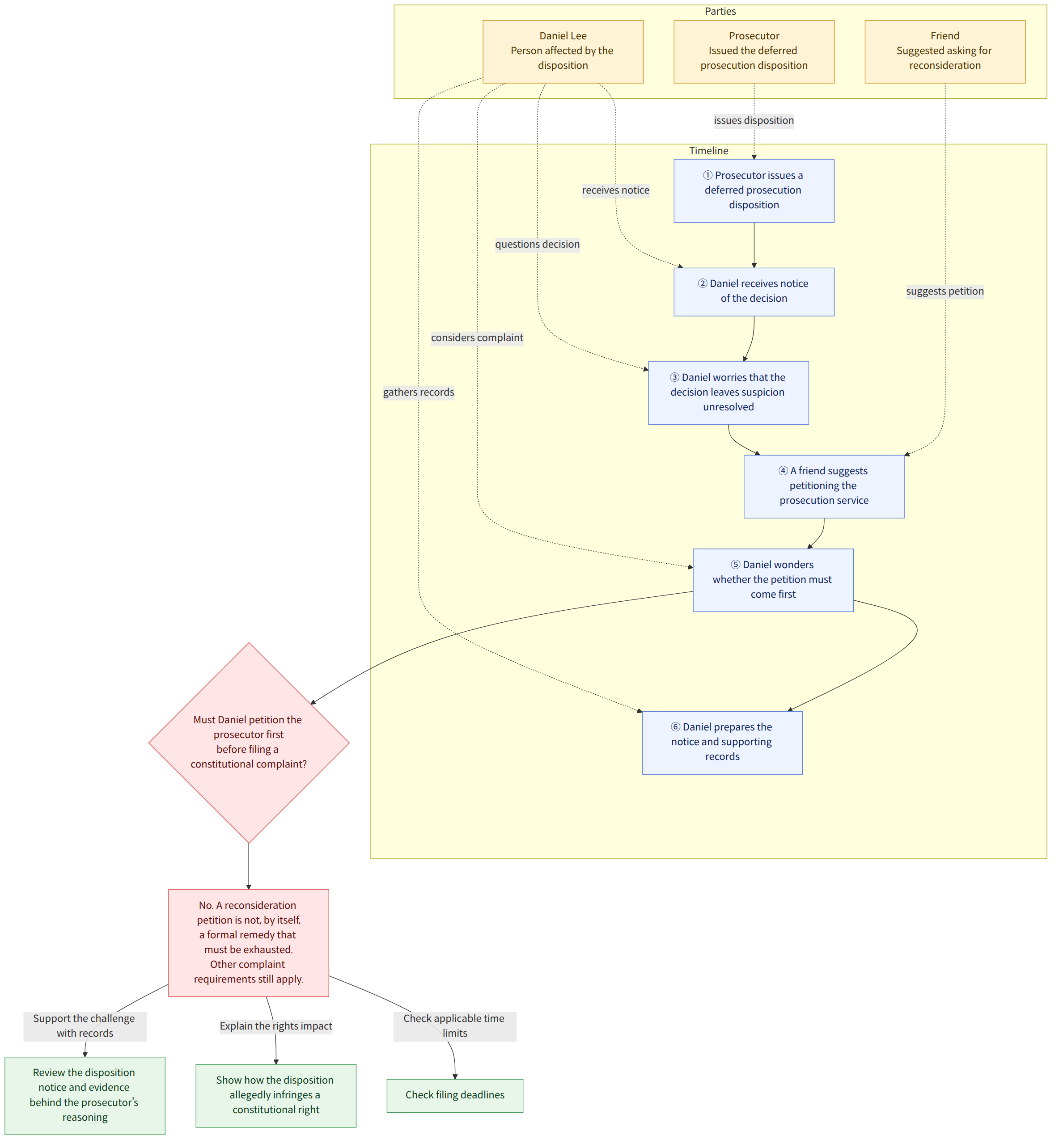
Daniel Lee had expected a difficult conversation when prosecutors called him in. He had not expected the letter that followed: the prosecutor would not take his case to trial, but had issued a deferred prosecution disposition. Daniel felt relief, followed by a more troubling thought. The decision, he believed, left an official suspicion hanging over him and did not reflect what had actually happened.
A friend told him to first send a petition to the prosecution service, asking it to reconsider. Daniel worried that filing a constitutional complaint without doing so might be rejected because he had failed to exhaust the available remedies. He needed to know whether that extra step was legally required—or whether waiting could cost him time.
2. The Legal Question
Must someone who receives a deferred-prosecution disposition first file a petition asking the prosecutor to reconsider before bringing a constitutional complaint in Korea?
3. What Korean Law Says
Korea’s Constitutional Court Act generally requires a person to use other legally established remedies before asking the Constitutional Court to review an exercise of public power. This is known as the supplementarity principle: constitutional review is not ordinarily a substitute for an available appeal or other formal legal process.
A constitutional complaint may generally be brought when an exercise or failure to exercise public power infringes a person’s basic rights, unless another remedy provided by law must first be used.
The key is what counts as a remedy “provided by law.” A jinjeong—often translated as a petition, complaint, or request for an authority to act—does not, by itself, give the petitioner a legally guaranteed appeal. It asks the authority to consider exercising its own powers.
A petition that merely urges an authority to exercise its discretion is not, for that reason alone, a formal legal remedy that must be exhausted before a constitutional complaint.
In the context of a deferred-prosecution disposition, the relevant points are:
- The person affected may seek constitutional review of the disposition.
- A petition asking prosecutors to reconsider is not a prerequisite merely because it might prompt them to act.
- The person must still satisfy the requirements for a constitutional complaint, including applicable time limits and the need to explain how the disposition affects a constitutional right.
- The evidence and reasoning behind the disposition matter. A right to file does not mean the complaint will necessarily succeed.
4. How Korean Courts Approach This
Korean constitutional review distinguishes between a formal remedy that the law requires a person to pursue and a request that simply invites an official to use discretionary powers. The first may have to be exhausted before a constitutional complaint; the second is not automatically a required step.
The Constitutional Court has applied that distinction to deferred-prosecution decisions. Its general approach is that a jinjeong does not itself constitute a remedy established by law: it is a request intended to prompt the prosecutor’s own action. A person challenging a deferred-prosecution disposition can therefore proceed directly to a constitutional complaint without first filing such a petition.
That procedural conclusion is limited. It answers whether the petition must come first; it does not decide whether the prosecutor’s assessment was wrong, whether the person’s rights were actually infringed, or whether the complaint meets all other filing requirements.
5. Applying the Law to Daniel’s Case
Step 1: Identify what Daniel is challenging
Daniel is not simply asking prosecutors to reconsider as a matter of discretion. He wants to challenge the deferred-prosecution disposition itself, which is an official decision affecting him. That makes a constitutional complaint a route he may consider, subject to the applicable legal requirements.
Step 2: Separate a petition from a formal remedy
The suggested jinjeong would ask prosecutors to exercise their authority and revisit the matter. It would not, merely by being filed, become a legally guaranteed appeal that Daniel must complete before seeking constitutional review. Under the supplementarity principle, the absence of that petition does not by itself bar his complaint.
Step 3: Focus on the substance and supporting record
Daniel should gather the disposition notice and the documents that bear on the prosecutor’s reasoning. He would need to explain why the decision allegedly infringed his rights, rather than relying only on the fact that he disagrees with it. The Constitutional Court’s willingness to hear a direct complaint does not establish that the complaint is justified on its merits.
Step 4: Choose the proper route and preserve the filing record
Daniel can proceed without first sending the discretionary petition, but he should promptly check the filing requirements and applicable deadline for his circumstances. The date he learned of the disposition, the notice itself, and the records supporting his account may all be important to preparing a properly documented complaint.
A reader in Daniel’s position could ask [[lawyer]] to review the prosecutor’s disposition notice, the date it was received, and the documents supporting the proposed constitutional complaint, so the procedural route and relevant facts can be assessed together.
A reader in Daniel’s position could ask attorney Ji-sun Ahn of Ijun Law Firm to review the prosecutor’s disposition notice, the date it was received, and the documents supporting the proposed constitutional complaint, so the procedural route and relevant facts can be assessed together.
6. Conclusion: What Happened, and What Should You Do?
Daniel learned that he did not have to file a jinjeong before seeking constitutional review of his deferred-prosecution disposition. He decided not to treat the suggested petition as a mandatory preliminary appeal. Instead, he organized the notice and supporting records and checked the filing requirements for a direct constitutional complaint. Whether the complaint would succeed remained a separate question for the Constitutional Court.
If you face a similar situation:
- Do not assume that every request for reconsideration is a legally required remedy. A petition asking an official to exercise discretion may be different from a formal appeal.
- Keep the disposition notice and note when you received or learned of it. Deadlines for constitutional complaints can be strict, so verify the deadline that applies to your case promptly.
- Build the complaint around the record. Collect the documents relevant to the prosecutor’s decision and explain the specific rights you believe were affected.
















