A Man Locked Away, and Then Locked Further In
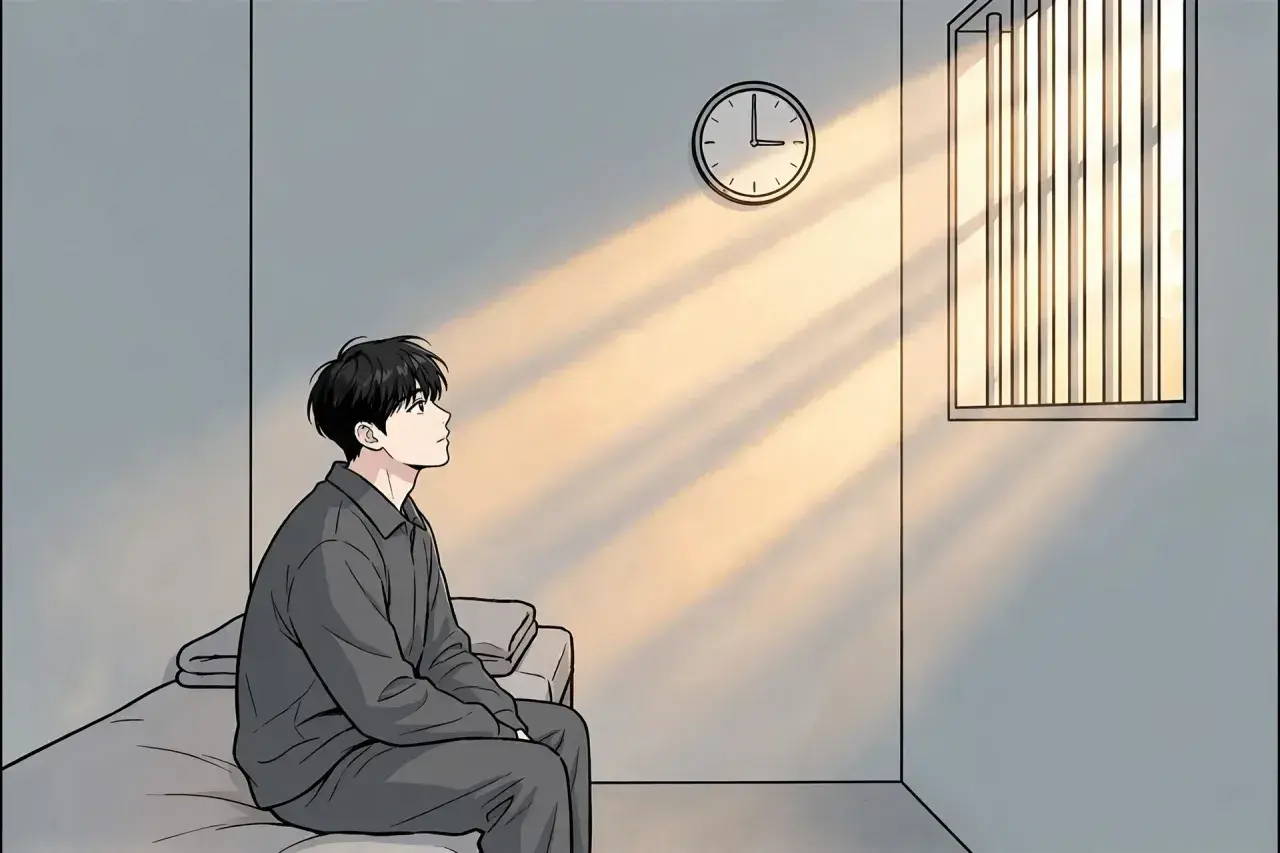
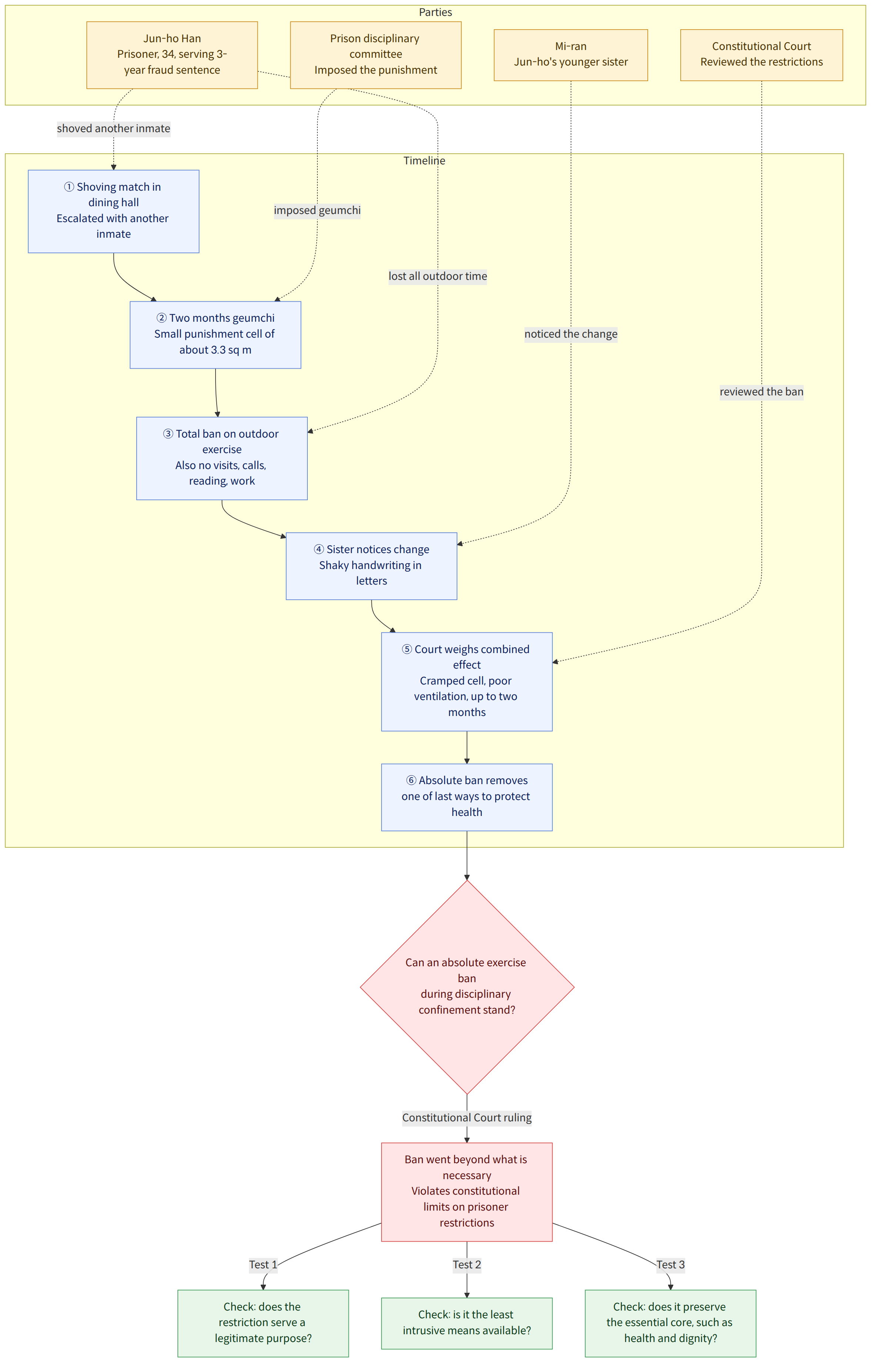
Jun-ho Han, 34, had been serving a three-year sentence for fraud at a regional correctional facility in Korea when a dispute in the dining hall escalated into a shoving match with another inmate. The prison's disciplinary committee found him responsible and imposed a disciplinary confinement order, known in Korean as geumchi, of two months in a small punishment cell.
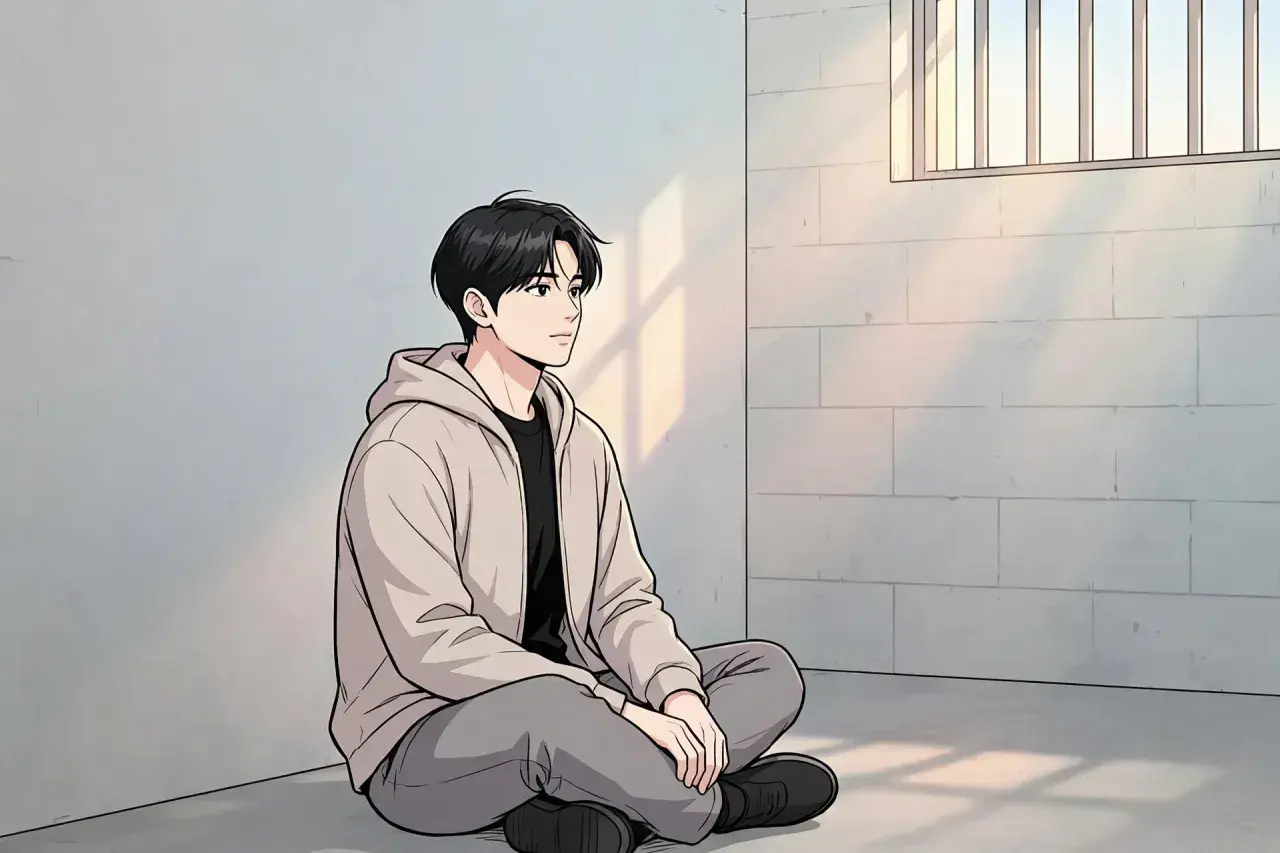
The cell was a little over one pyeong, roughly 3.3 square meters, with little ventilation. Under the rules applied to him, Jun-ho lost not only visits and letters but also his telephone access, the right to write, to read newspapers and books, to listen to the radio, to watch television, and to work. The most painful restriction, in his own words, was the total ban on going outside. For sixty days he did not see the sky.
His younger sister, Mi-ran, noticed the change within weeks. Her letters, which she was still allowed to send, came back with his handwriting turning shaky and his sentences trailing off. She wondered whether the punishment was meant to correct his behavior or simply to erase him from daily life. Jun-ho's question was more concrete: could a prison legally cut off every form of exercise for someone already confined, or did even a prisoner keep a floor of basic rights that the state could not go beneath?
The Legal Question
The central question is this: when a prisoner is serving disciplinary confinement, can the prison completely prohibit outdoor exercise for the entire period, and does that ban violate the prisoner's constitutional rights?
The answer depends on how Korean law balances two things that often pull in opposite directions: the state's duty to keep order inside prisons, and the basic rights that survive imprisonment.
What Korean Law Says
Korea's Constitution protects human dignity and value, as well as bodily integrity and freedom from unlawful physical harm. These protections do not disappear when a person is sentenced to prison. Imprisonment itself limits liberty, but the state may not add punishments that go beyond what is necessary.
Under the earlier Enforcement Decree of the former Prison Act, a prisoner placed in disciplinary confinement lost a long list of activities during the punishment period. Exercise was among them.
Prisoners who receive disciplinary confinement shall be held in a punishment cell, and during that period visits, correspondence, telephone calls, writing, work, exercise, reading newspapers and books, listening to the radio, watching television, and using self-funded items shall be prohibited.
While this provision looks absolute on its face, the Constitutional Court has repeatedly stressed that restrictions on prisoners are subject to constitutional limits. Three principles guide the analysis:
Restrictions on fundamental rights, even inside a prison, must not damage the essential content of the right, and must satisfy the principle of proportionality. Discipline imposed on prisoners is an additional burden on top of confinement itself, so it may be justified only where no less harmful means can achieve the purpose of maintaining order and safety.
The law recognizes three key requirements:
- The restriction must serve a legitimate purpose, such as maintaining security and discipline in the facility.
- The restriction must be the least intrusive means available to achieve that purpose.
- The restriction must not destroy the essential core of the right, such as the minimum needed to protect health and dignity.
The law has since changed. The former Prison Act was replaced by the Act on the Execution of Criminal Sentences and the Treatment of Inmates, and its Enforcement Decree now contains a more flexible rule:
Even when disciplinary confinement is being carried out, outdoor exercise may be permitted if it is judged especially necessary to maintain the basic health of the inmate.
How Korean Courts Approach This
The Constitutional Court has treated outdoor exercise as a basic requirement for prisoners rather than a privilege. In its reasoning, exercise is the minimum needed for physical and psychological health in a setting where movement, sunlight, and fresh air are already sharply limited.
The Court's analysis focused on the combined effect of disciplinary confinement. A prisoner in punishment was cut off from visits, letters, calls, reading, radio, television, and work, and was kept in a cramped cell with poor ventilation for up to two months. Under those conditions, banning all exercise was not a marginal limit. It removed one of the last remaining ways to protect health.
The Court concluded that an absolute ban on exercise during disciplinary confinement went beyond what was necessary, even if the purpose of punishment was legitimate. It amounted to an infringement of human dignity and of the freedom of bodily integrity. The decision did not say that prisoners must receive exercise in every case. It held that a blanket prohibition, applied automatically to everyone, was unconstitutional.
The practical lesson for courts and prisons is that discretion matters. A rule that forbids exercise in every case, without considering the prisoner's health, is harder to defend than one that allows the facility to assess necessity.
Applying the Law to Jun-ho's Case
To test Jun-ho's situation, it helps to break the analysis into steps.
Step one: Does exercise count as a protected interest? Yes. Outdoor exercise is closely tied to physical health and mental stability. Jun-ho was not asking for a luxury. He was asking for the minimum time outside a cell that would protect his body and mind.
Step two: Is the restriction serious? It is. Two months in a punishment cell, combined with the loss of nearly all contact with the outside world and no access to fresh air, is a heavy burden. The law already accepts that disciplinary confinement is a punishment. The question is whether the prison may add a total ban on exercise to that punishment.
Step three: Is a total ban necessary? This is where the case turns. The prison's purpose, maintaining order and discipline, can usually be served by limiting privileges such as work, visits, or self-funded items. It does not require cutting off all outdoor movement for every prisoner in punishment. Where the facility has a less harmful option, the absolute ban fails the necessity test.
Step four: Does the ban destroy the core of the right? Under the Court's reasoning, it can. A person kept in a small, poorly ventilated cell for weeks, with no exercise, faces real risks to physical and mental health. A ban that leaves no room for health-based exceptions crosses the line.
Step five: What does current law require? The updated Enforcement Decree allows outdoor exercise during disciplinary confinement when it is necessary for basic health. That means Jun-ho's entitlement does not depend on a generous warden. The facility must consider whether exercise is needed to protect his health, and a rigid refusal without that assessment is hard to justify.
Applying these steps, the outcome for Jun-ho is clear. A total prohibition on exercise, applied automatically during his disciplinary confinement, would be found to violate his constitutional rights to human dignity and bodily integrity. The prison could still limit many privileges and enforce the punishment, but it could not remove all outdoor time without considering his health.
If you are reviewing a disciplinary confinement notice or a written order that bans exercise, you could ask attorney Ji-sun Ahn of Ijun Law Firm to check the exact wording of the decision, the period it covers, and whether any health-based exception was considered or documented. Medical records and any written requests for outdoor exercise are also worth sharing, since they show what the facility knew at the time.
Conclusion: What Happened, and What Should You Do?
Jun-ho's ban on exercise was not a minor detail of his punishment. It was a constitutional problem. Korea's courts have held that a complete ban on outdoor exercise during disciplinary confinement goes beyond what is necessary and can damage a prisoner's physical and mental health. The current rules make health-based exercise a permitted option, so a prisoner in Jun-ho's position should not be treated as having no rights to fresh air at all.
For readers who face a similar situation, whether as prisoners, family members, or advocates, three practical points matter:
- Ask for the written basis of any restriction. Disciplinary decisions and the specific limits applied to each prisoner should be recorded. Knowing exactly which rights were removed, and for how long, is the first step in any challenge.
- Document health effects. Medical notes, complaints about sleep, breathing, or mood, and any change in physical condition during confinement can show why exercise is necessary to protect health.
- Raise the health-based exception directly. Requests for outdoor exercise should cite the current Enforcement Decree and explain the health reasons. A written request creates a record that the facility must address.