
1. A Human Story
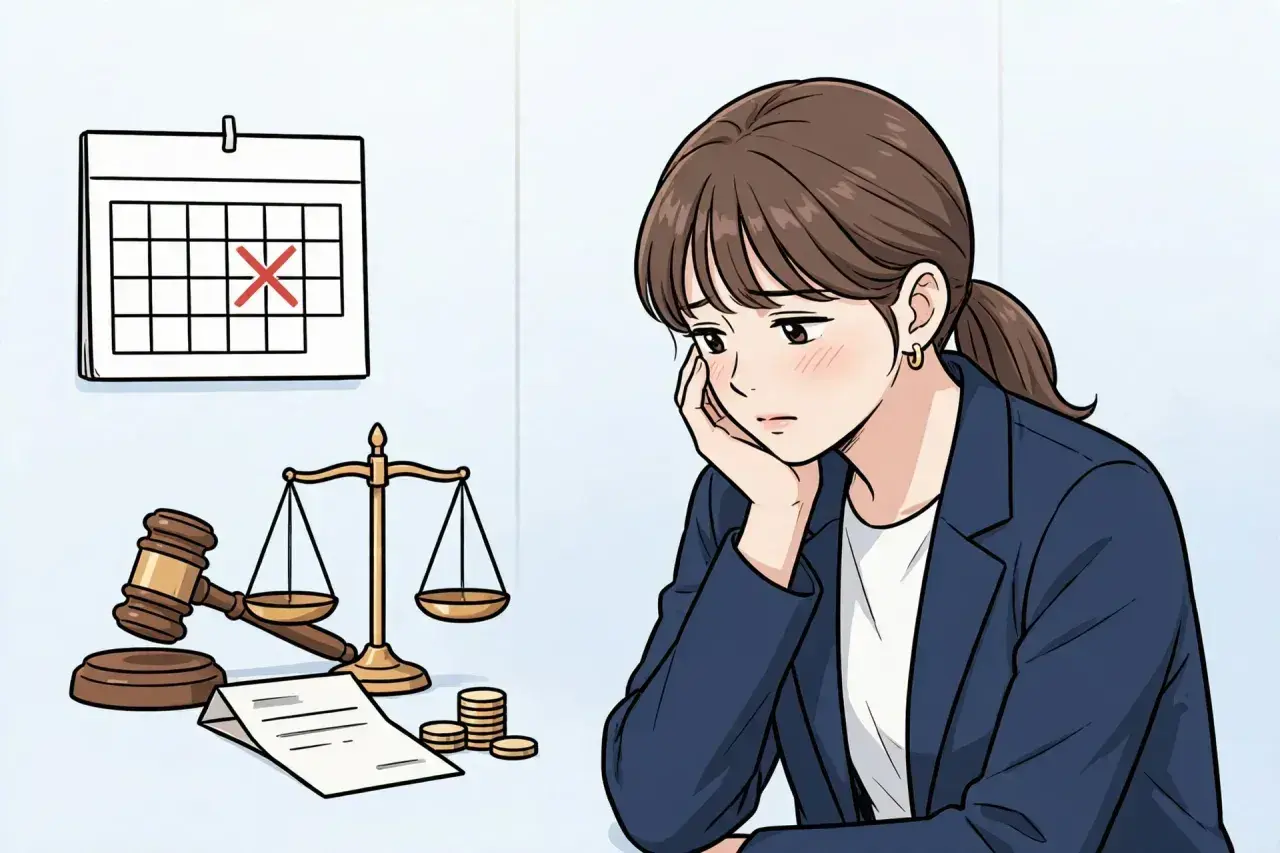
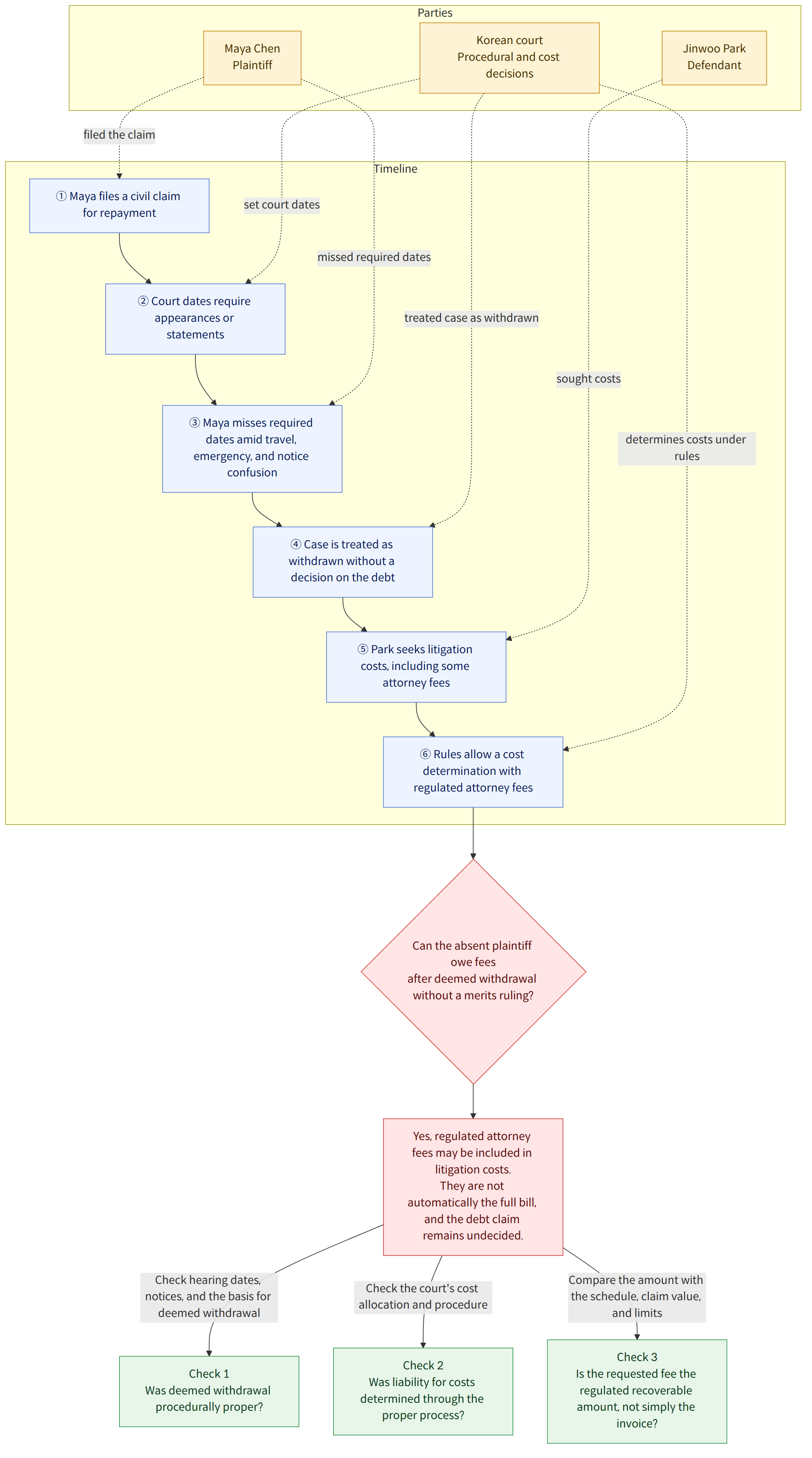
Maya Chen filed a civil lawsuit in Korea against a former business partner, Jinwoo Park, seeking repayment of money she said he owed her. She believed the claim was straightforward. But work travel, a family emergency, and confusion over a court notice kept her from attending the required court dates. After the procedural conditions for deemed withdrawal were met, the case ended without a judge deciding who was right about the debt.
Maya expected the matter to be over. Then Park sought reimbursement for litigation costs, including some of the fees he had paid his lawyer. To Maya, the demand seemed upside down: there had been no trial, no ruling on the debt, and—she thought—no meaningful legal work to charge for. Yet the case’s procedural ending did not necessarily erase the costs incurred along the way.
2. The Legal Question
When a civil lawsuit in Korea is treated as withdrawn because of a party’s failure to appear, can the plaintiff still be ordered to reimburse the other side for attorney fees—even though the court never decided the underlying dispute?
3. What Korean Law Says
Korean civil procedure recognizes that a case may end without a judgment on its merits. If the statutory conditions for deemed withdrawal are satisfied after the parties fail to appear or make the required statements on successive court dates, the case is treated as withdrawn. That is a procedural ending, not a finding that the plaintiff’s claim was false or that the defendant was right about the underlying facts.
But ending without a merits judgment does not automatically mean that no litigation costs are due. The Civil Procedure Act provides a way for the court to determine costs when a lawsuit ends without a judgment. Under the Act and the rules governing attorney fees as litigation costs, a recoverable amount may include a prescribed portion of the opposing party’s attorney fees.
A case ending without a judgment can still lead to a court decision about who must bear the litigation costs. The absence of a trial does not, by itself, rule out reimbursement of attorney fees.
The amount is not necessarily the amount the opposing party actually paid its lawyer. The relevant rules use a schedule tied in part to the value of the claim, subject to applicable limits. In practical terms:
- The court must address the allocation and amount of costs through the proper procedure; liability is not simply established by the opponent sending an invoice.
- Attorney fees may be included in recoverable litigation costs, but the recoverable figure is calculated under the governing schedule.
- Whether the case was deemed withdrawn, and why, can matter to the cost determination and to any procedural challenge.
The constitutional issue has also been considered. The Constitutional Court has reasoned that allowing regulated attorney fees to be included serves legitimate aims: helping parties obtain effective relief for valid claims, discouraging unjustified lawsuits and defenses, and supporting the fair operation of the courts. It has concluded that this framework does not violate the constitutional right to seek a trial, including when a case ends by deemed withdrawal.
The constitutional balance is not that every losing or absent party must pay the opponent’s entire legal bill. Rather, the law permits reimbursement within regulated limits to balance access to justice against the costs imposed on others and the court system.
4. How Korean Courts Approach This
Korean courts distinguish between deciding the substance of a dispute and deciding the costs produced by the proceedings. A case may end before the judge reaches the merits, yet the parties may still have incurred expenses and the court may still need to allocate them.
The courts’ general approach is to treat attorney-fee reimbursement as a limited, rules-based component of litigation costs—not as an automatic award of every won spent on counsel. The statutory schedule places boundaries on the amount that can ordinarily be shifted to another party. This helps prevent an unexpectedly large private legal bill from becoming an unrestricted penalty.
Courts also consider the procedural basis for ending the case. A costs determination is a separate question from whether Maya was entitled to repayment from Park. Deemed withdrawal does not decide that underlying claim. It does, however, leave open the possibility that the plaintiff who allowed the case to end in that manner will be ordered to bear costs.
5. Applying the Law to the Case
Maya’s situation involves two separate questions.
- Was the case properly treated as withdrawn? The court record should show which hearing dates were set, whether the required notices were served, who attended, and whether the legal conditions for deemed withdrawal were met. Maya’s missed dates alone do not answer every procedural question; the statutory sequence and the court’s records matter.
- Can Park recover attorney fees even without a trial? Yes, in principle. The case’s end without a merits decision does not create a categorical exemption from litigation costs. Park may seek a costs determination that includes a regulated amount for attorney fees.
- Does Park automatically recover everything he paid his lawyer? No. The recoverable amount is generally governed by the applicable fee schedule, not simply by the lawyer’s invoice. The court’s costs process determines what is properly included and who must bear it.
- Does a costs order mean Maya’s claim was legally baseless? No. Deemed withdrawal is not a ruling on whether Park owed the money. It reflects the procedural consequence of the case ending in the prescribed way, not a judgment on the debt itself.
On the facts as described, if the court correctly found that the statutory conditions for deemed withdrawal had been met, Maya could be ordered to reimburse Park for allowable litigation costs, including a scheduled portion of his attorney fees. The absence of a full trial would not, on its own, defeat that request. But the amount would be controlled by the rules, and Maya could examine whether the withdrawal and cost determination were procedurally correct.
If you are dealing with a similar issue, attorney Ji-sun Ahn of Ijun Law Firm can review the court notice, any ruling on costs, and documents about legal fees or eligibility for litigation aid with you. These details can help clarify which options apply to your situation.
6. Conclusion: What Happened, and What Should You Do?
Maya learned that “no trial” does not necessarily mean “no legal costs.” If her case was properly deemed withdrawn, the court could require her to bear allowable litigation expenses, including a regulated contribution toward Park’s attorney fees. That would not settle whether Park owed her the money; it would settle a separate question about the costs of the proceedings that had ended.
For anyone in a similar position:
- Check the court file promptly. Confirm the hearing dates, notices, attendance record, and the basis on which the case was treated as withdrawn.
- Do not assume the opponent’s invoice is the amount you owe. Review any formal costs determination against the applicable attorney-fee schedule and seek legal advice if the calculation appears wrong.
- Act before deadlines expire. If a serious circumstance explains the absence, or you believe the procedural requirements were not met, ask a Korean lawyer immediately about the proper procedure for challenging the withdrawal or costs order.

















