

1. A Human Story
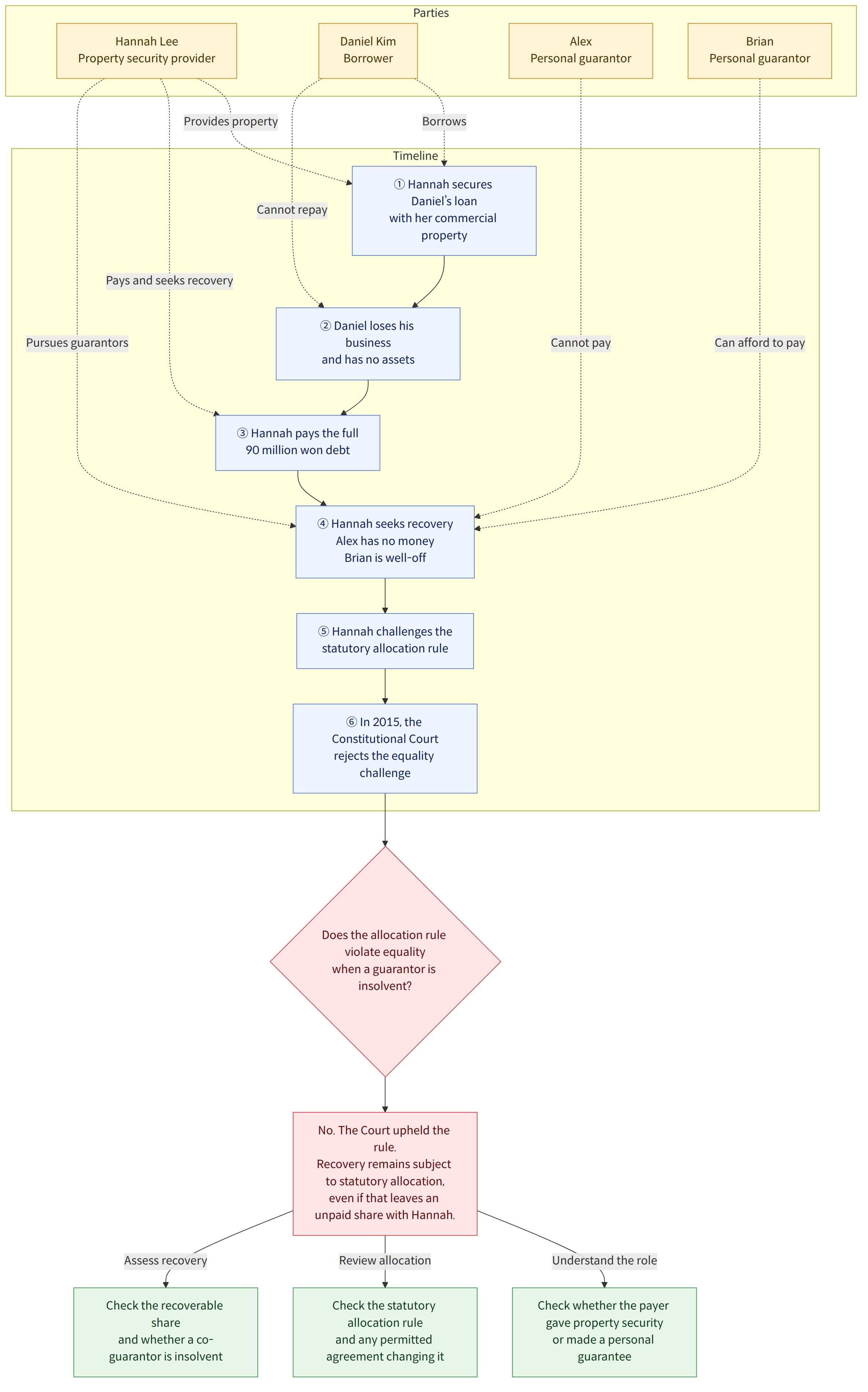
When Hannah Lee agreed to let a bank take a mortgage over her small commercial property, she thought she was helping a close friend through a temporary cash crisis. The borrower, Daniel Kim, needed a 90 million won loan. Hannah was not signing a personal promise to repay it; she was putting her property up as security. Daniel’s two personal guarantors, Alex and Brian, seemed to make the arrangement safer still.
The crisis did not pass. Daniel lost his business and had no assets left. To prevent the bank from selling her property, Hannah paid the entire 90 million won herself. She then turned to the guarantors. Alex had no money. Brian, by contrast, was well-off. Hannah expected to recover most—or perhaps all—of what she had paid from him. Her lawyer warned that Korean law might limit her claim to a statutory share, even though one guarantor was insolvent and the other could afford to pay.
2. The Legal Question
The central question is whether Korea’s statutory rule for allocating subrogation rights among guarantors and people who provide property as security violates the constitutional guarantee of equality when it leaves a paying property provider bearing part of an insolvent guarantor’s share.
Put more simply: can the law limit Hannah’s recovery from Brian because it allocates responsibility by a general formula rather than by each person’s ability to pay?
3. What Korean Law Says
Korean law distinguishes between a personal guarantor and a person who provides property as security for another’s debt. A personal guarantor may be pursued personally, subject to the guarantee’s terms. A property provider—often called a third-party security provider—puts particular property at risk but does not, merely by doing so, become personally liable for the entire loan.
If the property provider pays the debt, the law generally allows that person to step into the creditor’s position against the borrower and, in defined circumstances, other people who secured the same debt. This is known as subrogation. But the right is not necessarily unlimited: the Civil Act sets rules for how recovery rights are divided among those who provided security.
The key statutory idea: The Civil Act uses prescribed allocation rules to determine the extent to which one person who has paid may exercise the creditor’s rights against other guarantors or security providers. The relevant rule uses the number of persons in one part of the allocation and the value of property provided as security in another.
Those rules reflect a choice between different ways of dividing a shared burden:
- By number of persons: A headcount-based method can be used for the relevant relationship among guarantors and property providers.
- By value of property: Where the law addresses multiple properties provided as security, the value of the secured property can determine the relative shares.
- By agreement: The parties may make a special agreement that excludes or changes the statutory allocation rule, so far as the law permits.
The practical effect matters. A property provider who pays the creditor may have a claim against co-guarantors, but the amount recoverable from a particular guarantor can be limited by the statutory allocation. If one guarantor is insolvent, the paying property provider may not be able to shift that person’s unpaid share entirely onto a wealthier co-guarantor.
Important distinction: The rule does not convert the property provider into a personal guarantor of the whole debt. It governs the division of recovery rights after payment; it does not erase the difference between pledging particular property and making a personal guarantee.
4. How Korean Courts Approach This
In a 2015 decision, the Constitutional Court rejected the challenge to the Civil Act’s allocation rule. It concluded that the rule did not violate the constitutional principle of equality. The Court accepted that a headcount-based approach can sometimes produce a harsh result in an individual case, especially where one guarantor is insolvent, but it did not regard that consequence as enough to make the general rule unconstitutional.
The Court’s reasoning rested on the difficulty of using each person’s solvency as the standard for dividing responsibility. Solvency can change over time, and it may be unclear when or how it should be measured. A general allocation rule also helps prevent subrogation claims from circling endlessly among the people involved and gives them a workable basis for settling their respective shares.
The Court’s general principle: A statutory rule is not unequal merely because its application can disadvantage one person in a particular case. The question is whether the legislature chose a reasonable and coherent standard for the class of cases as a whole.
The Court also rejected related arguments that the rule improperly imposed a personal “debt” on someone who had undertaken only to provide property, or that the statute’s use of both headcount and property value created an impossible contradiction. The statutory provisions could be read as allocation rules for different aspects of the relationship, rather than as mutually incompatible commands.
5. Applying the Law to the Case
Hannah’s situation is sympathetic, but the legal analysis turns on the structure of the security arrangement—not simply on who has money now.
- Hannah paid the creditor’s claim. By paying the full 90 million won to prevent enforcement against her property, she acquired potential subrogation rights. She can pursue the borrower and, within the statutory framework, seek recovery from others who secured the debt.
- Daniel’s lack of assets makes recovery from him doubtful, not the allocation rule invalid. His insolvency explains why Hannah has turned to the guarantors. It does not automatically alter the statutory shares among the people involved.
- Alex’s insolvency does not necessarily enlarge Brian’s share. If the applicable statutory allocation gives each relevant participant a prescribed portion, Hannah may be unable to recover Alex’s unpaid portion from Brian simply because Brian is wealthy. The law does not generally make solvency the default measure of each person’s share.
- The exact amount depends on the arrangement and the statutory calculation. It would be unsafe to assume that Hannah can recover the whole 90 million won from Brian—or to state a fixed fraction without examining the guarantee documents, the security arrangement, the number and roles of the participants, and the relevant property values. The important point is that the law may cap her claim against Brian at the share allocated to him.
- A constitutional challenge is unlikely to change that result. The Constitutional Court has already held that the allocation approach is a reasonable legislative choice. Hannah’s argument—that a wealthy guarantor should bear an insolvent guarantor’s shortfall—resembles the fairness objection the Court considered and rejected as a basis for finding the rule unconstitutional.
- A different written agreement could matter. If Hannah, Daniel, Alex, and Brian had expressly agreed on a different allocation or on how an insolvent guarantor’s share would be handled, that agreement could affect the outcome. Without such a special agreement, the statutory rule is likely to govern.
If you are dealing with a similar issue, attorney Ji-sun Ahn of Ijun Law Firm can review the auction or enforcement file, the order of registered claims, and the notices and deadlines in your case with you. These details can help clarify which options apply to your situation.
6. Conclusion: What Happened, and What Should You Do?
Hannah’s constitutional challenge would probably fail. She paid the debt and has a basis to seek recovery, but Korean law may restrict how much she can claim from Brian. The fact that Alex is insolvent and Brian is wealthy does not, by itself, make the statutory allocation unconstitutional or require Brian to absorb Alex’s share. Hannah’s actual recovery would depend on the documents and the statutory calculation; she should not assume either that Brian owes nothing or that he must repay the entire 90 million won.
For anyone considering a similar arrangement:
- Put the allocation in writing. Before pledging property or guaranteeing a loan, agree expressly on how each participant’s share will be calculated and what happens if someone cannot pay.
- Check the full group of security providers. Identify every guarantor and property provider, review the relevant documents, and consider both their obligations and their ability to pay.
- Get advice before signing—and promptly after paying. A lawyer can assess the statutory shares, available claims, and procedural steps based on the actual contracts and property records.

















