
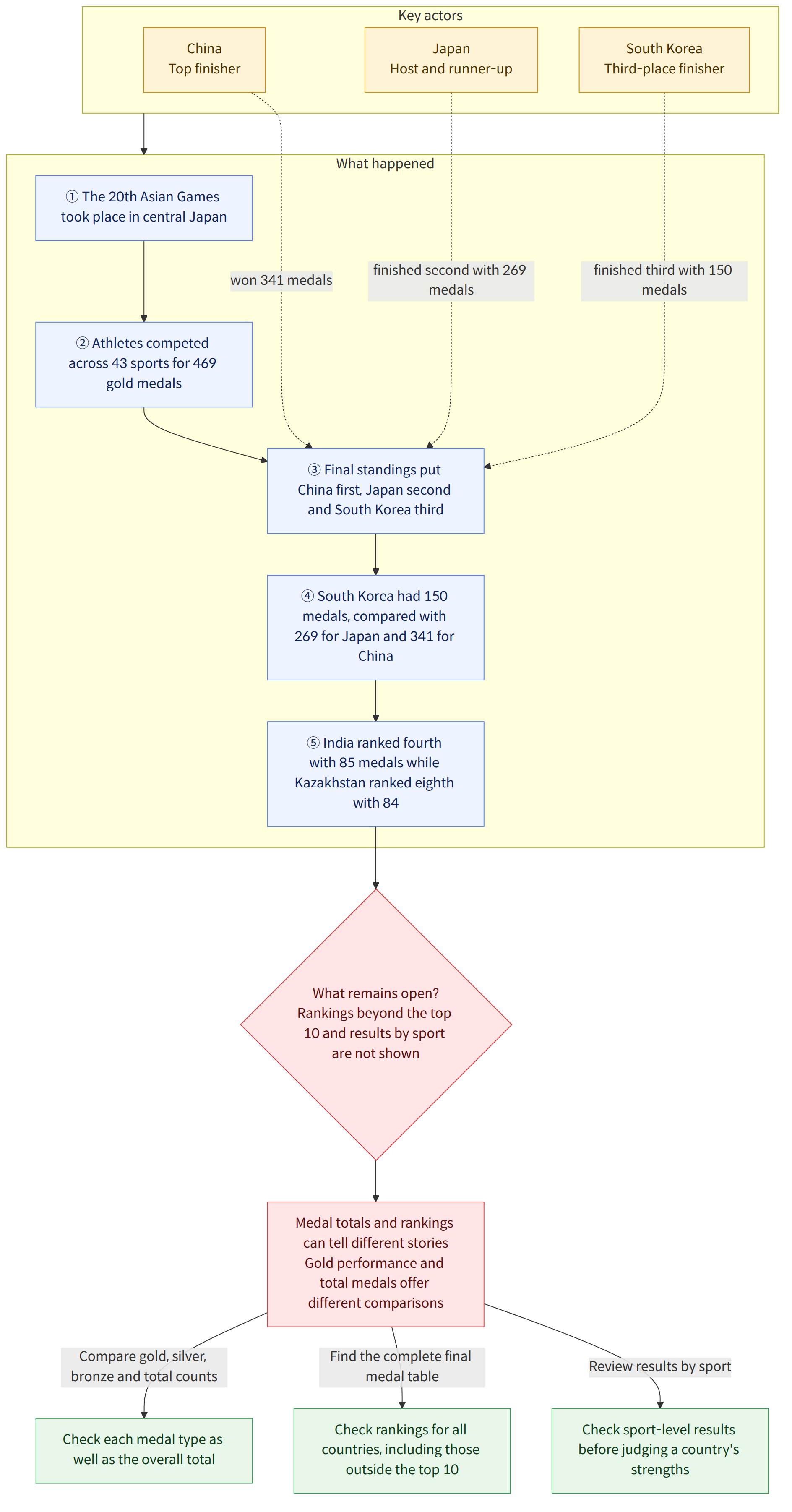
South Korea placed third in the final medal standings at the Aichi-Nagoya Asian Games, winning 150 medals in total: 39 gold, 43 silver and 68 bronze. China took first with 341 medals, including 169 golds, while host Japan finished second with 269 medals, including 83 golds. Reports on the final standings came from Nagoya, Japan, on October 4.
Background and context
This was the 20th Asian Games and the third time Japan had hosted the event. According to reports recapping the Games, about 10,000 athletes and officials from 45 countries took part over 16 days in central Japan, competing for 469 gold medals across 43 sports and 71 disciplines.
The Games also faced criticism over a shortage of accommodation for athletes and transportation disruptions. Reports said the organizers focused on keeping costs down by using existing or renovated venues, mainly in Aichi Prefecture and Nagoya. The medal table therefore serves both as a way to compare countries’ competition results and as a snapshot of the overall performance of an event held across multiple regions and venues.
What this news means
South Korea’s third-place finish shows that it won more gold medals than any country in the top 10 other than China and Japan. But in total medal count, South Korea had 119 fewer medals than Japan and 191 fewer than China. The results can look different depending on whether readers consider rankings alone or also take into account the overall totals of gold, silver and bronze medals.
There are also cases in which total medal counts and rankings do not match. India ranked fourth with 85 medals in total, while Kazakhstan won 84 but ranked eighth. The table alone cannot explain every criterion used to determine the rankings, but it does show that countries’ performances should not be compared based only on their total medal counts.
For example, readers who want to compare the overall scale of countries’ medal hauls can look at the total counts, while those interested primarily in gold-medal performance can look at golds separately. Depending on which measure they choose, South Korea’s third-place ranking and its medal gaps with China and Japan can each take on a different meaning.
What is confirmed and what remains unknown
Confirmed facts
- China took first with 341 medals in total: 169 gold, 89 silver and 83 bronze.
- Japan took second with 269 medals in total: 83 gold, 95 silver and 91 bronze.
- South Korea took third with 150 medals in total: 39 gold, 43 silver and 68 bronze.
- India, Uzbekistan, Iran, Thailand, Kazakhstan, Hong Kong and Bahrain placed fourth through 10th, in that order.
What remains unknown
- The final rankings and medal counts of countries outside the top 10 are not included in the standings presented here.
- The results broken down by sport for each country cannot be confirmed from this information alone.
What readers should check
- When comparing countries’ results, distinguish between the numbers of gold, silver and bronze medals and the total count.
- To check rankings beyond the top 10, readers need the complete final medal table, including all countries.
- If you want to know a country’s strengths or changes in its performance, do not draw conclusions based only on its overall total; check the results by sport as well.
References
- Other coverage consulted: en.yna.co.kr
- Other coverage consulted: koreatimes.co.kr