

A Human Story
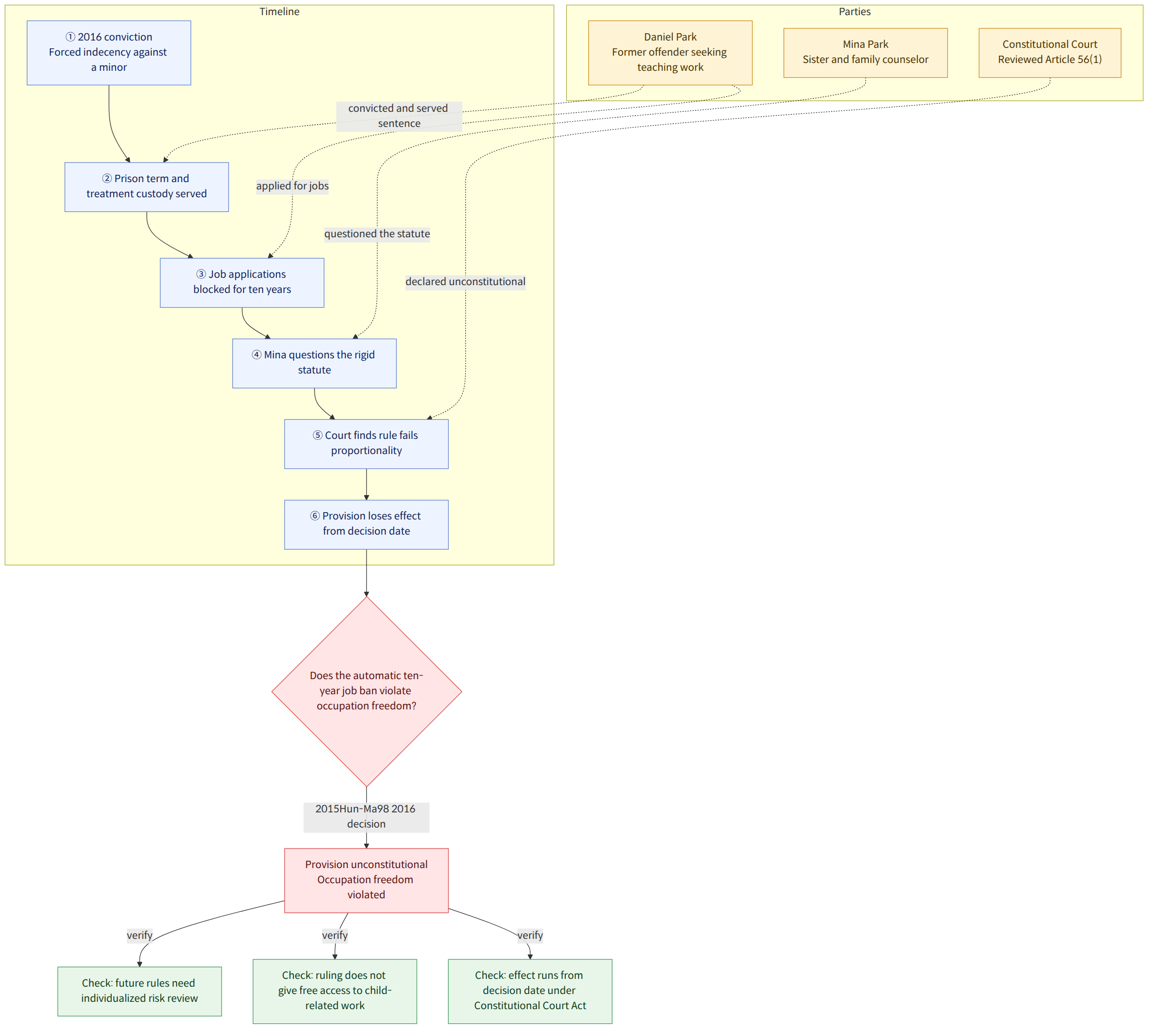
Daniel Park was thirty-four when a single night changed his life. In 2016 he was convicted of forced indecency against a minor under the Act on the Protection of Children and Youth Against Sex Offenses. The court sentenced him to one year and six months in prison, along with treatment custody. He served his sentence, took every required course, and returned to a quiet life in Busan.
He had spent years building skills as a after-school music instructor, and he hoped to return to teaching in a community center. But when he began applying for jobs, the answer was always the same. The law barred him from any role involving children, and from operating or working at any youth-related institution, for ten years after his sentence ended. The rule applied to him in the same way whether his case was mild or severe, and whether or not experts believed he still posed a danger.
His sister, Mina Park, a family counselor, read the statute late one night and asked the question that would matter most: could a law this rigid really be constitutional? Daniel's answer, and the answer the Constitutional Court eventually gave, would reshape how Korea thinks about punishment that continues long after a prison door opens.
The Legal Question
Does a law that automatically and permanently bars people convicted of child-related sex offenses from working with children for ten years unjustifiably violate their freedom to choose an occupation?
What Korean Law Says
The provision at the center of the case is Article 56(1) of the Act on the Protection of Children and Youth Against Sex Offenses. In its 2014 form, it stated:
Persons sentenced to imprisonment or treatment custody for child- or youth-targeted sex offenses, or adult-targeted sex offenses, shall not, for ten years from the date their sentence or custody is completed, suspended, or exempted, provide direct educational services to children at their homes, operate child or youth-related institutions, or be employed by or provide labor to such institutions.
The law exempted persons who had only received fines. Otherwise, it applied automatically, with no individual assessment.
The constitutional foundation is the freedom to choose one's occupation, protected under the Korean Constitution. Restrictions on it must satisfy the principle of proportionality, which has three parts:
- Suitability: the measure must actually advance a legitimate public purpose.
- Least restrictive means: no milder measure could achieve the same goal.
- Balance of interests: the public benefit must outweigh the harm to the individual.
A law that restricts basic rights must not go further than necessary to achieve its purpose, and the harm it causes must not be disproportionate to the good it does.
How Korean Courts Approach This
The Constitutional Court reviewed this provision in a 2016 decision (2015Hun-Ma98). It accepted that protecting children from sexual harm is an important public interest. The purpose of the rule was therefore legitimate. The problem lay in how it was designed.
The Court identified several defects. First, the rule treated past conviction as proof of continuing danger, with no exceptions. Second, it contradicted the logic of treatment custody, which is meant to end when a person's condition is treated; yet the job ban assumed the risk remained. Third, it ignored the kind and seriousness of the offense, placing a relatively minor offender under the same ten-year bar as someone whose crime was severe and whose risk was high.
Because a less intrusive approach was available, such as individualized risk assessment, the Court found the rule failed the least restrictive means test. It also failed the balance of interests test, because the protective benefit did not justify such a sweeping loss of livelihood. The provision was declared unconstitutional.
Applying the Law to the Case
Applying this reasoning to Daniel's situation, the analysis proceeds in steps.
If you hold a sentencing judgment or treatment custody decision like the one in Daniel's story, the first document to bring to attorney Ji-sun Ahn of Ijun Law Firm is the full judgment, since its exact wording and the dates of completion determine which rules apply to you. You could also ask them to review whether any new procedure for individualized risk assessment has been enacted since the decision.
Step 1: Was the rule actually binding on him?
Daniel's conviction carried a prison term and treatment custody, so he fell squarely within the category the provision covered. On its face, the ban would have applied to him for ten years.
Step 2: Did the Constitutional Court strike it down?
Yes. Because the Court declared this part of the provision unconstitutional, it lost effect from the date of the decision under the Constitutional Court Act. Daniel is therefore not expected to be subject to that automatic ban.
Step 3: Does the ruling mean he can work with children freely?
Not necessarily. The Court recognized that the purpose of restricting such employment is legitimate. It said that future rules should require an individualized review: whether the person still poses a risk of reoffending, and if so, what level of restriction is needed. Until new legislation sets out the procedure and the authority responsible for it, the outcome for someone in Daniel's position remains open to the rules that follow.
Step 4: What does this mean for Mina's question?
The answer is that the ruling protects individuals from blanket, permanent exclusion, but it does not remove all oversight. The important shift is from automatic presumption to case-by-case evaluation.
Conclusion: What Happened, and What Should You Do?
Daniel's blanket ten-year ban was invalidated because it treated every conviction the same, regardless of the facts or the current risk. He is not bound by that automatic rule. However, he should not assume he can return to child-facing work without restriction, since future legislation is expected to introduce individualized review procedures.
For readers in similar situations, three practical points stand out:
- Check the current law and its effective date. Constitutional decisions can be complicated, and the status of a provision depends on when it was struck down and what replaces it.
- Gather your full record. Sentencing documents, treatment records, and evidence of rehabilitation may matter when a future individualized review takes place.
- Watch for new legislation. The Court invited a more careful system. Its details, including who decides and how, will determine real outcomes.
















