

1. A Human Story
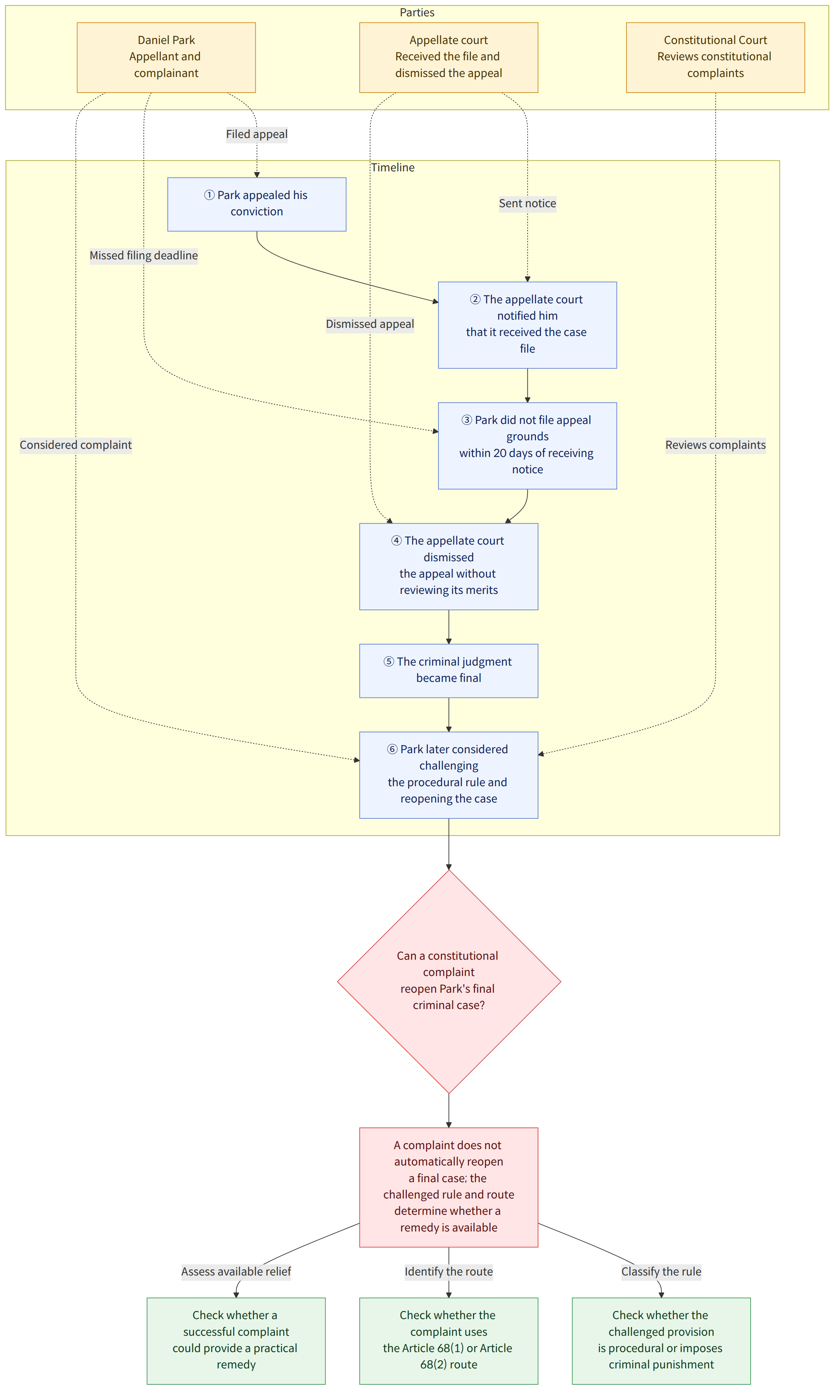
Daniel Park left the courthouse with a conviction he believed was wrong. He appealed, expecting that the next court would examine the evidence and hear why the first decision should be changed. Then the appellate court sent notice that it had received the case file. Daniel read it, put it aside, and assumed there would be another reminder before anything important happened.
There was no further filing from him within the required 20 days. The appellate court dismissed his appeal without considering its substantive arguments, and the judgment became final. Months later, Daniel focused on the deadline itself. If the rule had prevented a proper appeal, he wondered, could he ask the Constitutional Court to strike it down—and use that ruling to reopen his case?
2. The Legal Question
Can someone whose criminal appeal was dismissed for failure to file grounds within the required period challenge the relevant procedural rule through an individual constitutional complaint—and, if successful, use that complaint to reopen the now-final criminal case?
3. What Korean Law Says
Korean criminal procedure requires an appellant to explain the grounds for an appeal within a set period after receiving notice that the appellate court has received the case file. The notice rule and the deadline are related, but distinct parts of the process.
Article 361-2(1) of the Criminal Procedure Act requires the appellate court, after receiving the case records, to notify the appellant and the other party. The connected appeal procedure requires the appellant to submit grounds within the statutory period, generally 20 days after receiving the notice.
If the appellant does not file the required grounds in time, the appeal may be dismissed without a decision on the merits. This is a procedural consequence: it determines how an appeal proceeds, rather than defining a crime or imposing a criminal punishment.
That distinction matters under the Constitutional Court Act:
- Article 68(1) provides a route for an individual constitutional complaint against a public authority’s exercise or failure to exercise public power, subject to the statute’s requirements.
- Article 68(2) provides a route to challenge the constitutionality of a statute after a court refuses a request to refer that statute to the Constitutional Court.
- Articles 47 and 75 govern the effects of Constitutional Court decisions. In broad terms, an unconstitutional ruling on a law imposing criminal punishment may permit a retrial of a final conviction based on that law. A non-penal law is treated differently: a retrial concerning a related case may be available when the statute is found unconstitutional through the Article 68(2) route, but an Article 68(1) ruling does not generally create that retrial ground.
A constitutional complaint is not automatically a way to undo a final judgment. The type of provision challenged and the statutory route taken can determine whether any remedy remains available.
4. How Korean Courts Approach This
Korean courts distinguish between a rule that defines criminal liability and one that regulates the steps in a lawsuit. A deadline for filing appeal grounds belongs to the second category. It may have serious consequences for the person who misses it, but that does not make it a criminal-penalty provision.
Courts also ask whether a constitutional complaint can still provide a practical benefit to the person bringing it. This is the question of protection of rights interest: a complaint may be inadmissible if, even assuming the person won, the ruling could not change their legal position or provide a remedy for the harm they identify.
The distinction between Articles 68(1) and 68(2) is therefore not merely technical. A person cannot assume that a constitutional challenge filed by one route will have the same effect on a final criminal case as a challenge brought through the other.
A court may dismiss a complaint as inadmissible without deciding whether the challenged rule is constitutional. That is different from ruling that the rule is constitutional on its merits.
5. Applying the Law to the Case
Daniel’s situation turns on several steps.
- The appeal was dismissed for a procedural failure. Daniel did not submit appeal grounds within 20 days of receiving notice that the appellate court had received the case file. The appellate court therefore did not review his arguments about the conviction.
- The challenged rule concerns procedure, not punishment. Daniel’s complaint identifies Article 361-2(1), which concerns notice that the appellate court has received the records. The 20-day filing obligation operates in the connected appeal procedure. Whether he challenges the notice provision or the related deadline, the issue is procedural; it does not define an offence or prescribe a criminal penalty.
- The route he chose limits the effect of any successful challenge. Daniel files an individual constitutional complaint under Article 68(1). Even if the Constitutional Court accepted his constitutional argument, that kind of ruling would not generally create a basis to seek a retrial of his final criminal case over a non-penal procedural provision.
- The judgment is already final. Because the ordinary appeal has ended and the judgment is final, a ruling that cannot support a retrial would not give Daniel the practical relief he seeks. That lack of a remaining rights-protective interest can make the constitutional complaint inadmissible.
The likely result is therefore not a decision that the deadline is constitutionally valid. It is dismissal of Daniel’s complaint as inadmissible because, under the route he chose and the procedural nature of the rule, the complaint cannot reopen his final case.
If you are considering a similar challenge, attorney Ji-sun Ahn of Ijun Law Firm could review the appellate-court notice, proof of when you received it, any appeal-ground filing, and the final judgment to assess how the deadline and the constitutional-review route affect your options.
6. Conclusion: What Happened, and What Should You Do?
Daniel’s constitutional complaint does not give him a second appeal. Since the rule he challenges is procedural rather than a criminal-penalty law, an Article 68(1) complaint would not generally allow him to seek a retrial after his conviction became final. His complaint is therefore likely to be dismissed as inadmissible, without the Constitutional Court deciding the underlying constitutional question.
For anyone facing a similar situation:
- Treat the notice as time-sensitive. Record when it arrived and promptly confirm the applicable deadline and filing requirements.
- Keep the documents together. Preserve the notice, proof of receipt, appeal filings, and final judgment; the dates and the exact procedural route may matter.
- Check the remedy before filing a constitutional complaint. A lawyer can help assess whether the proposed challenge is procedurally available and whether a favorable ruling could still provide a remedy.
















