

Section 1 — A Human Story
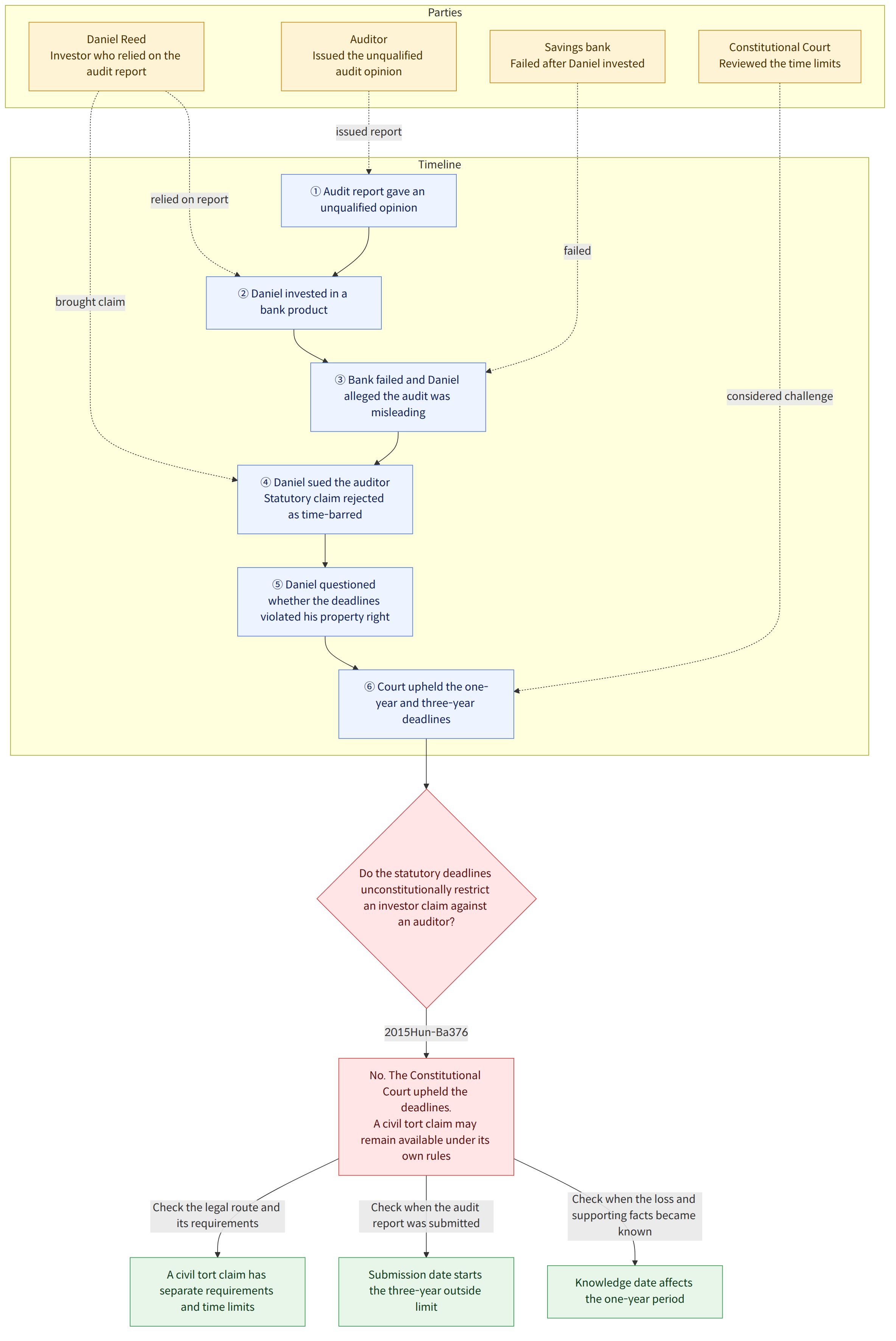
For Daniel Reed, the savings bank’s annual report seemed reassuring. Its financial statements carried an auditor’s unqualified opinion—a formal indication that, in the auditor’s view, the statements were fairly presented. Daniel took that report as one reason to trust the institution and put his savings into one of its financial products.
Then the bank failed. As the collapse came into focus, Daniel concluded that the auditor had not done its job properly. He sued, arguing that the audit report had helped him rely on a misleading picture of the bank’s finances. But his claim was rejected because the statutory filing periods had passed. Daniel’s next question was a constitutional one: could a deadline extinguishing his claim unfairly take away his property right to seek compensation?
Section 2 — The Legal Question
The central issue is whether the deadlines in Article 170(1) of Korea’s Capital Markets Act—one year from learning of the relevant loss and three years from submission of the audit report—unconstitutionally restrict an investor’s right to claim damages from an auditor.
Section 3 — What Korean Law Says
The statutory deadlines
Article 170(1) provides a specific period for bringing certain damages claims against auditors. In broad terms, the claim must be made within both of these limits:
- One year after the claimant learns of the loss and the facts supporting the claim.
- Three years after the audit report was submitted, regardless of when the claimant discovered the alleged problem.
These are strict statutory time limits. The first focuses on the claimant’s knowledge; the second places an outside limit on how long an auditor may remain exposed to this type of claim. The exact application can depend on the circumstances, including when the relevant facts became known and which legal claim is being pursued.
A short deadline does not mean that an auditor is free to issue a careless report. It means that a particular statutory damages claim must be brought within the period the legislature has set.
Why the legislature set limits
An audit report can influence investors’ decisions, and an auditor may be liable when legally required conditions are met. At the same time, an auditor should not face indefinite uncertainty years after a report is issued. The deadlines aim to balance those interests and support stability in the capital markets.
The statutory claim is not the only possible legal route. An investor may also consider a civil tort claim under the Korean Civil Act. That route has its own requirements and time limits; it is not automatically successful simply because the statutory period has expired.
Section 4 — How Korean Courts Approach This
In its 2015 decision in case 2015Hun-Ba376, the Constitutional Court rejected the argument that the deadlines violated investors’ property rights. It considered the purpose of the time limits and whether they made it unreasonably difficult for an investor to pursue compensation.
The Constitutional Court reasoned that the deadlines serve a legitimate purpose: preventing the growth and prolongation of litigation from leaving auditors in an unstable legal position and thereby supporting capital-market stability.
The Court also noted that securities-law claims offer investors certain procedural advantages, including rules that can shift the burden of proof and presumptions concerning damages. In its view, those features made it possible for good-faith investors to pursue claims with relative speed and ease, so the one-year period was not excessively short.
The three-year outside limit also served a balancing function. Investors might learn of an audit’s alleged deficiencies through regulatory disclosures or announcements about investigations during that period. Afterward, the law could reasonably protect auditors from open-ended exposure. The Court further observed that comparable claims involving misleading registration statements or business reports also had one-year and three-year periods. And it emphasized that a civil tort claim could remain available, subject to its own rules.
Section 5 — Applying the Law to the Case
1. Daniel relied on an audit report
Daniel’s account fits the basic concern behind an auditor-liability claim: he says the bank’s audit report helped him trust the institution, and he suffered loss when the bank failed. But reliance and loss alone do not establish that the auditor is legally liable. The relevant facts, the auditor’s conduct, causation, and the requirements of the particular claim all matter.
2. The statutory clock may have run out
Daniel’s statutory claim was rejected because the applicable periods had expired. Under Article 170(1), a claimant must consider both the one-year period tied to learning of the relevant facts and the three-year limit tied to submission of the report. Learning about a failure or suspected misstatement late does not necessarily restart the three-year outside limit.
3. The constitutional challenge does not erase the deadlines
Daniel argued that applying these limits deprived him of property. But the Constitutional Court’s approach is that the legislature may set reasonable time limits to reconcile investors’ interests with auditors’ need for legal certainty. Because the periods were not found to make claims practically impossible or unreasonably difficult, the Court held that they did not violate the constitutional protection of property.
4. A separate civil claim needs separate analysis
The end of Daniel’s Article 170 claim does not, by itself, answer whether he can bring a civil tort claim. That possibility depends on the facts and on the Civil Act’s separate requirements and deadlines. Daniel would need prompt legal advice to assess whether such a claim remains available and whether he can prove the necessary elements.
If you are dealing with a similar issue, attorney Ji-sun Ahn of Ijun Law Firm can review the dates, the underlying agreement or decision, and records that show the circumstances of this case with you. These details can help clarify which options apply to your situation.
Section 6 — Conclusion: What Happened, and What Should You Do?
Daniel could not revive his expired statutory claim by arguing that Article 170(1) was unconstitutional: the Constitutional Court upheld the one-year and three-year periods as a reasonable balance between investor protection and market stability. His next step would be to have counsel examine whether a distinct civil tort claim remains possible, rather than assuming that the statutory dismissal ends every route—or that another route is automatically open.
If you believe a misleading audit report contributed to your investment loss:
- Record the dates immediately: when you learned of the suspected problem, when the loss became apparent, and when the audit report was submitted.
- Get advice before relying on a different claim: civil tort liability has its own requirements and deadlines, and its availability depends on the facts.
- Preserve the evidence: keep the audit report, investment documents, disclosures, correspondence, and any regulatory or investigation announcements that may help establish what you knew and when.

















