

1. A Human Story
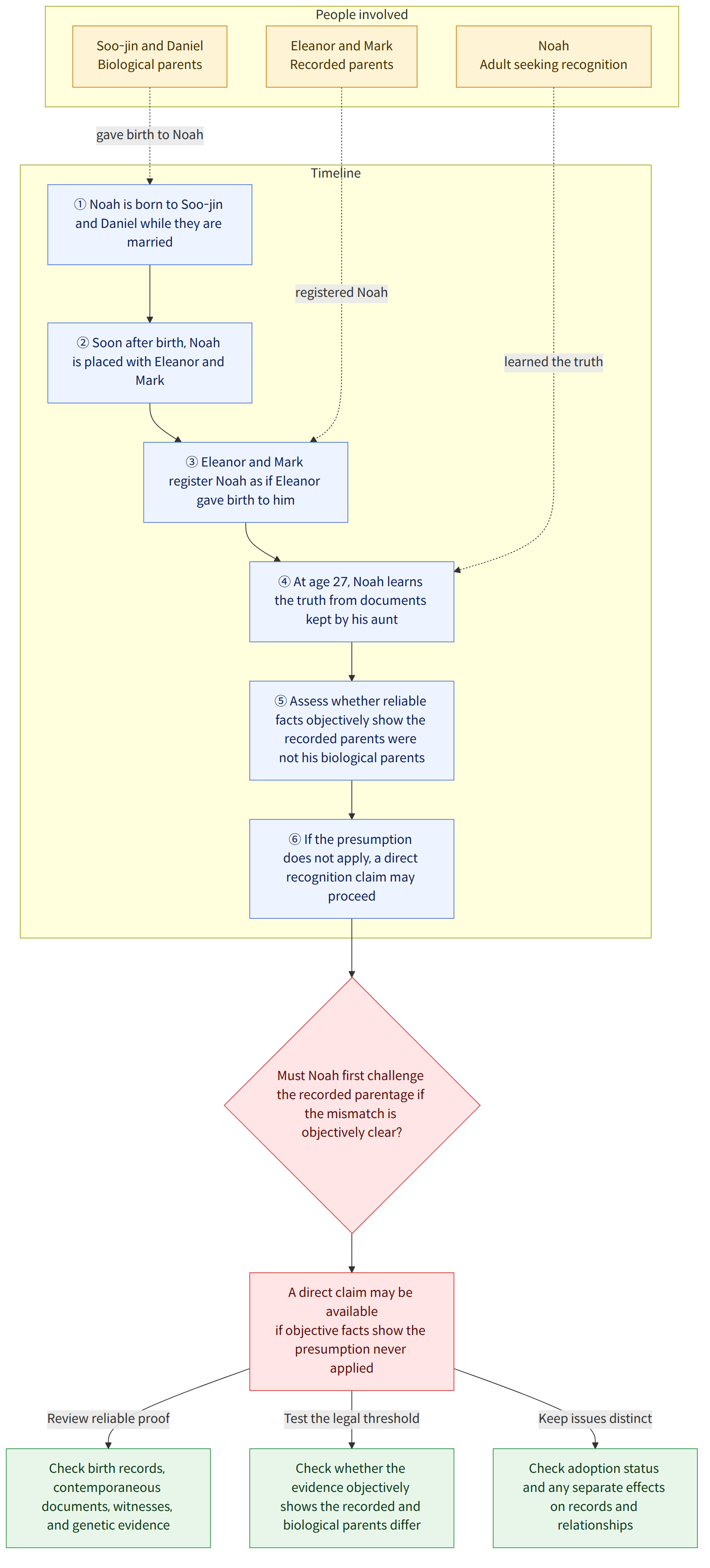
When Noah was twenty-seven, his aunt gave him a small envelope she had kept for years. Inside were a hospital note, an old photograph, and a letter explaining that the couple who raised him, Eleanor and Mark, had not given birth to him. His birth parents, Soo-jin and Daniel, had welcomed him into the world while married, but soon after his birth he was placed with Eleanor and Mark.
Noah had always believed he was their biological child. The records supported that story: instead of completing a formal adoption, Eleanor and Mark had registered him as if Eleanor had given birth to him. Now Noah faced a painful question. If the family register named one couple as his parents, could he ask a court to recognize the two people who had actually brought him into the world?
2. The Legal Question
The central question is whether a person recorded as the child of a married couple must first bring a lawsuit to disprove that recorded parentage before seeking legal recognition from their biological parents—or whether a direct recognition claim is possible when the mismatch is objectively clear.
3. What Korean Law Says
Korean law generally protects the stability of a child’s legal status. Under Article 844 of the Civil Act, a child born during a marriage is subject to a legal presumption of paternity in relation to the mother’s husband. That presumption is not normally set aside simply because someone alleges that another man is the biological father.
When the statutory presumption of paternity applies, it ordinarily must be overturned through the prescribed action denying paternity before a claim against another person can proceed.
But the rule does not cover every situation in which a family record names a married couple as parents. Korean Supreme Court doctrine recognizes an important distinction: if it is objectively clear that the registered parents are not the child’s biological parents, the presumption may not apply in the first place. In that exceptional situation, the child may bring a claim seeking legal recognition directly against the biological parent or parents.
A family-register entry alone does not make the statutory presumption conclusive where objective facts show that the recorded parents and the biological parents are different people.
In practical terms, the key points are:
- The ordinary rule: A child covered by the marital presumption generally must first use the legal procedure for challenging it.
- The exception: Where objective facts clearly establish that the listed parents are not the biological parents, the presumption does not extend to that situation.
- The available claim: The child may seek judicial recognition of the biological parentage directly from the biological mother, father, or both, as appropriate.
- The evidence: The court will need reliable proof of the circumstances, which may include birth records, contemporaneous documents, witness testimony, and genetic evidence.
This is a legal route to establishing biological parentage. It should not be confused with a formal adoption: a false birth registration is not, by itself, the same thing as completing the legal steps for adoption. The precise effect on existing records and relationships may require separate attention.
4. How Korean Courts Approach This
Korean courts generally seek to balance two concerns. On one side is legal stability: parentage cannot ordinarily be changed through informal claims, because family status affects identity, support obligations, inheritance, and other rights. The statutory presumption therefore has a defined procedure for being challenged.
On the other side is the need to avoid applying that presumption mechanically where the basic facts make it inapplicable. Courts look for an objectively demonstrable mismatch—not merely a suspicion or an unsupported assertion. If the evidence shows that the registered couple did not give birth to the child and that different people are the biological parents, the court may allow the child to proceed directly with a recognition claim.
The distinction is therefore not simply between a family record and a DNA test. The court considers the full factual picture to decide whether the presumption attached at all. If it did, the ordinary challenge procedure matters. If it did not, a preliminary challenge may not be required before the child seeks recognition from the biological parents.
5. Applying the Law to the Case
Noah’s case turns on whether the facts establish more than a family story. He would need to show that Eleanor and Mark were recorded as his parents through a false birth report, rather than through a birth to Eleanor followed by a later dispute about parentage.
- Establish how the record was created. Hospital documents, correspondence, or testimony from people involved at the time could help show that Eleanor did not give birth to Noah and that no formal adoption was completed in place of the false registration.
- Identify the biological parents. Evidence linking Soo-jin and Daniel to Noah’s birth would be central. Genetic testing may be powerful evidence, but it can be considered alongside birth records, family documents, and witness accounts.
- Ask whether the marital presumption applies. The fact that Noah’s register describes him as the child of a married couple does not end the analysis. If the evidence objectively establishes that Eleanor and Mark were not his biological parents, the special exception may mean the presumption does not reach Noah’s situation.
- Bring the recognition claim directly. If that exception is established, Noah may seek recognition from Soo-jin and Daniel without first bringing the ordinary action to deny the presumption in relation to the couple listed in the register.
- Address the records and consequences. A judgment recognizing biological parentage can provide a basis for correcting family records, but changes to registration and any separate questions about Noah’s legal relationship with Eleanor and Mark should be reviewed with a Korean family-law professional. Recognition of biological parentage does not automatically answer every issue arising from the false registration.
On the facts described, the original documents and the identity of Noah’s birth parents make the mismatch objectively demonstrable. His strongest route is therefore a direct recognition claim against Soo-jin and Daniel, supported by the evidence of his birth and biological connection.
If you are dealing with a similar issue, attorney Ji-sun Ahn of Ijun Law Firm can review family registration records, dates of marriage and birth, and any earlier acknowledgment of paternity, test result, or ruling with you. These details can help clarify which options apply to your situation.
6. Conclusion: What Happened, and What Should You Do?
Noah filed a recognition claim against Soo-jin and Daniel. The court examined the birth-era documents and genetic evidence and found that Eleanor and Mark had been listed as parents through a false birth report, even though they were not Noah’s biological parents. Because that difference was objectively clear, the marital presumption did not bar his direct claim. The court recognized Soo-jin and Daniel as his biological parents. Noah then sought advice about the additional steps needed to bring the family records into line with the judgment and to clarify any remaining legal questions about his status.
For anyone facing a similar situation:
- Preserve original evidence. Keep birth records, letters, medical documents, adoption-related papers, and contact details for witnesses; do not rely on memory alone.
- Get advice before filing. A Korean family-law lawyer can assess whether the facts meet the “objectively clear” standard and whether a direct recognition claim or another procedure is appropriate.
- Treat recognition and record correction as connected but distinct steps. Ask specifically what further filings may be needed after a judgment to update the family register and address related legal consequences.

















