
1. A Human Story
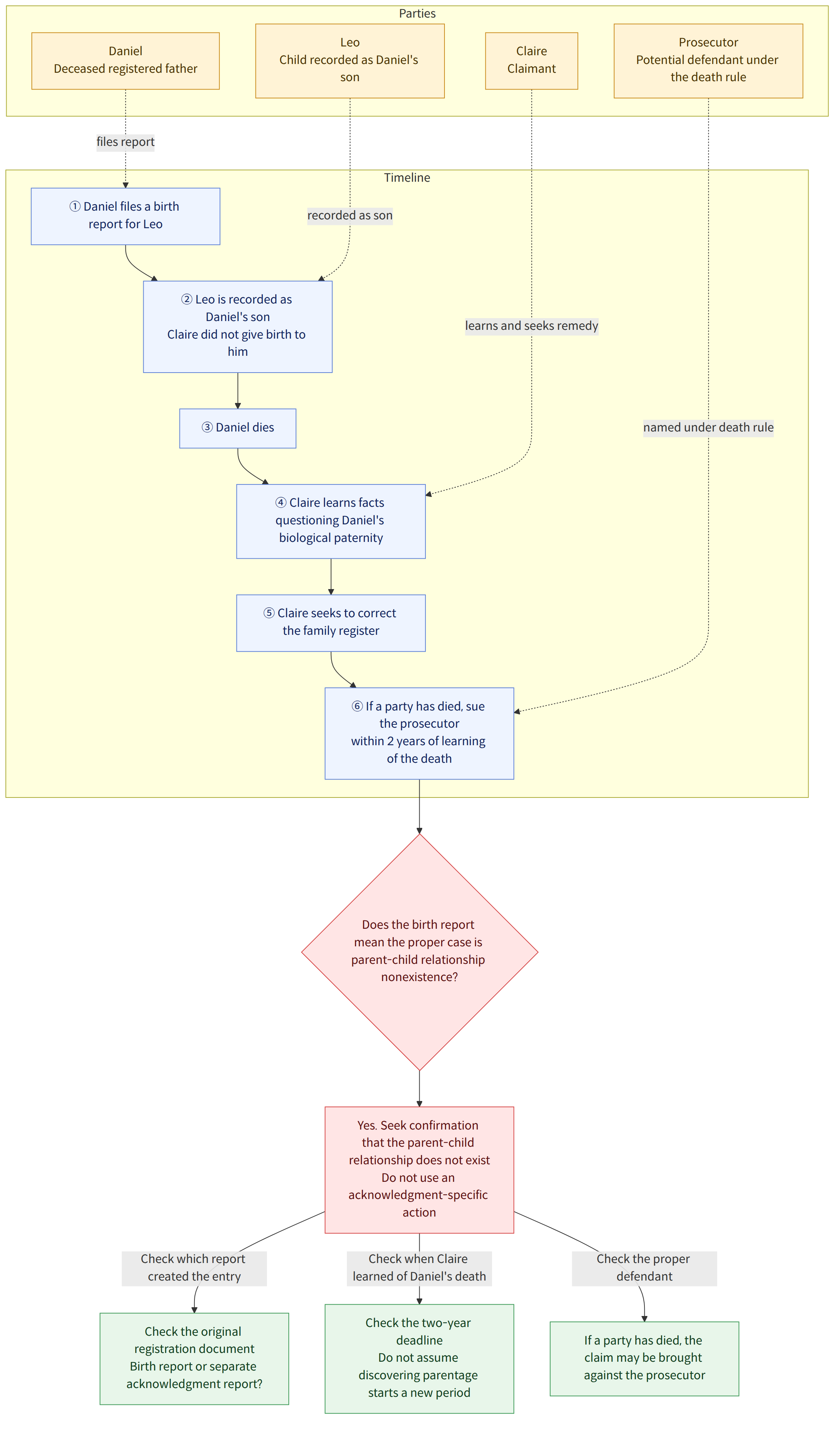
Claire and Daniel had been married for years when Daniel registered a baby named Leo as his son. Claire had not given birth to Leo. Daniel nevertheless believed Leo was his biological child and filed a birth report that placed him on the family register as Leo’s father.
After Daniel died, Claire learned facts that caused her to question that belief. The documents she found, and later information about Leo’s parentage, persuaded her that Daniel was not Leo’s biological father. She wanted the family register to reflect what she believed was the truth—but she was unsure whether to bring a case challenging an acknowledgment of paternity or to seek a declaration that no parent-child relationship existed.
2. The Legal Question
When a man registers a child as his own through a birth report, even though the child is not biologically his, what kind of lawsuit must be filed to challenge the recorded parent-child relationship? And what should be done if that man has already died?
3. What Korean Law Says
The key distinction is between an acknowledgment report and a birth report. Both may lead to a child being recorded as related to a parent, but the legal route for challenging the record depends on how it was created.
Korean law provides for lawsuits challenging or declaring invalid an acknowledgment of paternity. Those actions are generally aimed at a case where a biological father or mother formally acknowledged a child born outside marriage through an acknowledgment report.
The form of the registration matters: a birth report is not converted into an acknowledgment report simply because the law gives it the effect of an acknowledgment.
Under the registration rule discussed in this context, a father’s birth report for a child born outside marriage may have the effect of acknowledging that child. But if the recorded relationship arose from a birth report, the usual action to remove that relationship’s legal appearance is not an acknowledgment challenge or an acknowledgment-nullity action. It is an action for confirmation that the parent-child relationship does not exist.
The Civil Act provides a special procedure when one of the parties has died:
If one party has died, an action to confirm whether the parent-child relationship exists may be brought against the prosecutor within two years from the day the claimant learned of the death.
In practical terms, the main points are:
- Identify the document that created the recorded relationship: was it a birth report or a separate acknowledgment report?
- If it was a birth report, consider an action seeking confirmation that the parent-child relationship does not exist.
- If the person whose parentage is disputed has died, the claim may have to be brought against the prosecutor.
- Treat the two-year period as urgent. The statutory wording links it to when the claimant learned of the death, so do not assume that discovering the truth about parentage starts a fresh period.
4. How Korean Courts Approach This
Korean courts generally focus on the legal form of the original registration, not only on the result it produced. A birth report may carry the effect of an acknowledgment under the registration rules. Even so, where the challenged relationship was entered through that birth report, courts distinguish the case from one in which a parent separately filed an acknowledgment report.
A legal effect similar to acknowledgment does not, by itself, make the acknowledgment-specific lawsuits the correct procedure. The action must match the kind of report that created the recorded relationship.
That distinction is important because choosing the wrong type of lawsuit can leave the underlying family-register entry unresolved. If one of the people whose relationship is at issue has died, the Civil Act’s special rule allows the surviving claimant to proceed against the prosecutor, subject to the statutory time limit.
5. Applying the Law to the Case
Claire’s case turns on what Daniel filed and what she is asking the court to decide.
- Daniel filed a birth report. The facts say he registered Leo as his child through a birth report, not through a separate acknowledgment report. That is the procedural starting point, even if the birth report had an acknowledgment-like legal effect.
- The requested decision concerns parentage itself. Claire wants a court to declare that no parent-child relationship existed between Daniel and Leo. An action challenging or nullifying an acknowledgment is generally designed for a relationship created through a formal acknowledgment report, so it is not the best-fitting route on these facts.
- The appropriate action is a parent-child relationship nonexistence case. Claire should seek confirmation that the relationship between Daniel and Leo does not exist. She will need evidence supporting that claim, such as relevant registration records and reliable evidence concerning Leo’s birth and biological parentage.
- Daniel’s death changes whom Claire must sue. Because Daniel—the person whose relationship with Leo is disputed—has died, Claire may bring the action against the prosecutor under the Civil Act’s special procedure.
- The deadline requires immediate attention. The two-year period is tied by statute to when Claire learned of Daniel’s death. If she files within that period, she may pursue the appropriate action. If that period may already have elapsed, she should obtain Korean legal advice immediately rather than assume that learning about the parentage later restarts the clock.
A judgment confirming that the relationship does not exist could provide the legal basis to seek correction of the family-register record. The lawsuit is therefore not merely a request to change paperwork; it asks the court to determine whether the recorded legal relationship exists at all.
If you are dealing with a similar issue, attorney Ji-sun Ahn of Ijun Law Firm can review the family registration, the marriage, separation and birth dates relevant to the parentage dispute, and any prior court records with you. These details can help clarify which options apply to your situation.
6. Conclusion: What Happened, and What Should You Do?
Claire did not need to frame her case as a challenge to an acknowledgment report. Daniel’s registration was made through a birth report, so the better-fitting action was to seek confirmation that the parent-child relationship between Daniel and Leo did not exist. Since Daniel had died, Claire needed to bring that action against the prosecutor within the applicable two-year period measured from when she learned of his death. She gathered the registration documents and evidence of parentage, then filed promptly so the court could decide the relationship and, if appropriate, support correction of the record.
If you face a similar situation:
- Get copies of the registration and filing records. The distinction between a birth report and a separate acknowledgment report can determine the correct lawsuit.
- Do not choose a case by its label alone. Ask a Korean family-law lawyer which action matches the document that created the recorded relationship.
- Check the deadline immediately. If a party has died, act quickly and get advice about the two-year period and the evidence needed to support the claim.

















