1. A Human Story
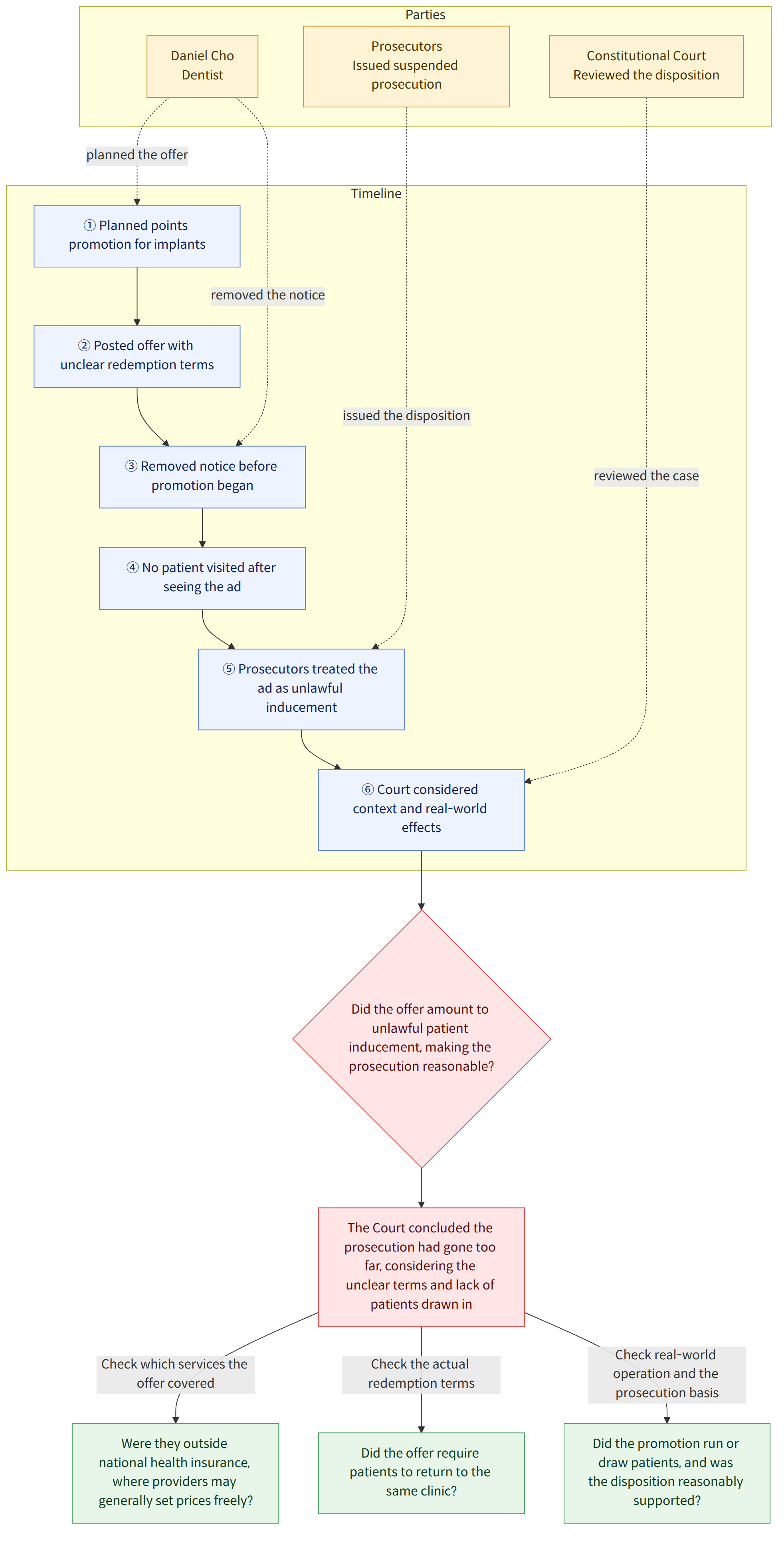
When Daniel Cho, a dentist in Seoul, planned a promotion for his clinic, he hoped to make the cost of implants feel less daunting. His website announced that patients receiving certain services not covered by national health insurance could earn points. The advertisement did not explain in detail how the points could be redeemed.
Before the promotion even began, Daniel took the notice down. No patient came to the clinic because of it. Still, prosecutors later treated the advertisement as an attempt to lure patients for profit, a practice restricted by Korean medical law. They issued him a suspended-prosecution disposition—a decision not to bring a formal trial, but one made on the premise that he had committed an offense.
Daniel wondered whether a promotion that had never brought in a patient could fairly be treated as unlawful inducement. The question would ultimately turn not just on the word “points,” but on the offer’s real terms and effects.
2. The Legal Question
Did Daniel’s website advertisement amount to a profit-driven act of attracting patients to a medical institution or practitioner, such that prosecutors could lawfully issue a suspended-prosecution disposition? Or, given the offer’s ambiguity and the fact that it was withdrawn before the promotion began, was that decision an arbitrary exercise of prosecutorial authority?
3. What Korean Law Says
Korean medical law restricts certain conduct intended to steer patients toward a particular medical provider for commercial gain. The concern is that financial inducements may distort patients’ choices or undermine the integrity of medical services. But the legal question is not answered simply by asking whether an advertisement mentions a benefit.
The central issue is whether the conduct, considered in its actual context, constitutes a profit-driven inducement of patients to seek care from a particular medical institution or practitioner.
Several points mattered in Daniel’s situation:
- The type of service: Services not covered by national health insurance are, in principle, an area in which providers may set their prices freely. That does not exempt every related promotion from scrutiny, but it is relevant context when evaluating an offer tied to such services.
- The terms of the points offer: The advertisement did not specify how the points could be used. It therefore did not establish that a patient had to return to the same clinic to redeem them.
- The promotion’s actual operation: The advertisement was removed before the event began, and no patient had visited the clinic after seeing it.
- The prosecutor’s decision: A suspended-prosecution disposition is not the same as a conviction after trial. But when it rests on the conclusion that a person committed an offense, it can still be challenged if the decision was arbitrary and infringed constitutional rights.
A promotional benefit should not be treated as unlawful inducement merely by assumption. Its conditions, purpose, and real-world operation must be examined.
4. How Korean Courts Approach This
Korean courts and the Constitutional Court assess the substance of the conduct rather than relying on a label or a single phrase in an advertisement. A points scheme may raise concern if, for example, its terms effectively require patients to return to one clinic or are structured to direct them there through a financial reward. But the existence of a possible benefit does not, by itself, establish every element of prohibited inducement.
In constitutional review of prosecutorial decisions, the question is not simply whether prosecutors could have reached a different view. The focus is whether their decision had a reasonable basis in the facts and law, or instead reflected an arbitrary use of prosecutorial power. In Daniel’s case, the Constitutional Court considered the pricing context, the unclear redemption conditions, and the absence of any patients drawn in by the advertisement. It concluded that the prosecution had gone too far.
The ruling was tied to the specific facts. It did not declare that all points programs or discounts advertised by medical providers are lawful.
5. Applying the Law to the Case
The reasoning in Daniel’s case can be followed step by step.
- Identify the service and the commercial setting. The points related to implant and other services not covered by national health insurance. Because providers may generally set prices freely for these services, the promotion had to be assessed in that context rather than treated as automatically improper.
- Ask what the advertisement actually promised. The website notice said that points would be earned, but it did not spell out how they could be used. Without clearer terms, it was not possible to conclude that patients had to return to Daniel’s clinic to redeem them—or that the points necessarily operated as a device to channel patients back there.
- Consider whether the promotion had any effect. Daniel removed the advertisement before the event began. No patients visited because of it. That fact did not, by itself, settle every legal question about the advertisement, but it was important evidence against treating the notice as an implemented patient-attraction scheme.
- Evaluate the prosecution’s conclusion against the full record. Taken together, the freely priced services, unspecified point-redemption method, and absence of any resulting patient visits undermined the conclusion that Daniel had committed the prohibited form of profit-driven inducement. Treating the advertisement as unlawful without adequately accounting for those circumstances was, in the Constitutional Court’s view, an arbitrary exercise of prosecutorial authority.
- Recognize the constitutional consequence. Because the suspended-prosecution disposition rested on that unsupported conclusion, the Court found that it infringed Daniel’s right to equality and right to pursue happiness. The disposition was therefore subject to cancellation.
If you are dealing with a similar issue, attorney Ji-sun Ahn of Ijun Law Firm can review the applicable permit, business records or advertisements, and the legal grounds given by the authority with you. These details can help clarify which options apply to your situation.
6. Conclusion: What Happened, and What Should You Do?
Daniel’s suspended-prosecution disposition was canceled. The outcome did not mean that a medical provider may freely advertise any reward or discount. It meant that, on these particular facts, prosecutors could not reasonably treat an unclear points notice—withdrawn before the promotion began and followed by no patient visits—as proof of prohibited patient inducement without properly considering the surrounding circumstances.
For medical providers and anyone facing a similar issue:
- Write the terms clearly. Explain how points or discounts work, whether they can be used for future care, and whether any conditions apply. Ambiguity can create avoidable legal risk.
- Keep a record of what happened. Preserve the advertisement, its publication and removal dates, the promotion’s terms, and any evidence about whether patients responded to it.
- Get advice before launching a promotion or challenging a disposition. A fact-specific constitutional ruling is not a general license for medical advertising; the design and operation of each offer matter.