

1. A Human Story
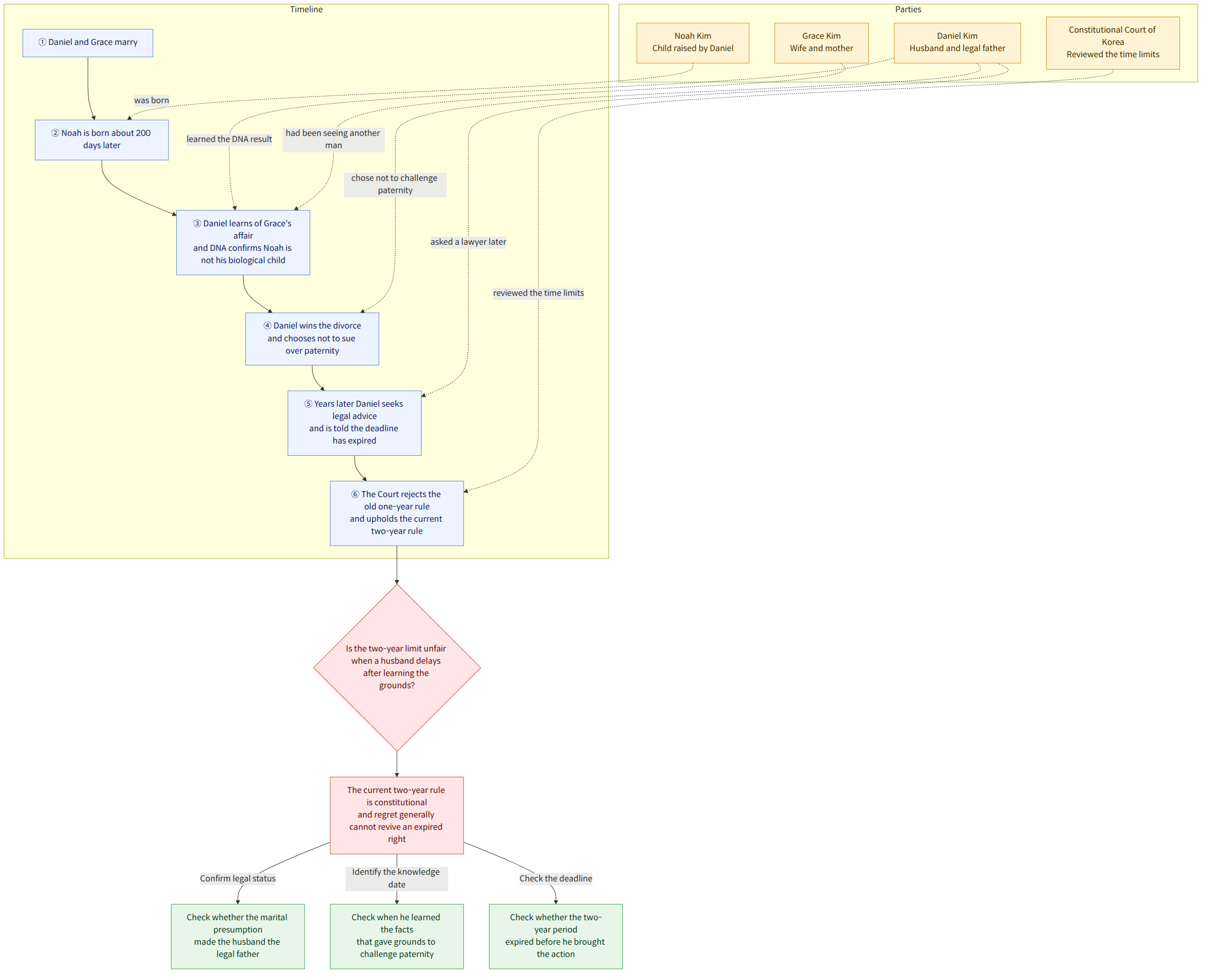
Daniel Kim first saw the DNA report in a quiet room at his lawyer’s office. He and his wife, Grace, had married less than a year before their son, Noah, was born—about 200 days after the wedding. During the marriage, Daniel had learned that Grace had been seeing another man. The test confirmed what he had feared: Noah was not biologically his child.
Daniel was already fighting for a divorce. He won, but the paternity question felt different from the marriage itself. He had fed Noah through sleepless nights, carried him on his shoulders, and watched him take his first steps. Daniel decided not to start another lawsuit. He wanted, at least then, to remain the father Noah knew.
Years passed. The affection remained, but so did Daniel’s resentment and uncertainty about the legal status of their relationship. When he finally asked a lawyer whether he could challenge paternity, he was told that the deadline had expired. Daniel’s question was understandable: could a law that gives him only two years to act be unconstitutional?
2. The Legal Question
The central question is whether Korea’s two-year deadline for a husband to bring an action denying legal paternity unfairly restricts his rights—especially when he chose not to sue earlier because of his relationship with the child, then changed his mind later.
3. What Korean Law Says
Korean law may treat a child born within marriage as the husband’s legal child, even if later evidence shows that he is not the biological father. Where that legal presumption applies, the husband cannot simply end the legal relationship by declaring that the DNA test is conclusive. He must use the legally recognized action to deny paternity and meet its deadline.
The relevant rule is in Article 847 of the Korean Civil Act. In general terms, it sets a two-year period, running from the day the husband learns of the grounds for denying paternity.
The key date is generally when the husband learns the facts that give him grounds to challenge legal paternity—not the date he later decides that he wants to bring a case.
This deadline is a peremptory period: once it expires, the right to bring the action is generally lost. It is not simply a routine filing date that a court can extend because a person has reconsidered or regrets waiting.
The Constitutional Court has considered two different versions of the time limit:
- An older rule required the husband to act within one year of the child’s birth. The Court found that period constitutionally deficient because it could expire before a husband had a meaningful opportunity to learn the truth and decide what to do.
- The current rule allows two years from learning the relevant grounds. The Court upheld it as constitutional.
The constitutional balance is not one-sided. A husband’s personal dignity, freedom to shape his life, and rights concerning marriage and family life matter. But the child’s welfare and the stability of an established family relationship matter too.
The law must give a husband a real opportunity to act once he knows the relevant facts. But if he knows the truth and does not act for two years, the child’s interest in a secure legal and social family status can justify bringing the opportunity to an end.
4. How Korean Courts Approach This
Korean courts and the Constitutional Court recognize that biological truth is important. A legal parent-child relationship should, where possible, reflect the reality of blood ties. But family law also has to protect children from prolonged uncertainty about who their legal parents are and whether relationships on which they depend can be undone at any time.
That is why the Constitutional Court rejected the old one-year rule measured from birth: it could deny a husband a fair chance to challenge paternity before he knew there was reason to do so. The current rule is different. It gives him two years after learning the grounds, allowing time for reflection and legal action while also setting a point at which the child’s status can become secure.
In upholding the current rule, the Court emphasized that a child should not remain indefinitely exposed to a possible change in legal parentage. Once the husband has clear knowledge of the facts and lets the two-year period pass, the law may give greater weight to the stability of the child’s legal and social family life.
5. Applying the Law to Daniel’s Case
Daniel’s situation is painful, but the legal analysis turns on a sequence of practical questions.
- Was Daniel the child’s legal father under the marital presumption? Noah was born about 200 days after Daniel and Grace married. If the legal presumption of paternity applied, Daniel needed to use the statutory action to challenge that status; biological non-paternity alone would not automatically remove it.
- When did Daniel learn the grounds for a challenge? The DNA test during the divorce proceedings appears to have given him clear knowledge that Noah was not biologically his child. The exact start date can depend on the evidence and circumstances, but the test result is a strong indication of when Daniel knew the relevant facts.
- Did he bring the action within two years of that knowledge? No. Daniel chose not to sue at the time, in part because he loved Noah and wanted to preserve their relationship. Those reasons are deeply human, but they do not ordinarily stop the statutory period from running. The period is tied to knowledge of the grounds, not to when Daniel’s feelings changed.
- Can the constitutional argument rescue his late claim? Probably not. The Constitutional Court has already held that the current two-year period is compatible with the Constitution. Daniel can point to the importance of biological truth and his personal rights, but the Court has also accepted the need to protect a child from indefinite uncertainty after the father has learned the truth and had a substantial opportunity to act.
This does not mean that Daniel’s bond with Noah was legally meaningless, or that the law considers his decision to wait irrational. It means that the deadline serves a purpose beyond convenience: it can protect the child’s settled identity and family relationships. Once the period has elapsed, a later change of heart is unlikely to reopen the action.
If you are dealing with a similar issue, attorney Ji-sun Ahn of Ijun Law Firm can review the family registration, the marriage, separation and birth dates relevant to the parentage dispute, and any prior court records with you. These details can help clarify which options apply to your situation.
6. Conclusion: What Happened, and What Should You Do?
Daniel’s claim is unlikely to succeed. If the DNA test during the divorce gave him clear knowledge of the grounds for denying paternity, and he waited more than two years to act, the limitation period has probably expired. A constitutional challenge to the current rule is also unlikely to change that result, because the Constitutional Court has upheld the two-year period.
For anyone facing a similar situation:
- Get advice promptly after learning facts that may affect legal paternity; do not assume you can wait until you have made an emotional decision.
- Keep a clear record of when you received test results, communications, or other evidence. The date you learned the grounds may be decisive.
- Ask a Korean family-law attorney to assess the exact deadline and legal route before relying on a general rule. The child’s birth circumstances and the evidence of when you knew can matter.

















