
1 — A Human Story
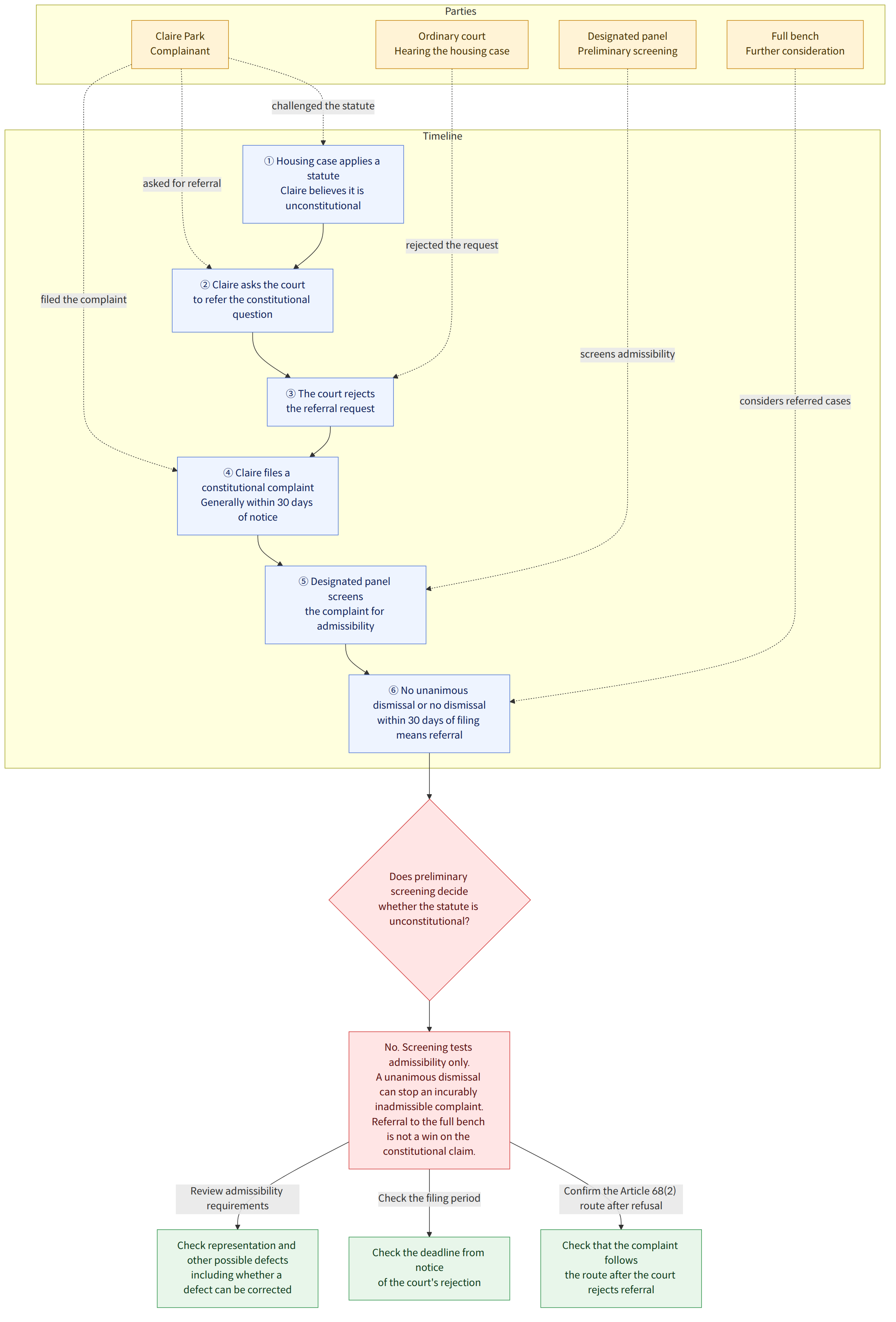
Claire Park had spent months challenging a housing-related judgment that threatened to force her family out of their apartment. She believed the statute the court had applied was unconstitutional. During the case, she asked the court to refer that constitutional question to the Constitutional Court of Korea. The court refused.
Claire’s lawyer explained that the refusal did not end every possible route to constitutional review—but it started a deadline. Claire gathered the court papers, arranged representation, and filed a constitutional complaint. Then came the wait: before any full hearing, a designated panel would decide whether her case could proceed at all.
2 — The Legal Question
What does the Constitutional Court’s preliminary screening do, and when can a complaint be stopped before the full bench considers the constitutional issue?
For a complaint under Article 68(2) of the Constitutional Court Act, a central practical question is whether the complainant has followed the required route and filed on time after a court rejects a request for constitutional referral.
3 — What Korean Law Says
A constitutional complaint is not automatically sent to the full bench for a decision on its substance. First, a designated panel examines whether the complaint meets the legal requirements for review. This preliminary stage is a filter for admissibility, not a final judgment about whether the challenged law is constitutional.
For an Article 68(2) complaint, the route is tied to an ordinary court case. A party asks the court hearing that case to refer a question about the constitutionality of a statute. If the court rejects the request, the party may bring a constitutional complaint, generally within 30 days of receiving notice of the rejection.
Article 68(2) provides a route to the Constitutional Court when a court rejects a party’s request to refer the constitutionality of a statute for review. The complaint must be filed within the statutory period following that rejection.
At the preliminary stage, a designated panel may dismiss a complaint by a unanimous decision where a legal defect makes it inadmissible and cannot be corrected. The grounds described in the law include:
- The complainant failed to complete another legally available remedy that had to be pursued first. How this applies depends on the type of constitutional complaint; an Article 68(2) complaint follows its own route after a court rejects a referral request.
- The complaint challenges a court judgment. There is a narrow exception where the judgment applied a statute that the Constitutional Court has already declared unconstitutional.
- The complaint was filed after the applicable deadline.
- The complainant has not appointed a lawyer and has not received a decision appointing a court-appointed representative, where legal representation is required.
- The complaint is otherwise inadmissible and the defect cannot be corrected.
A preliminary dismissal requires unanimity among the designated panel’s judges. If the panel does not unanimously dismiss the complaint, it must issue a decision referring the case to the full bench.
There is also a time-based safeguard: if no dismissal decision has been made within 30 days after the complaint is filed, the case is treated as having been referred to the full bench. That deemed referral does not mean the complainant has won. It means only that the case has passed this initial screening stage.
4 — How Korean Courts Approach This
The preliminary screen is meant to separate complaints that are legally ready for consideration from those barred by procedural rules. Korean constitutional review is not a general appeal from an unfavorable court judgment. A person cannot ordinarily use a constitutional complaint simply to ask the Constitutional Court to reconsider how an ordinary court decided a case.
At the same time, the screening rules are applied as procedural requirements, not as a decision on the underlying constitutional claim. A unanimous dismissal at this stage ends the complaint on admissibility grounds. If the panel cannot reach unanimity to dismiss—or if the 30-day period expires without a dismissal—the matter proceeds to the full bench for further consideration.
The distinction matters: referral is not a finding that a statute is unconstitutional. The full bench must still decide whether the claim is within its jurisdiction and, if so, whether the constitutional argument succeeds.
5 — Applying the Law to the Case
Claire’s position can be assessed in a sequence of steps.
- Was this the correct route? Claire challenged the constitutionality of a statute being applied in her pending court case. She first asked that court to refer the issue. Once the court rejected that request, an Article 68(2) complaint was the relevant constitutional route.
- Did she meet the deadline? Claire filed within 30 days after receiving notice of the rejection. That avoids the clearest time-bar defect. Someone who misses the deadline may have a complaint dismissed without the full bench reaching the constitutional question.
- Was she trying to appeal the judgment itself? Her complaint focused on the constitutionality of the statute, rather than simply asking the Constitutional Court to overturn the ordinary court’s reasoning. That distinction is important because challenges to court judgments are generally barred, subject to the narrow exception involving a judgment that applied a statute already declared unconstitutional.
- Did she satisfy the representation requirement? Claire filed through a lawyer. Had she filed without appointing counsel and without receiving a court-appointed representative, the complaint could face a separate admissibility problem.
- What can the designated panel decide? It can unanimously dismiss if it finds a specified, uncorrectable defect. If it does not unanimously do so, it must refer the case to the full bench. If 30 days pass after filing without a dismissal decision, referral is treated as having occurred.
On these facts, Claire’s timely filing and use of the Article 68(2) route mean that the panel cannot reject her merely because an ordinary court ruled against her. The screening question is whether her complaint satisfies the applicable procedural requirements—not whether her constitutional argument is ultimately correct.
If you are dealing with a similar issue, attorney Ji-sun Ahn of Ijun Law Firm can review the request for constitutional review, the court’s response, and proof of the date you received it with you. These details can help clarify which options apply to your situation.
6 — Conclusion: What Happened, and What Should You Do?
Claire’s complaint was not dismissed by a unanimous decision during the 30-day preliminary-screening period. It was therefore treated as referred to the full bench. That outcome gave her the opportunity to have the constitutional claim considered further; it did not overturn the housing judgment or establish that the statute was unconstitutional.
For readers facing a similar situation:
- Mark the deadline immediately. For an Article 68(2) complaint, calculate the 30 days from notice that the court rejected the request for constitutional referral, and get legal advice promptly.
- Keep the procedural record. Preserve the referral request, the court’s rejection, proof of when you received it, and documents showing how the challenged statute applies to your case.
- Check representation and the precise target of the complaint. Confirm that counsel or an appointed representative is in place where required, and frame the claim as a constitutional challenge rather than an ordinary appeal from the court’s judgment.

















