

1. A Human Story
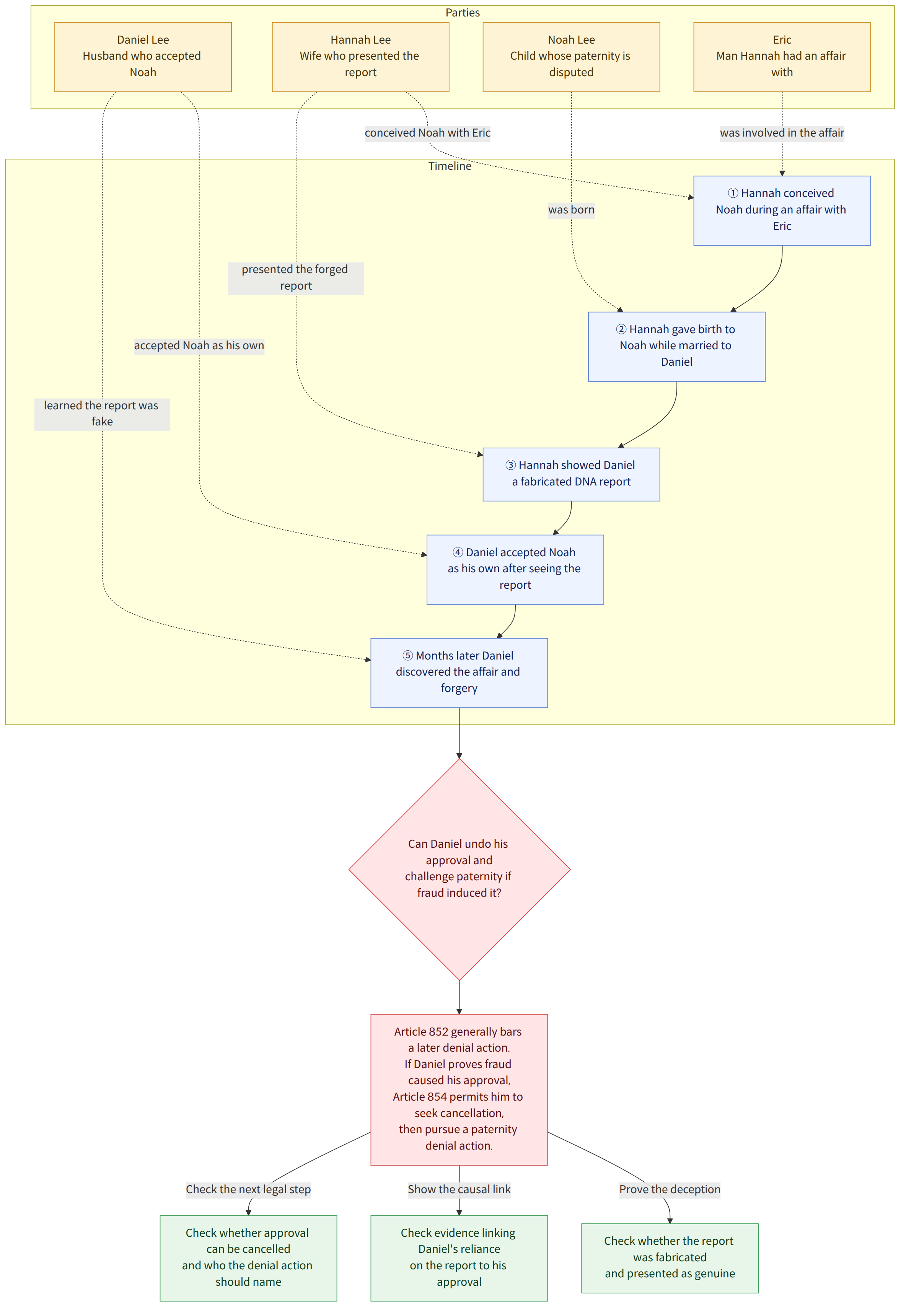
When Daniel Lee visited the hospital after his wife, Hannah, gave birth to Noah, he believed he was meeting his son. The couple were legally married, and Hannah told him that the baby was his. To reassure Daniel, she showed him what appeared to be a DNA test result confirming paternity.
Daniel did not know that the report was fabricated. Hannah had conceived Noah during an affair with Eric, another man, and had forged the document to make Daniel believe he was the child’s biological father. After seeing it, Daniel accepted Noah as his own. Months later, he discovered the affair and learned that the test result had never been genuine. He now faces a painful question: did his acceptance permanently prevent him from challenging paternity?
2. The Legal Question
Under Korean law, can a husband who has accepted a child as his own after birth still bring an action denying paternity if his acceptance was induced by his wife’s forged DNA report?
The answer turns on two rules: approval of paternity normally closes the door to a later denial action, but approval obtained through fraud may be cancelled.
3. What Korean Law Says
Korean Civil Act Article 852 provides a strong rule of finality. Once a person approves a child as their own after the child’s birth, that person generally may not later bring an action denying paternity.
Civil Act Article 852: A person who has approved a child as their own after the child’s birth may not bring an action denying paternity.
But the rule is not absolute. Article 854 permits the approval to be cancelled when it resulted from fraud or duress.
Civil Act Article 854: An approval may be cancelled if it was made as a result of fraud or duress.
In this context, fraud means that someone gives the person entitled to approve paternity false information, causing that person to make the approval while mistaken about the facts. Duress is different: it involves communicating a threatened harm that creates fear and influences the decision to approve.
The practical sequence is therefore important:
- Was there an approval? The question is whether the person accepted the child as their own after birth.
- Was the approval induced by fraud or duress? A deliberate falsehood that caused the approval may qualify; a later change of heart, by itself, does not.
- Can the approval be cancelled? If the statutory exception applies, the person may seek to undo the approval.
- Can paternity then be challenged? Once the approval is cancelled, the person may pursue a paternity-denial action against the wife or the child, as appropriate to the case.
These rules distinguish an informed decision to accept a child from one made because the decision-maker was deceived. They also show why proof matters: the claimant must connect the deception to the approval, not merely show that the report was inaccurate.
4. How Korean Courts Approach This
Korean courts generally treat approval as legally significant because parentage disputes affect more than the adults involved. A child’s family status and stability are also at stake. Article 852 reflects that concern by preventing someone from freely reversing an acceptance after the fact.
At the same time, the fraud exception prevents that rule from becoming a shield for deliberate deception. Courts examining an allegation of fraud focus on whether false information was given, whether the person approving paternity was misled by it, and whether that mistake led to the approval. A fabricated DNA report presented as genuine is especially important evidence because it may directly explain why the person accepted paternity.
The central distinction: A person cannot undo an approval merely because it later becomes inconvenient. But an approval obtained through a falsehood that caused the person’s mistake may be cancelled under the statutory exception.
The court’s inquiry is therefore not simply whether the child is biologically related to the husband. It must also consider how the husband came to approve paternity and whether the approval can legally be set aside. The child’s interests remain important, but they do not erase the express exception for approval induced by fraud or duress.
5. Applying the Law to Daniel’s Case
First, Daniel did approve Noah as his own after the birth. He did not merely remain silent or postpone a decision: after Hannah presented the supposed test result, he accepted the child as his son. That brings the general rule in Article 852 into play. Without more, he would be barred from later bringing an action denying paternity.
Second, the alleged deception goes to the heart of that approval. Hannah did not simply offer a mistaken opinion about who Noah’s father was. On these facts, she forged a DNA report and presented it as authentic. If Daniel relied on that report and accepted Noah because it appeared to establish a biological connection, the false information caused the mistake that led to his approval.
Third, that causal link supports cancellation for fraud. Daniel would need to establish the relevant facts: that the report was false, that Hannah presented it to him as genuine, and that he approved paternity because he believed it. Evidence might include the document itself, communications about the test, records from the laboratory said to have conducted it, and reliable evidence about the affair and Noah’s biological parentage. The precise evidence and procedure would depend on the case.
Finally, cancellation can reopen the path to a paternity-denial action. Article 852 does not give Daniel an unconditional right to reverse himself. Rather, Article 854 supplies a route to challenge an approval induced by fraud. If the court accepts that the approval was obtained through Hannah’s forged report, Daniel may seek to cancel it and bring the paternity-denial action against Hannah or Noah.
The result would not rest on Daniel’s regret or on the affair alone. It would rest on proof that he made his approval while deceived by a deliberate falsehood. On the stated facts, the forged report provides a strong basis for invoking the fraud exception.
If you are dealing with a similar issue, attorney Ji-sun Ahn of Ijun Law Firm can review the parentage registration, the test reports and records showing how samples were obtained, and any prior ruling with you. These details can help clarify which options apply to your situation.
6. Conclusion: What Happened, and What Should You Do?
Daniel’s acceptance would normally bar a later paternity-denial action. But because Hannah allegedly used a forged DNA report to cause him to accept Noah as his child, Korean law allows him to seek cancellation of that approval for fraud. If he proves the deception and its connection to his decision, he may proceed with a paternity-denial action against Hannah or Noah.
Anyone in a similar position should:
- Preserve evidence immediately: keep the report, messages, emails, and any records showing how it was obtained or presented.
- Get Korean family-law advice promptly: the correct claims, parties, and procedural steps depend on the facts, and delay can make evidence harder to secure.
- Separate suspicion from proof: document both the false statement and how it led to the approval; a later discovery alone may not establish fraud.

















