

1. A Human Story
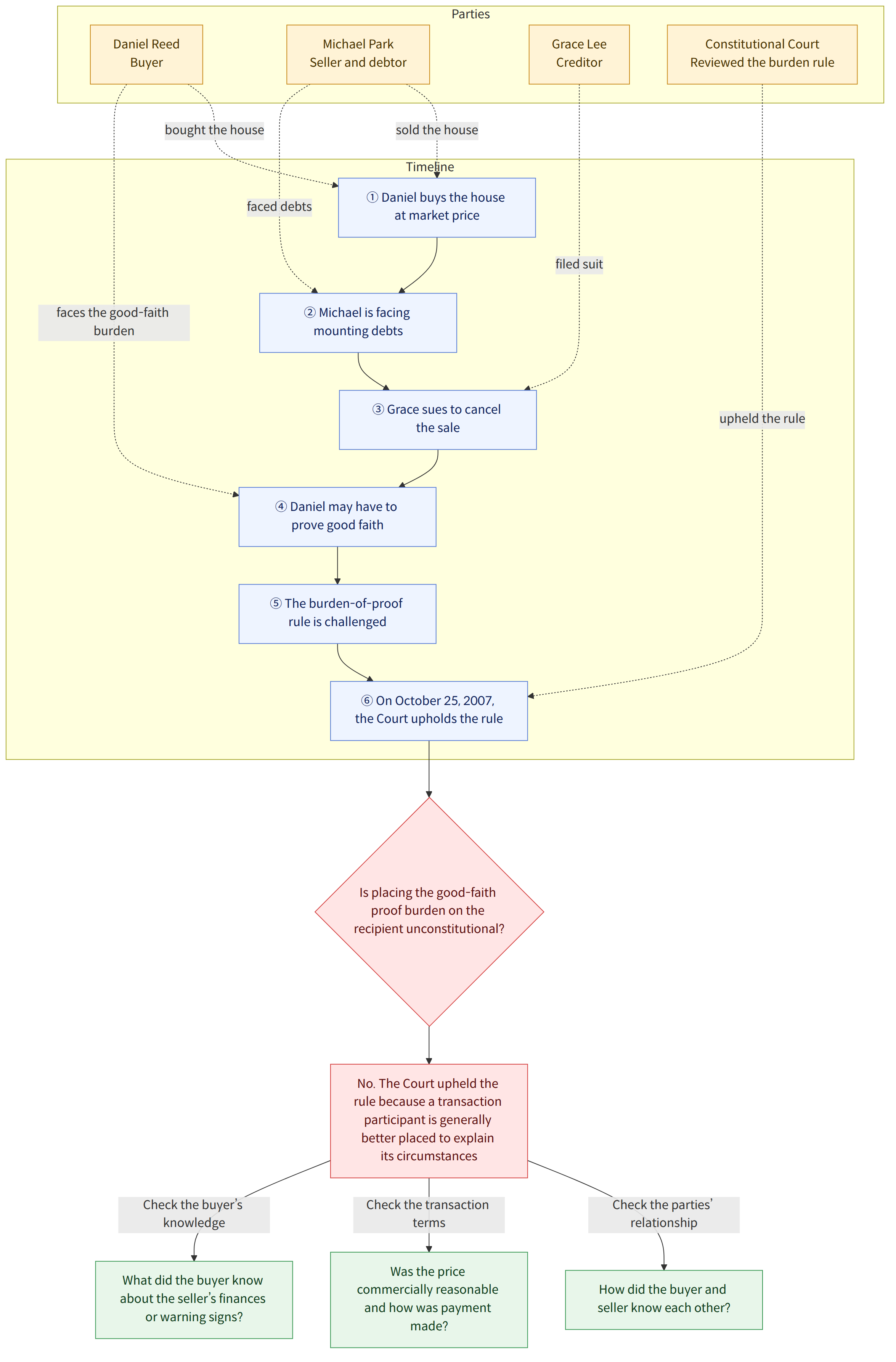
Daniel Reed thought he had found a straightforward home purchase. He paid the asking price for a small house from its owner, Michael Park, completed the registration, and began planning renovations. Daniel had no personal connection with Michael and did not know that Michael was facing mounting debts.
Several months later, a creditor named Grace Lee sued to cancel the sale. She alleged that Michael had transferred the house to keep it beyond the reach of creditors. Daniel’s lawyer explained that, in this kind of case, Daniel might have to prove he bought in good faith—that he did not know the sale would harm Michael’s creditors. Daniel was startled. How could he prove the absence of knowledge?
2. The Legal Question
The central question is whether Korea’s Civil Act is unconstitutional because it places the burden of proving good faith on the buyer or other recipient of a transaction challenged as fraudulent, rather than requiring the creditor to prove that recipient knew of the harm to creditors.
3. What Korean Law Says
Article 406(1) of the Civil Act provides a remedy commonly known as the creditor’s right of revocation. In broad terms, it allows a creditor to seek cancellation of a debtor’s transaction when the debtor acts knowing that the transaction will prejudice the creditor. The provision also protects a recipient who acted in good faith.
If a debtor performs a legal act while knowing that it will prejudice a creditor, the creditor may seek its revocation and restoration. This does not apply where the beneficiary or a subsequent transferee was in good faith.
The Supreme Court has interpreted this structure to mean that the creditor must establish the basis for revoking the transaction, including the debtor’s knowledge of the harm, while the beneficiary or subsequent transferee bears the burden of proving good faith. In practical terms, the person who received the property may need to show that they did not know of the debtor’s purpose or the transaction’s harmful effect.
The Constitutional Court upheld that arrangement in a decision issued on October 25, 2007. It rejected the argument that proving good faith is an impossible demand. Its reasoning was practical: the buyer took part directly in the transaction and is generally better placed to explain its circumstances than a creditor who was not a party to it.
The Court also rejected challenges based on clarity, freedom of contract, and excessive restriction of constitutional rights. It observed that civil statutes, unlike criminal laws, function chiefly as rules for resolving disputes in court. For that reason, they may use somewhat more general language so that they can be applied to varied situations in social and commercial life.
The allocation of the burden of proof is a legislative choice. Where the evidence is uncertain, it provides a rule that allows a court to decide the dispute; assigning that burden to the transaction’s direct participant can be reasonable because that person is better positioned to explain the transaction.
A single justice disagreed in part, offering a limited-unconstitutionality view. The justice considered that the provision should not be applied to take more than the amount by which the debtor’s assets were reduced to the point of insolvency, or more than the value of the benefit received by the beneficiary or transferee. That was a separate opinion, not the Court’s controlling conclusion.
4. How Korean Courts Approach This
Korean courts generally examine a creditor-revocation claim by separating the creditor’s case from the recipient’s good-faith defense. A creditor must show that the transaction meets the legal conditions for revocation—for example, that it harmed the creditor’s ability to collect and that the debtor knew of that harm. The beneficiary’s good faith is treated as an exception that the beneficiary must establish.
That allocation does not mean a buyer must produce impossible proof of an invisible state of mind. Courts can assess good faith through surrounding facts: how the parties knew each other, whether the price was commercially reasonable, how payment was made, what the buyer knew about the seller’s finances, and whether the transaction had features that should have raised concern.
The constitutional issue is different from the factual issue in the lawsuit. The Constitutional Court’s ruling makes a broad attack on the burden-of-proof rule difficult. It does not decide whether a particular buyer acted in good faith, nor does it prevent that buyer from defending the case with evidence.
5. Applying the Law to the Case
Daniel’s case would be assessed in several steps.
- Grace must establish the basis for revocation. She would need to show that Michael’s transfer of the house harmed her ability to collect and that the legal conditions for a creditor-revocation claim were met. The mere fact that a debtor sold property is not, by itself, enough to resolve every issue.
- Daniel must prove his good faith. Because Daniel was the direct purchaser, he carries the burden of showing that he did not know the sale would prejudice Michael’s creditors. Simply saying, “I had no idea,” may not be persuasive without supporting circumstances.
- The evidence should be viewed as a whole. Daniel can point to a sale at a price consistent with market value, payment through ordinary banking channels, an independent negotiation, and the absence of a personal relationship with Michael. A property search and records of what Daniel was told about the sale may also help. None of these facts automatically settles the case, but together they can support his account.
- The constitutional argument is unlikely to replace the factual defense. Daniel may feel that the burden is unfair, but the Constitutional Court has held that the rule does not violate property rights, general freedom of action, or the requirement that laws be sufficiently clear. His stronger course is to contest Grace’s proof and substantiate his own good faith.
On the facts as imagined here, Daniel has a credible defense: he paid a normal price, dealt independently with Michael, and had no warning of the seller’s financial distress. If the court accepts that evidence as sufficient—and Grace does not otherwise establish a basis for undoing the transfer—her revocation claim should fail. The result would turn on evidence, not on Daniel’s constitutional objection alone.
If you are dealing with a similar issue, attorney Ji-sun Ahn of Ijun Law Firm can review the land register, agreements or permits affecting the property, and the dates when rights were registered or changed with you. These details can help clarify which options apply to your situation.
6. Conclusion: What Happened, and What Should You Do?
Daniel’s constitutional challenge did not provide a shortcut to keeping the house. The governing rule was upheld, so he had to defend the transaction on its facts. He gathered the sale contract, bank-transfer records, valuation materials, and correspondence with Michael. Those records supported his account that the purchase was an ordinary, good-faith transaction. On that assumed evidentiary record, Daniel prevailed against Grace’s claim.
For anyone buying property from a person who may be in financial distress, three steps can make a real difference:
- Document the transaction as it happens. Keep the contract, proof of payment, valuation information, and communications explaining how the price and terms were reached.
- Pay attention to warning signs. An unusually low price, secrecy, a close relationship with the seller, or a rushed transfer may later be used to challenge a claim of good faith.
- Get prompt legal advice if a creditor sues. Preserve records and respond to the creditor’s allegations directly; a constitutional challenge is unlikely to succeed where the Constitutional Court has already upheld the rule.

















