
1. A Human Story
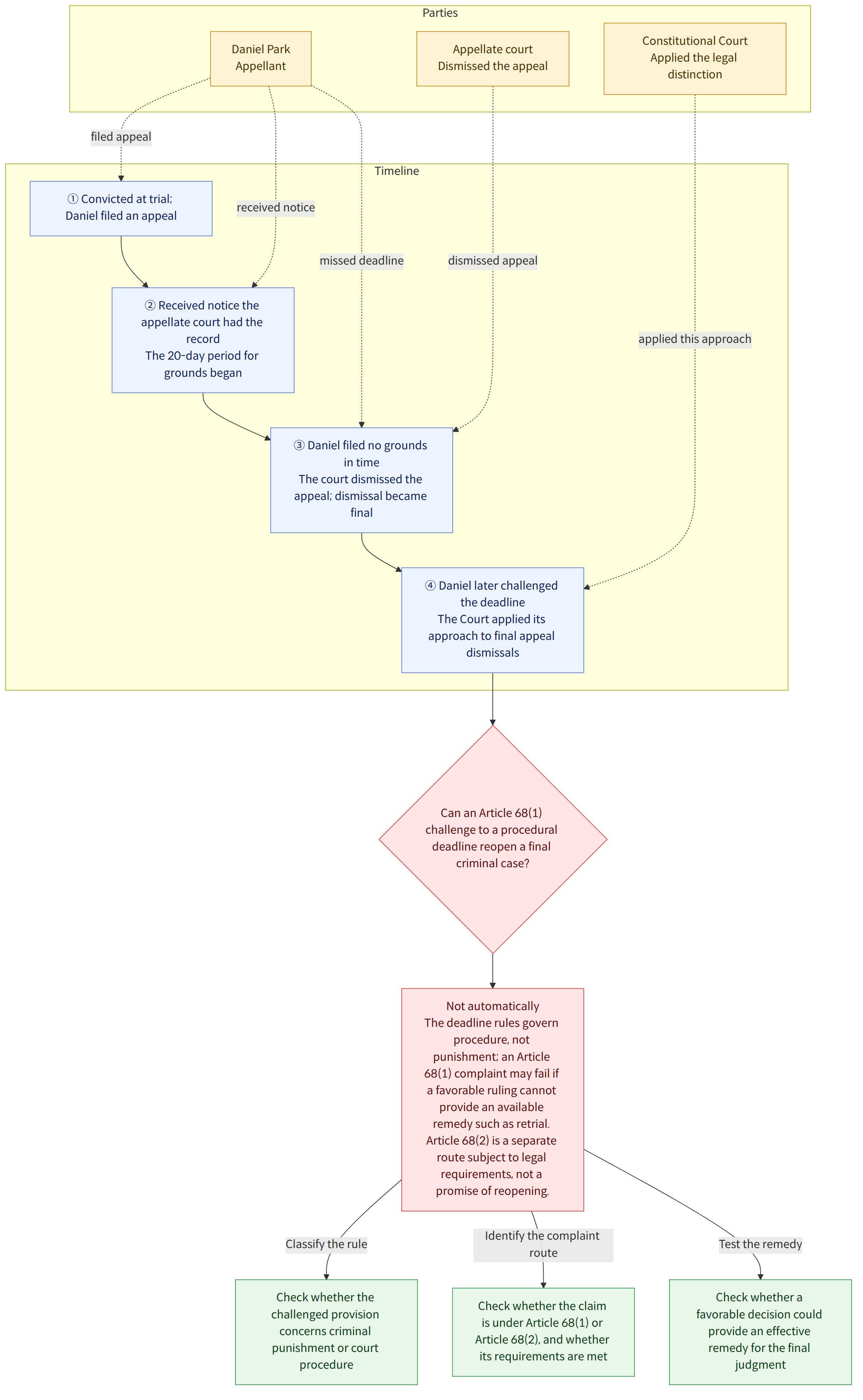
Daniel Park had expected his appeal to be the moment when a court would finally hear his side. He had been convicted at trial and filed an appeal, but the next step required a written statement explaining the grounds. The appellate court sent notice that it had received the case record. Daniel, overwhelmed and unsure what the notice required, failed to submit his statement within the stated period.
The court dismissed his appeal. Daniel did not challenge that decision in time, and it became final. Later, he focused on the rule that had led to the dismissal: the deadline for filing appeal grounds. He believed that the rule had denied him a fair chance to be heard and asked whether a constitutional complaint could now reopen his criminal case.
2. The Legal Question
Can someone whose appeal was finally dismissed for missing the statutory deadline use a constitutional complaint against that deadline rule to obtain a retrial or otherwise revive the criminal appeal?
The answer turns on two distinctions: whether the challenged provision concerns criminal punishment or court procedure, and which kind of constitutional complaint is being brought.
3. What Korean Law Says
Korean law provides a possible route to retrial when a law imposing criminal punishment is later held unconstitutional. But the rules that govern how an appeal must be filed are different: they regulate procedure, not the punishment itself.
Under the Constitutional Court Act, an unconstitutional criminal-penalty provision can, in the circumstances set out by law, support a request for retrial of a final criminal judgment based on that provision.
The provisions relevant to Daniel’s missed deadline are Article 361-3(1) and Article 361-4(1) of the Criminal Procedure Act. In general terms, they require an appellant to file a statement of appeal grounds within 20 days after receiving notice that the appellate court has received the case record, and permit dismissal of the appeal if the statement is not filed in time.
These are procedural provisions. They set the steps for pursuing an appeal; they do not define a crime or prescribe a criminal penalty.
That classification matters because Korean law treats two forms of constitutional complaint differently:
- A constitutional complaint under Article 68(1) generally challenges an exercise of public power that allegedly violates a constitutional right. But if a favorable decision would not give the person a legally available remedy—such as a retrial of a final conviction—the complaint may be dismissed for lack of a protected legal interest.
- A constitutional complaint under Article 68(2) concerns the constitutionality of a law applied in a court case, subject to the statutory requirements for that procedure. A decision that a non-penal provision is unconstitutional may have consequences for a related case in the circumstances permitted by law.
The availability of a route to ask the Constitutional Court to review a law does not mean the Court will find the law unconstitutional—or that a final criminal judgment will automatically be reopened.
4. How Korean Courts Approach This
Korean courts and the Constitutional Court focus on the practical legal effect of the complaint, not only on the claimant’s sincere belief that a constitutional right was violated. For a general constitutional complaint, the claimant must have a concrete legal interest that the Court’s decision can still protect. If the challenged rule is procedural and the complaint cannot lead to a retrial or another effective remedy, that interest may be absent once the criminal decision is final.
Courts also distinguish between a law that determines criminal liability or punishment and a law that sets procedural requirements. A missed filing deadline can have serious consequences, but seriousness alone does not transform a procedural rule into a criminal-penalty provision.
The Constitutional Court has applied these principles to a final dismissal of an appeal for failure to file appeal grounds on time. Its approach is that a challenge under Article 68(1) may be dismissed when a ruling in the claimant’s favor would not provide a basis to reopen the final criminal judgment. A separate statutory route under Article 68(2) is not a promise of success; it is a distinct means of seeking review when its legal conditions are satisfied.
5. Applying the Law to Daniel’s Case
Daniel’s situation can be assessed in four steps.
- Identify the rule that caused the dismissal. The appellate court relied on the Criminal Procedure Act’s deadline for filing appeal grounds and the provision allowing dismissal if the deadline is missed.
- Classify that rule. The provisions govern the conduct of an appeal. They do not define an offense or set a sentence, so they are procedural rather than criminal-penalty laws.
- Ask what an Article 68(1) complaint could accomplish. Even if Daniel persuaded the Constitutional Court that the procedure violated a constitutional right, that form of complaint would not itself create a retrial ground for a final judgment based on a procedural provision. With the dismissal final, Daniel lacks the necessary legal interest in using that complaint to reopen the criminal case, and it would be subject to dismissal.
- Consider the separate statutory route. Daniel may be able to seek constitutional review under Article 68(2) if the statutory requirements for that procedure are met. But that is a request to review the provision’s constitutionality, not an automatic restoration of his appeal. The Constitutional Court could reject the challenge, and even a ruling against a non-penal provision does not mean a retrial is automatically available.
The crucial point is that Daniel’s constitutional argument and his missed appeal are not interchangeable. A constitutional challenge does not erase the fact that the appeal was dismissed, and the possibility of challenging the deadline rule does not itself reopen the case.
A review of the appellate court’s notice, proof of when it was received, the dismissal decision, and any earlier request to refer the relevant law for constitutional review could help clarify which procedure, if any, remains available. You can ask attorney Ji-sun Ahn of Ijun Law Firm to review those documents and explain what legal effect a constitutional challenge could have in your circumstances.
6. Conclusion: What Happened, and What Should You Do?
Daniel’s general constitutional complaint under Article 68(1) would not provide a path to retrial on these facts. The provisions he challenges regulate appellate procedure, not criminal punishment, and the dismissal of his appeal is already final. A separate Article 68(2) challenge may be possible if its procedural requirements are satisfied, but it offers no guarantee that the deadline rule will be struck down or that his criminal case will be reopened.
Anyone facing a similar problem should:
- Keep every notice and record the dates—especially when the appellate court’s notice was received and when any appeal-ground statement was filed or due.
- Get prompt advice about the exact procedural history. The available route can depend on what motions were made, what the court decided, and when those decisions became final.
- Do not assume a constitutional challenge revives a missed appeal. Confirm separately whether a constitutional review procedure is available and what remedy it could actually provide.

















