

1. A Human Story
When Daniel Park opened his prepaid funeral-services company, he built its business around a familiar bargain: customers paid in installments over time, and the company promised to provide funeral services when they were needed. The advance payments helped keep the business running. Daniel knew that a customer might cancel or that the company might one day have to return money, but he expected to manage those risks under the rules in place when each contract was signed.
Then the law changed. The new requirement called for a consumer-damage compensation arrangement to cover payments made under contracts signed before the change. Daniel would have to set aside or otherwise protect part of the money he had previously received. He worried that the government was changing the legal consequences of completed transactions—and tying up funds on which his company depended.
His customers saw the same change differently. They had paid for services they had not yet received. If the company closed before those services were provided, they could lose both the promised funeral arrangements and the money already paid. The dispute was not simply about whether a new rule could affect an old contract. It was about whether that contract’s obligations were truly over.
2. The Legal Question
Can a Korean law require a prepaid installment-service business to arrange consumer compensation for payments received under contracts signed before the law changed, without violating the constitutional ban on retroactive legislation or the principle of protecting legitimate reliance?
A related question is whether penalties for submitting false advance-payment information can reach conduct that occurred before the penalty provisions took effect.
3. What Korean Law Says
Korea’s Installment Transactions Act regulates certain prepaid installment arrangements, including prepaid funeral-service contracts. A central safeguard is a consumer-damage compensation arrangement—a legally recognized means of protecting consumers if an operator cannot provide the promised goods or services or return the required payments. Depending on the statutory scheme, this protection may be arranged through mechanisms such as insurance or a mutual-aid arrangement.
The constitutional concern is often described as retroactive legislation. But not every new rule affecting an existing contract is constitutionally forbidden. A key distinction is whether the law changes the legal consequences of a matter that was already fully completed, or instead governs a situation that is still continuing.
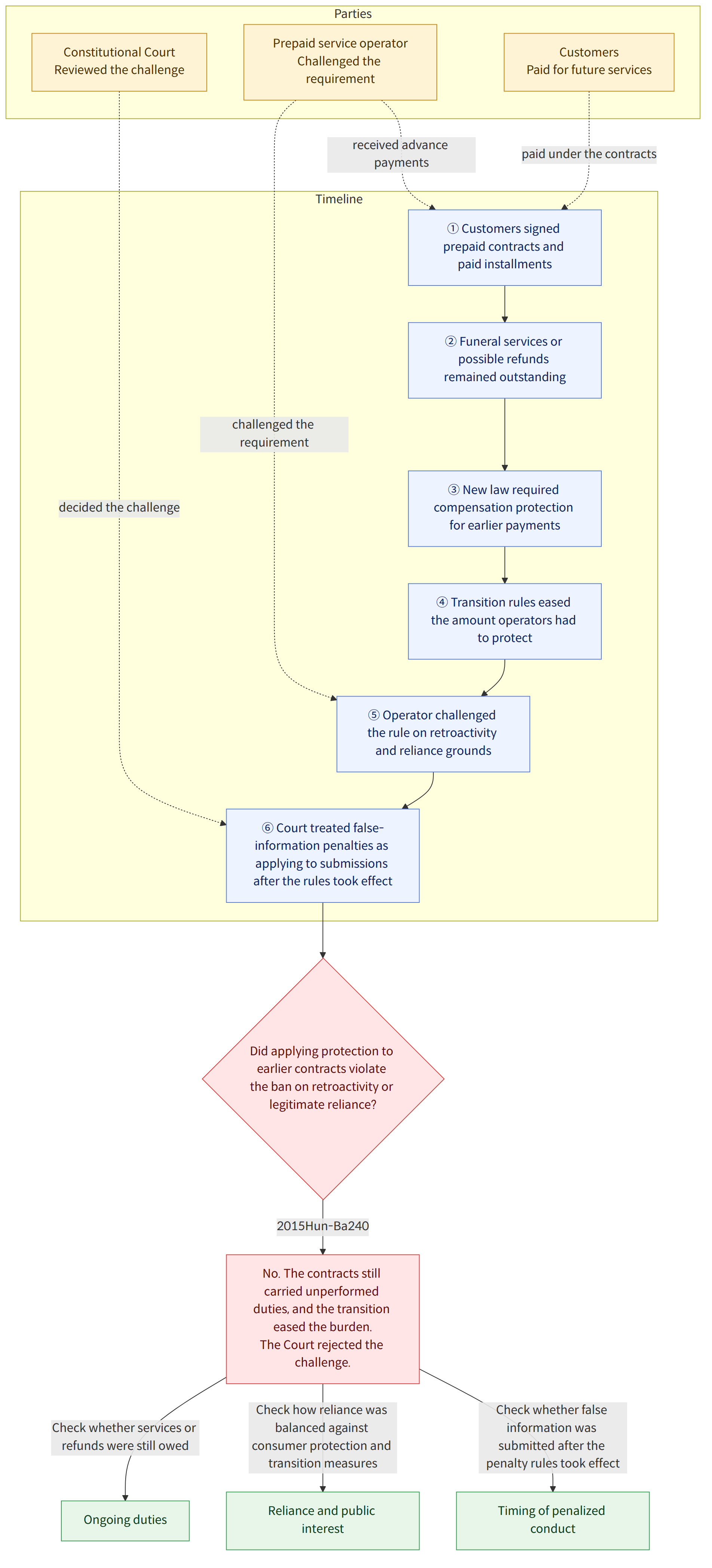
The Constitutional Court reasoned that receiving advance payments does not end the operator’s obligations: the promised services may still have to be provided, and money may have to be returned if the contract ends or the operator cannot perform.
That distinction leads to several practical principles:
- True retroactivity generally concerns a new law imposing new legal consequences on facts or relationships that were fully completed before the law took effect.
- A rule applied to an ongoing relationship may instead govern continuing duties that remain unperformed after the change.
- Even when a new rule affects existing arrangements, courts consider whether it unfairly defeats a legitimate expectation. They weigh the strength of that reliance against the public interest served by the law.
- Transitional measures matter. Here, the regulatory framework eased the amount operators had to protect during the transition, offering some accommodation to their reliance interests.
The Constitution also prohibits retroactive punishment. That is a separate issue from applying a consumer-protection obligation to an ongoing contract. A penalty for submitting false advance-payment information concerns the act of submitting the false information; the relevant question is whether that act took place after the prohibition and penalty became effective.
A new penalty cannot be used to punish conduct that occurred before the criminal provision took effect. The Court’s analysis treated the prohibited submission of false information as conduct occurring after the relevant rules were in force.
4. How Korean Courts Approach This
In its 2015 decision in case 2015Hun-Ba240, the Constitutional Court rejected the challenge to the transitional provision applying the consumer-protection requirement to earlier prepaid contracts. The Court focused on the continuing nature of the operator’s duties, rather than treating the signing of the contract and receipt of the money as the end of the legal relationship.
The Court also considered the operator’s reliance. A business might have expected to use advance payments freely until it had to provide services or refund money. But that expectation was not especially strong, the Court reasoned, because the operator already faced a duty to perform or return payments if the contract ended or performance became impossible. The law also included transitional relief that reduced the required level of protection for a period.
Against those interests, the Court placed the public purpose of preventing consumers from losing prepaid money when a business closed or lacked the resources to perform. It regarded that purpose as weighty. On that balance, applying the compensation requirement to earlier contracts did not violate the protection-of-reliance principle and was not impermissible true retroactivity.
The Court treated the criminal-law issue separately. The prohibition on submitting false payment information penalized submissions made after the provision took effect. It therefore did not impose punishment retroactively for earlier conduct.
5. Applying the Law to the Case
Daniel’s constitutional argument would be tested in stages.
- Were the earlier contracts fully completed? No. The customers had paid in advance, but Daniel’s company still owed funeral services. If a contract ended or the company could not perform, it might also owe a refund of some or all of the payments. The relationship remained active.
- Did the new rule attach consequences to a completed past event, or regulate a continuing duty? The compensation requirement applied to money connected with contracts whose performance and refund obligations were still outstanding. Under the Court’s reasoning, that made the rule one governing an ongoing situation, not true retroactive legislation.
- Was Daniel’s expectation of free use of the money entitled to protection? His business had relied on having access to the advance payments. But the expectation was limited: the funds were connected to contracts under which the company still had duties to customers. The possibility of having to provide services or return payments already existed.
- Was the burden balanced against an important public interest? The required protection was aimed at a concrete risk: customers could lose money they had paid in advance if the operator became insolvent, closed, or otherwise could not perform. The Court considered preventing that consumer harm a substantial public interest.
- Did the transition soften the effect on operators? Yes. Transitional rules reduced the protection amount operators had to provide during the adjustment period. That did not erase the burden on Daniel, but it supported the conclusion that the legislature had not ignored operators’ reliance altogether.
- Could Daniel be punished for earlier inaccurate records? Not under a penalty provision that had not yet taken effect. But if, after the relevant prohibition became effective, he submitted false information about advance payments while arranging or maintaining consumer protection, that later conduct could fall within the rule.
If you are dealing with a similar issue, attorney Ji-sun Ahn of Ijun Law Firm can review the applicable permit, business records or advertisements, and the legal grounds given by the authority with you. These details can help clarify which options apply to your situation.
6. Conclusion: What Happened, and What Should You Do?
Daniel’s challenge to the requirement covering his earlier contracts would fail under the Constitutional Court’s approach. Although the contracts predated the amendment, the company’s duties had not ended: it still owed services or, in some circumstances, refunds. The law was therefore treated as regulating continuing obligations, not rewriting a fully completed past transaction. The consumer-protection purpose outweighed the company’s limited expectation of unrestricted access to the advance payments, particularly with transitional relief in place.
That conclusion does not authorize retroactive punishment. Daniel could not be penalized under the new false-information provisions for submissions made before they took effect. He would, however, need to provide accurate information for later submissions and comply with the compensation requirements then applicable.
For businesses and consumers in similar situations:
- Identify what remains outstanding. Review older contracts for unperformed services, cancellation rights, and possible refund duties; the date of signing alone may not settle the retroactivity question.
- Check the applicable protection and transition rules. Confirm which consumer-compensation mechanism and protection level apply, and keep clear records of payments and coverage.
- Separate compliance duties from penalties. Meet current reporting requirements accurately, and seek Korean legal advice promptly if a regulator alleges that earlier conduct violated a later rule.

















