
1. A Human Story
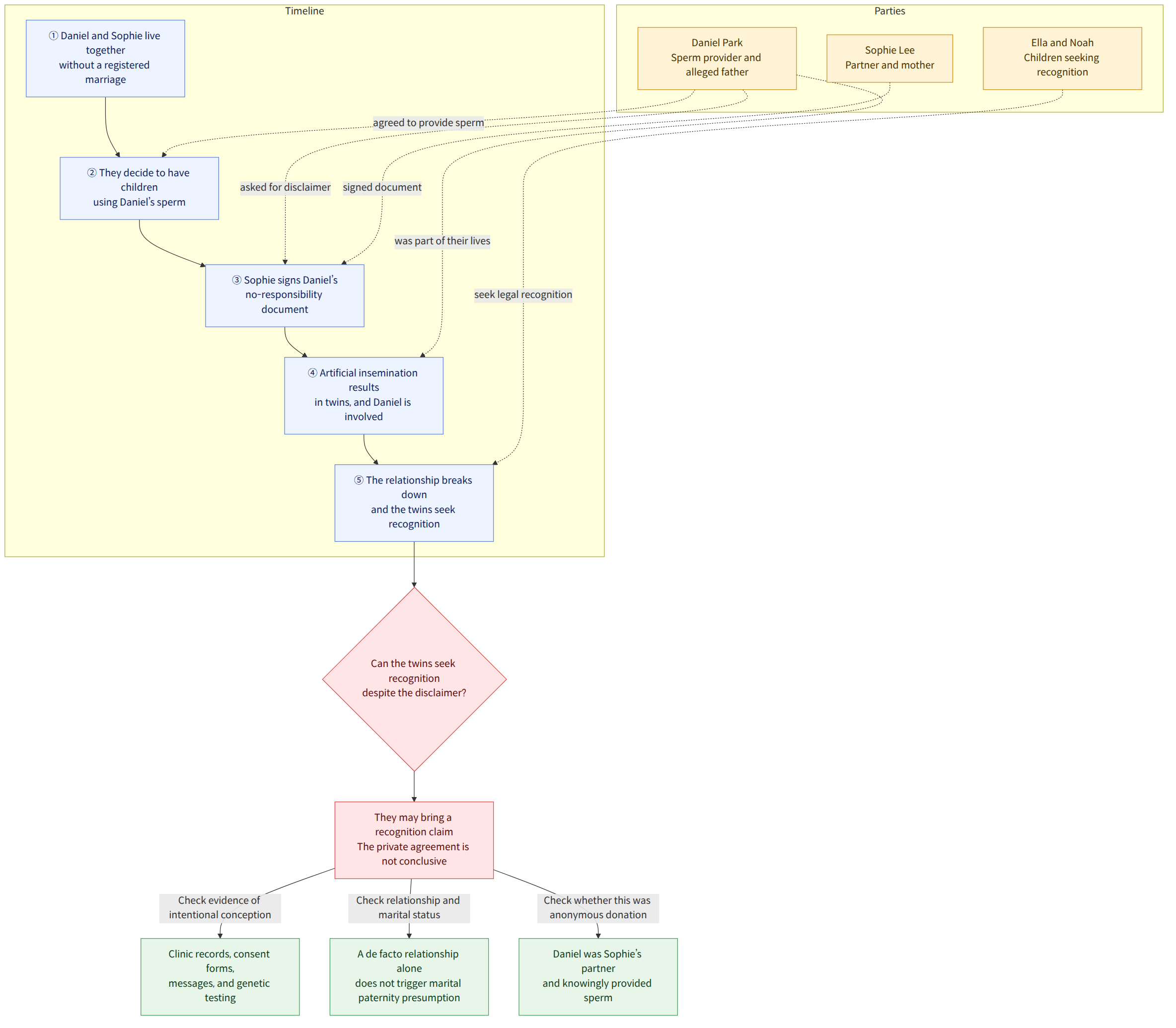
Daniel Park and Sophie Lee had lived together for years and thought of themselves as a family, though they had never registered a marriage. When they decided to have children, they agreed that Daniel would provide the sperm and Sophie would undergo artificial insemination. Before the procedure, Daniel asked Sophie to sign a short document stating that he would bear no responsibility for childbirth or child-rearing. She signed it, believing it was simply a way to put their understanding in writing.
The procedure resulted in twins, Ella and Noah. For a time, Daniel was part of their lives. But the relationship later broke down, and he began pointing to the document as proof that he had no parental obligations. As the twins grew older, they wanted their legal records to reflect the person whose sperm had been deliberately used to conceive them. Their question was direct: could they ask a Korean court to recognize Daniel as their father, despite the signed promise?
2. The Legal Question
Can children conceived through artificial insemination using a man’s sperm, while he is in a de facto relationship with their mother, bring a claim to have him legally recognized as their father—even if the adults signed an agreement disclaiming responsibility for the children?
3. What Korean Law Says
Korean law distinguishes between children born to legally married parents and children born outside a registered marriage. But the fact that conception took place through medical assistance does not, by itself, make the sperm provider a legal stranger to the child.
A court has reasoned that when a husband’s sperm is used for artificial insemination, the child’s relationship to the father is comparable to that of a child conceived through sexual intercourse: the medical technique changes how conception occurs, not the underlying parentage. Where the parents are in a de facto relationship but have not registered a marriage, however, the child is generally treated as born outside marriage unless and until the parents marry.
The relevant principles include:
- Civil Act Article 844 provides a presumption of paternity for a child conceived or born during a legal marriage. That presumption does not automatically apply merely because a couple has a de facto relationship.
- Civil Act Article 863 allows a child, or the child’s legal representative, to bring an action seeking recognition of the child’s parentage by a father or mother.
- Civil Act Article 855(2) provides that when parents of a child born outside marriage later marry, the child is treated as a child born in wedlock from the time of that marriage.
A private agreement between adults cannot, simply by its wording, decide whether a child has a legal parent-child relationship or remove the child’s own right to seek recognition.
The circumstances matter. This situation is different from a person donating sperm anonymously, without an intention to parent or a personal relationship with the recipient. Here, the alleged father was the mother’s partner and knowingly provided his sperm for the purpose of conceiving their children.
4. How Korean Courts Approach This
Korean courts focus on the nature of the conception and the evidence connecting the alleged father to it. In cases involving artificial insemination with a partner’s sperm, courts have treated the use of medical assistance as a substitute for natural conception—not as a reason to deny the parent-child relationship.
The court will also distinguish between a legal marriage and a de facto relationship. A de facto relationship alone does not trigger the marital presumption of paternity. But the absence of that presumption does not prevent a child from bringing a separate recognition claim.
Courts look beyond a document’s label to the rights at stake. An agreement made by adults cannot conclusively bargain away a child’s independent claim to legal parentage.
Evidence may include clinic records, consent forms, messages discussing the decision to conceive, the couple’s relationship at the time, and genetic testing. A signed disclaimer may be part of the evidence, but it does not necessarily establish that the man was merely an uninvolved donor or that the children have no claim against him.
5. Applying the Law to the Case
First, Daniel knowingly provided the sperm. This was not described as an anonymous donation to an unrelated recipient. Daniel was Sophie’s partner, and the insemination was arranged as a way for the couple to have children. That context supports treating the conception as an intentional joint decision.
Second, the medical procedure does not erase the biological and legal significance of that decision. The fact that Ella and Noah were conceived through artificial insemination rather than sexual intercourse does not, on its own, defeat a parentage claim. The court’s approach to partner-sperm insemination is that the technology is a different means of conception, not an automatic escape from fatherhood.
Third, the couple’s lack of a registered marriage affects the route to legal parentage, not whether the children can seek it. Because Daniel and Sophie were not legally married, the children would not automatically rely on the marital presumption under Article 844. They may instead ask the court to recognize Daniel as their father under Article 863.
Fourth, the disclaimer is not decisive. Daniel may argue that Sophie agreed he would have no responsibilities. But the twins were not parties to that agreement. A promise between the adults cannot, by itself, extinguish the children’s right to ask a court to establish their parentage. Nor does the document change the fact that Daniel provided sperm for the purpose of conceiving them.
If the parents later marry, Article 855(2) may also affect the children’s legal status from the time of that marriage. But in the circumstances described here, the twins need not depend on a later marriage to bring a recognition claim.
If you are dealing with a similar issue, attorney Ji-sun Ahn of Ijun Law Firm can review family registration records, dates of marriage and birth, and any earlier acknowledgment of paternity, test result, or ruling with you. These details can help clarify which options apply to your situation.
6. Conclusion: What Happened, and What Should You Do?
Ella and Noah can bring a claim seeking recognition of Daniel as their father. On the facts described, the signed disclaimer alone should not defeat that claim. If they can establish that Daniel knowingly provided his sperm for their conception, the court has a strong basis to recognize the parent-child relationship. Recognition can carry significant legal consequences, including consequences for family records and other rights and responsibilities; those consequences should be addressed with legal advice specific to the family’s circumstances.
For readers facing a similar situation:
- Preserve evidence: keep clinic records, consent forms, messages, and any documents showing who provided sperm and why the procedure was undertaken.
- Do not assume a disclaimer ends the matter: a written agreement between adults may not remove a child’s independent right to seek legal recognition.
- Get Korean family-law advice early: ask a qualified lawyer about the recognition procedure, evidence, and any related issues such as support, family registration, or inheritance.

















