

1. A Human Story
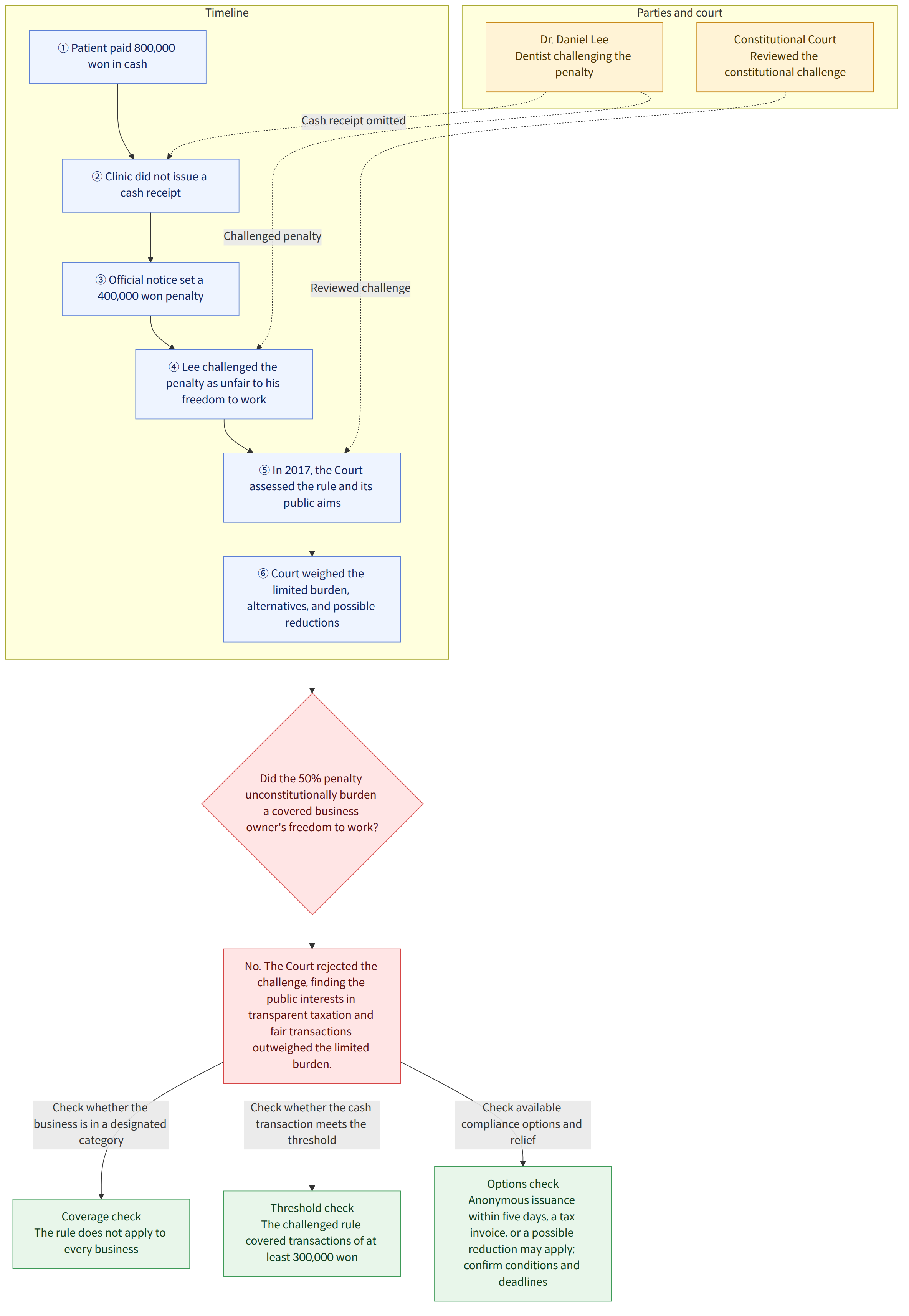
Dr. Daniel Lee had built his dental clinic on a reputation for careful work and personal attention. One busy afternoon, a patient paid 800,000 won in cash for a treatment plan. The clinic was running behind, the front desk was juggling calls, and the receipt was never issued. Daniel noticed the omission only after the patient had left.
Weeks later, an official notice arrived: because the clinic belonged to a business category required to issue cash receipts, the failure could cost him 400,000 won—half the transaction amount. Daniel was not arguing that the receipt system was difficult or expensive. He believed the size of the penalty was unfair and asked whether the government had crossed a constitutional line by burdening his freedom to run his profession.
2. The Legal Question
Can South Korea constitutionally require businesses in designated, cash-intensive sectors to issue receipts for large cash payments—and impose a penalty equal to 50% of the unreceipted amount when they fail to do so?
3. What Korean Law Says
South Korean law requires businesses in specified categories, including certain professional services, to issue cash receipts for qualifying transactions. The rule at issue applies to cash transactions of 300,000 won or more. It is not a general requirement imposed in this form on every business or every cash sale.
The Constitutional Court treated the rule as a measure to make taxable income more visible, prevent tax evasion, and support a fair and transparent system of commercial transactions.
For a business covered by the mandatory-issuance rules, the practical points are:
- Check whether the business is covered. The obligation applies to designated categories, not to all merchants indiscriminately.
- Watch the transaction threshold. The rule challenged in the constitutional case concerned an individual cash transaction of at least 300,000 won.
- Issue the required record. The customer’s request is not necessarily what determines whether the obligation applies to a qualifying transaction.
- Use an available alternative where appropriate. The Court noted that the rules allow methods such as anonymous issuance within five days when the customer’s identifying details are unavailable, and that issuing a tax invoice may also avoid a breach in an applicable transaction.
- Check whether a reduction is available. The Court noted that a business may be able to obtain a reduction by paying voluntarily within the period for submitting an opinion, or where statutory eligibility conditions are met. The applicable conditions and deadlines should be confirmed in the particular case.
The penalty addressed in the constitutional challenge was 50% of the amount for which the cash receipt was not issued. It is important not to confuse this administrative penalty with a criminal sentence. Its size is tied to the value of the transaction, rather than being a fixed charge.
4. How Korean Courts Approach This
In its 2017 decision, the Constitutional Court rejected the challenge to the 50% penalty. The Court recognized that the rule imposes a real obligation on a business, but assessed that burden against the public aims of preventing income from being concealed and establishing fair trading practices.
The Court’s central conclusion was that the public interest in transparent taxation and fair transactions outweighed the limited burden placed on covered businesses when they record qualifying cash sales.
The Court’s reasoning followed a familiar constitutional balance. First, the legislative objective was legitimate. Second, requiring a receipt was suited to that objective because it creates a record of transactions that might otherwise be difficult to verify. Third, the Court considered whether the rule went further than necessary. It emphasized the limited scope of the obligation, the relative ease and low cost of issuing receipts, and the availability of alternatives and possible reductions. Finally, it compared the public benefit with the business burden and found the former more significant.
The Court also observed that lawmakers generally have room to decide whether a regulatory breach should lead to an administrative penalty or another kind of sanction, and how large an administrative penalty should be. That discretion is not unlimited, but the 50% rate was not considered irrationally excessive in this setting.
5. Applying the Law to the Case
Daniel’s situation can be assessed step by step.
- Was the clinic within a covered business category? If Daniel’s dental practice was among the designated businesses subject to mandatory issuance, the obligation applied. The rule did not depend on whether he personally thought the clinic’s bookkeeping system was convenient.
- Did the payment meet the threshold? The patient paid 800,000 won in cash—well above the 300,000-won threshold considered by the Court.
- Was a receipt issued, or was an alternative used? No receipt was issued at the time, and Daniel did not arrange an available alternative, such as permitted anonymous issuance within five days or, where relevant, a tax invoice. His omission therefore fell within the kind of failure the penalty was designed to address.
- Was the amount automatically unconstitutional because it was 50%? The Court said no. It viewed the rate as proportionate to the transaction amount and found that the rule targeted higher-value transactions in business categories considered more vulnerable to income concealment. It also considered the process of issuing a receipt neither especially complicated nor costly.
- Could Daniel still seek relief? A constitutional ruling upholding the rule does not mean every penalty notice is beyond challenge. Daniel could check whether the clinic was correctly classified, whether the transaction and amount were accurately recorded, and whether he qualified for a reduction or had grounds to contest the assessment under the applicable procedure. The Court specifically noted possible reductions for timely voluntary payment and for people meeting prescribed eligibility conditions.
On the facts as described, however, Daniel’s argument that the penalty itself violated his freedom to conduct his profession would face the same constitutional obstacle as the challenge rejected by the Court.
If you are dealing with a similar issue, attorney Ji-sun Ahn of Ijun Law Firm can review the applicable permit, business records or advertisements, and the legal grounds given by the authority with you. These details can help clarify which options apply to your situation.
6. Conclusion: What Happened, and What Should You Do?
Daniel’s constitutional objection did not remove the penalty. Because his clinic was covered, the cash payment exceeded the threshold, and no receipt or qualifying alternative was used, the 50% penalty could apply. The Constitutional Court’s reasoning was that a focused recordkeeping duty for large cash transactions in designated sectors is a modest business burden when weighed against the public interest in preventing tax evasion and improving transaction transparency.
For businesses in a similar position:
- Confirm your status and threshold obligations with a tax professional or the relevant tax authority; do not assume the rule applies—or does not apply—to your business.
- Build a routine for every qualifying cash payment, including a process for anonymous issuance when customer details are unavailable and for any alternative documentation permitted by law.
- Act quickly after an omission: check the notice, preserve transaction records, confirm the response and payment deadlines, and ask whether voluntary-payment or other statutory reductions are available.

















