

1. A Human Story
Daniel Han had built his small business in Busan one careful year at a time. Then a lawsuit turned on a statutory provision he believed was unfairly being applied to him. His lawyer asked the court handling the case to refer that provision to the Constitutional Court for review.
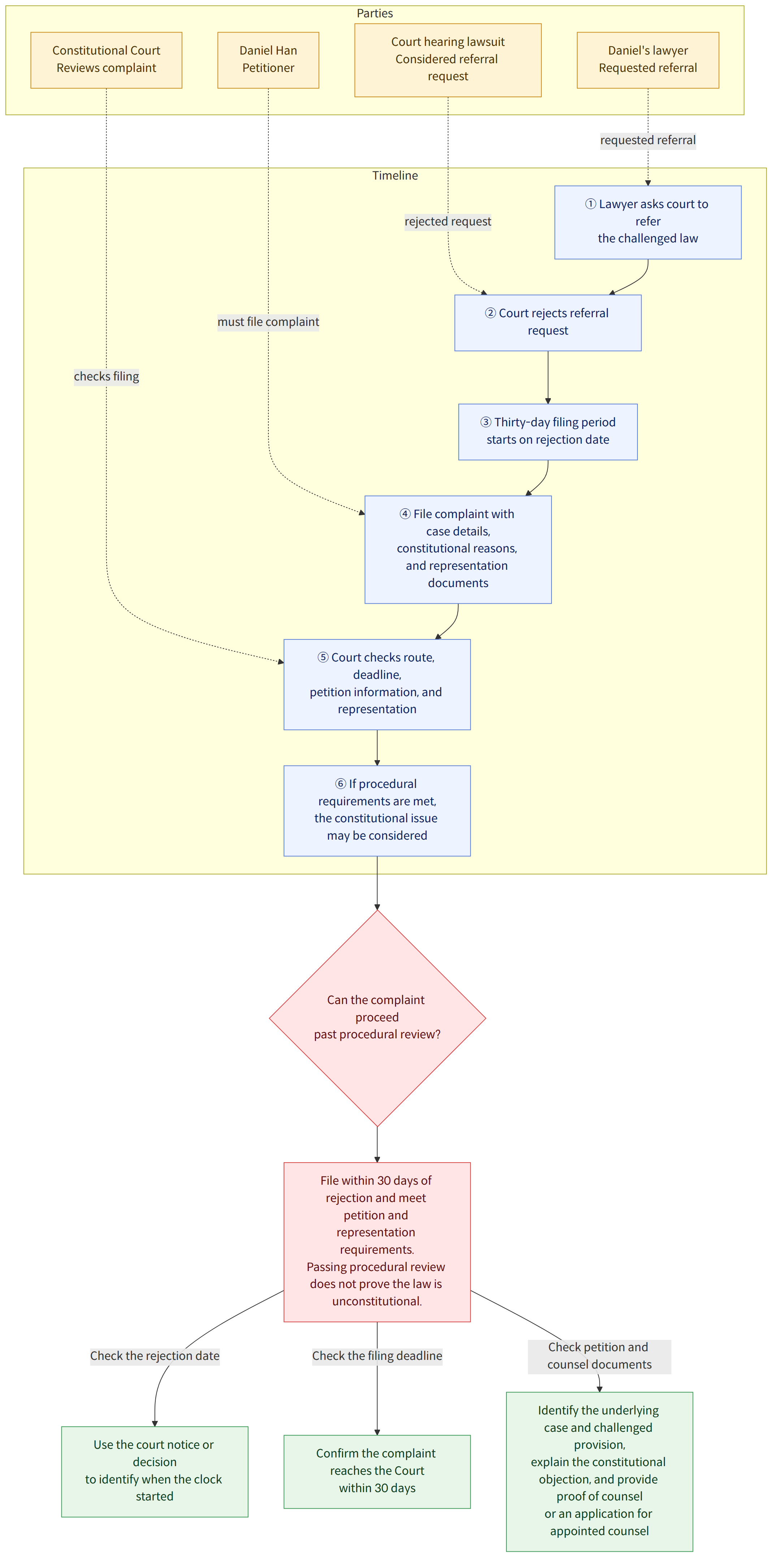
The request was denied. Daniel was disappointed, but the refusal did not close every door. It opened a narrow one: he could file a constitutional complaint under Article 68(2) of the Constitutional Court Act. The trouble was that the clock had already started. Daniel needed to act within 30 days—and his filing had to contain the information and representation documents the law requires.
2. The Legal Question
When a court rejects a request to refer a law for constitutional review, how long does the person have to file an Article 68(2) constitutional complaint, and what must the petition include?
3. What Korean Law Says
Article 68(2) provides a route to the Constitutional Court for a party who has asked the court hearing their lawsuit to refer a relevant law for constitutional review, but whose request has been rejected.
The complaint must be filed within 30 days from the date the request for referral is rejected.
This is a defined statutory filing period. A person should not assume that the time will be extended simply because preparing the papers takes longer than expected.
The petition must provide enough information to show both what is being challenged and why the constitutional question arises in the underlying lawsuit. It should include:
- The identity of the petitioner and other relevant parties.
- The underlying lawsuit and the parties to that lawsuit.
- The law or specific legal provision said to be unconstitutional.
- The reasons the petitioner believes the provision violates the Constitution.
- Any other information needed to explain the request.
There is also a representation requirement. A person filing a constitutional complaint generally must be represented by an attorney. The petition should therefore include proof that counsel has been retained, or an application for appointment of counsel where the petitioner seeks that assistance.
A timely complaint is not enough by itself: the filing must also identify the underlying case and challenged provision, explain the constitutional objection, and address the requirement for legal representation.
4. How Korean Courts Approach This
Korean constitutional review has procedural gates as well as substantive questions. The Constitutional Court first needs to be able to determine whether the complaint was filed through the correct route, within the prescribed period, and with the information and representation documents required for review.
Courts generally treat statutory filing periods as important limits, not informal targets. A complaint filed after the 30-day period may face dismissal without a decision on whether the challenged law is constitutional. Likewise, a petition that fails to explain the underlying litigation or the specific legal provision at issue may not give the Court what it needs to assess the case.
Clearing the procedural requirements only gets the constitutional question before the Court; it does not establish that the challenged law is unconstitutional.
5. Applying the Law to the Case
Daniel’s next steps turn on a few concrete questions.
- When was the referral request rejected? The date of the rejection starts the 30-day period. Daniel and his lawyer must identify that date from the court’s notice or decision rather than relying on memory or an informal conversation.
- Was the complaint filed within 30 days? Daniel must ensure that the petition reaches the Constitutional Court within the statutory window. Waiting until the final day risks practical problems, such as an incomplete application or a filing that does not arrive as intended.
- Does the petition make the dispute clear? It must identify Daniel, the lawsuit in which the constitutional issue arose, the parties to that case, and the exact statutory provision he challenges. It must also explain why that provision is said to violate the Constitution and why the issue matters to the underlying dispute.
- Has the representation requirement been addressed? Daniel’s filing should include documentation showing that an attorney represents him, or an application for appointed counsel if he is seeking that assistance.
Daniel’s belief that the law is unfair may explain why he wants review, but it cannot replace these formal requirements. Nor does a successful filing prove his constitutional argument. It means only that the Court can proceed to consider whether the complaint is properly before it and, if so, whether the challenged provision is unconstitutional.
If you are dealing with a similar issue, attorney Ji-sun Ahn of Ijun Law Firm can review the request for constitutional review, the court’s response, and proof of the date you received it with you. These details can help clarify which options apply to your situation.
6. Conclusion: What Happened, and What Should You Do?
Daniel did not wait for the underlying lawsuit to end. He obtained the rejection notice, worked with his lawyer to prepare a petition identifying the relevant case and statutory provision, and filed it within 30 days. He also included proof of representation. Those steps meant his complaint could move forward without being defeated for the particular timing and documentation problems he had feared. They did not predetermine whether the Constitutional Court would agree with his argument.
For anyone in a similar position:
- Mark the rejection date immediately and treat the 30-day period as urgent; do not leave preparation until the last moment.
- Identify the exact provision and the underlying lawsuit in the petition, and explain clearly why the constitutional issue matters to that case.
- Arrange legal representation or seek appointed counsel promptly, and include the required proof or application with the filing.

















