
1. A Human Story
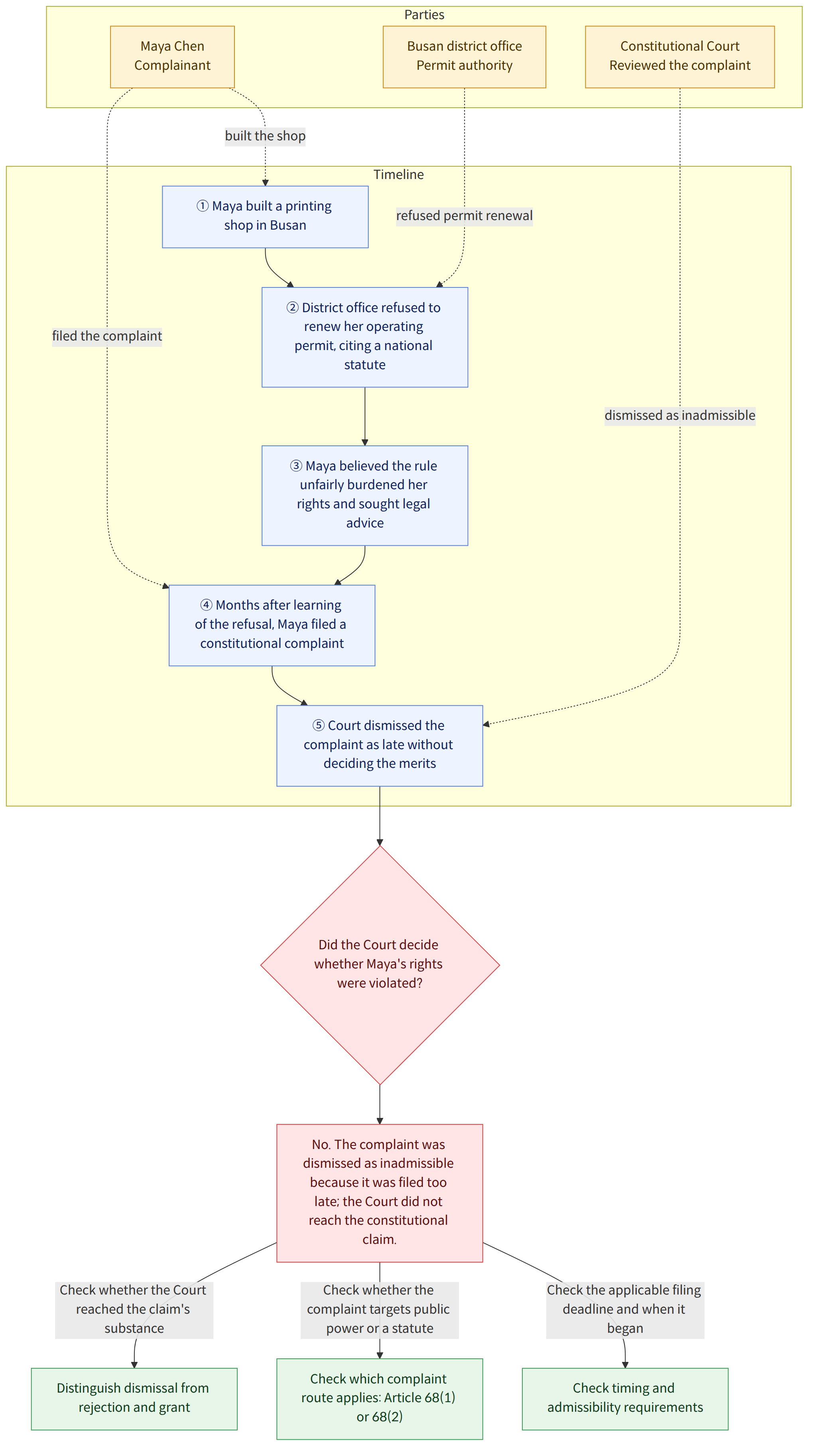
Maya Chen had built her small printing shop in Busan one careful order at a time. When the district office refused to renew a permit she needed to operate, the explanation was brief: a provision in a national statute, the official said, left the office no choice. Maya believed the rule had been applied in a way that unfairly burdened her constitutional rights.
She gathered the refusal letter, spoke with a lawyer, and eventually filed a constitutional complaint challenging the district office’s decision. But months had passed since she learned of the refusal. The Constitutional Court did not decide whether the statute or the office’s action violated her rights. It dismissed her complaint as inadmissible because it had been filed too late.
Maya’s disappointment came with a difficult lesson: a constitutional complaint can fail before the Court ever reaches the constitutional question. And when the Court does reach that question, its final decision can take more than one form.
2. The Legal Question
What can the Korean Constitutional Court decide in a constitutional complaint, and what is the practical difference between dismissing a complaint, rejecting it, and granting it?
The answer depends in part on which of two routes the complainant uses: a complaint against an exercise or failure to exercise public power under Article 68(1) of the Constitutional Court Act, or a complaint challenging a statute under Article 68(2).
3. What Korean Law Says
The Constitutional Court’s final decisions in constitutional complaints fall into three broad categories:
- Dismissal: The complaint is inadmissible. A procedural requirement has not been met, so the Court does not decide the constitutional claim on its merits.
- Rejection: The Court considers the claim but finds it unfounded. The complainant does not obtain the requested constitutional relief.
- Grant: The Court finds the complaint well-founded and provides the form of relief permitted for that type of case.
The distinction matters. A dismissal does not mean the Court has decided that the challenged act or law is constitutional. It means the complaint could not proceed. Rejection, by contrast, is a decision against the complainant after the Court has considered the substance of the claim.
Two routes, two kinds of remedy
Article 68(1), in practical terms: A person may complain that an exercise or failure to exercise public power has infringed their fundamental rights. If the complaint is well-founded, the Court identifies the right affected and the public-authority action or omission responsible. It may cancel the action or declare the omission unconstitutional.
If the Court finds that the challenged public action or failure to act resulted from an unconstitutional statute or statutory provision, it may also declare that law or provision unconstitutional.
Article 68(2), in practical terms: A person may challenge the constitutionality of a statute or statutory provision in the circumstances allowed by law. If the complaint is well-founded, the Court declares the challenged law or provision unconstitutional.
In an Article 68(2) case, the Court may declare the entire statute unconstitutional if striking down only the particular provision would make it impossible for the statute as a whole to operate.
These remedies are not interchangeable. An Article 68(1) complaint focuses on a public authority’s act or omission and the rights injury it caused. An Article 68(2) complaint focuses on the constitutionality of a law or provision.
Procedure comes first
Before considering the merits, the Court checks whether the complaint is legally admissible. Depending on the route and circumstances, requirements may include:
- Showing that the complaint concerns a matter the Constitutional Court can review.
- Following the required procedures, including any requirement to use available legal remedies first.
- Filing within the applicable time limit.
- Explaining how the challenged act, omission, or statutory provision personally affects the complainant’s fundamental rights.
A failure at this stage can lead to dismissal, regardless of how serious the complainant believes the underlying rights issue to be.
If the issues discussed under “Procedure comes first” apply to your situation, attorney Ji-sun Ahn of Ijun Law Firm can review the provision applied in your case, the ruling or notice you received, and the dates relevant to challenging it with you to help clarify your options.
4. How Korean Courts Approach This
The Constitutional Court generally separates the threshold question—whether it may hear the complaint—from the substantive question—whether a constitutional right was violated. It addresses admissibility first. If a complaint fails that threshold, the Court can dismiss it without deciding whether the government’s conduct or the law was constitutionally sound.
That sequence explains why the three outcomes should not be read as three versions of the same answer. A dismissal says the case cannot proceed in its current form. A rejection says the Court examined the claim and found it unpersuasive. A grant means the Court found a constitutional violation and issued the remedy available under the relevant route.
When it reaches the merits, the Court connects the alleged rights injury to the particular public act, omission, or legal provision being challenged. It also tailors its order to that subject: cancelling or condemning a public-authority action under Article 68(1), or declaring a law or provision unconstitutional under Article 68(2). The existence of a serious disagreement with government policy, by itself, does not determine the outcome; the legal requirements and the constitutional claim must both be established.
5. Applying the Law to the Case
Maya’s case illustrates why the first question is not always whether a law is fair.
- Identify the route. Maya challenged a district office’s refusal to renew her permit. That is an alleged exercise of public power, making Article 68(1) the relevant route on the facts of this example. If she were instead bringing an Article 68(2) complaint, the focus would be the challenged statutory provision and the procedural circumstances permitting that route.
- Identify the alleged rights injury. Maya needed to explain which fundamental right she believed had been infringed and how the permit refusal caused that injury. A bare assertion that the decision was unfair would not, on its own, establish a constitutional violation.
- Pass the admissibility threshold. The Court must be able to consider the claim under the applicable procedural rules, including the filing deadline. In Maya’s fictional case, she filed after the deadline had passed.
- Determine the consequence. Because the complaint was late, the Court dismissed it as inadmissible. It did not reject her claim on the merits, and it did not grant relief. The Court therefore did not decide whether the district office’s action was unconstitutional or whether the statute behind it was valid.
Had Maya filed on time and satisfied the other requirements, the Court could have gone on to consider the substance. If it found her Article 68(1) claim well-founded, it could identify the rights infringement and cancel the public-authority action; if the infringement stemmed from an unconstitutional statute, it could also declare that law or provision unconstitutional. If she proceeded under Article 68(2) and established that the challenged provision was unconstitutional, the Court could declare the provision—or, where necessary for the statute to function, the entire statute—unconstitutional.
6. Conclusion: What Happened, and What Should You Do?
Maya received a dismissal, not a ruling that her constitutional argument was wrong. The Court stopped at the procedural threshold because she had filed too late. Her case shows why it is essential to distinguish a complaint that cannot be heard from one that has been heard and rejected.
For anyone considering a constitutional complaint in Korea:
- Check the deadline and the correct legal route immediately. A direct challenge to public power and a challenge to a statute are not the same procedure.
- Gather the decision, notices, and proof of when you learned of the challenged act. Those records can be important to admissibility as well as to the merits.
- State precisely what right was affected, what act or provision caused the injury, and what remedy you seek. If the procedure is unclear, obtain advice from a Korean lawyer promptly rather than waiting until the constitutional deadline is near.

















