1. A Human Story
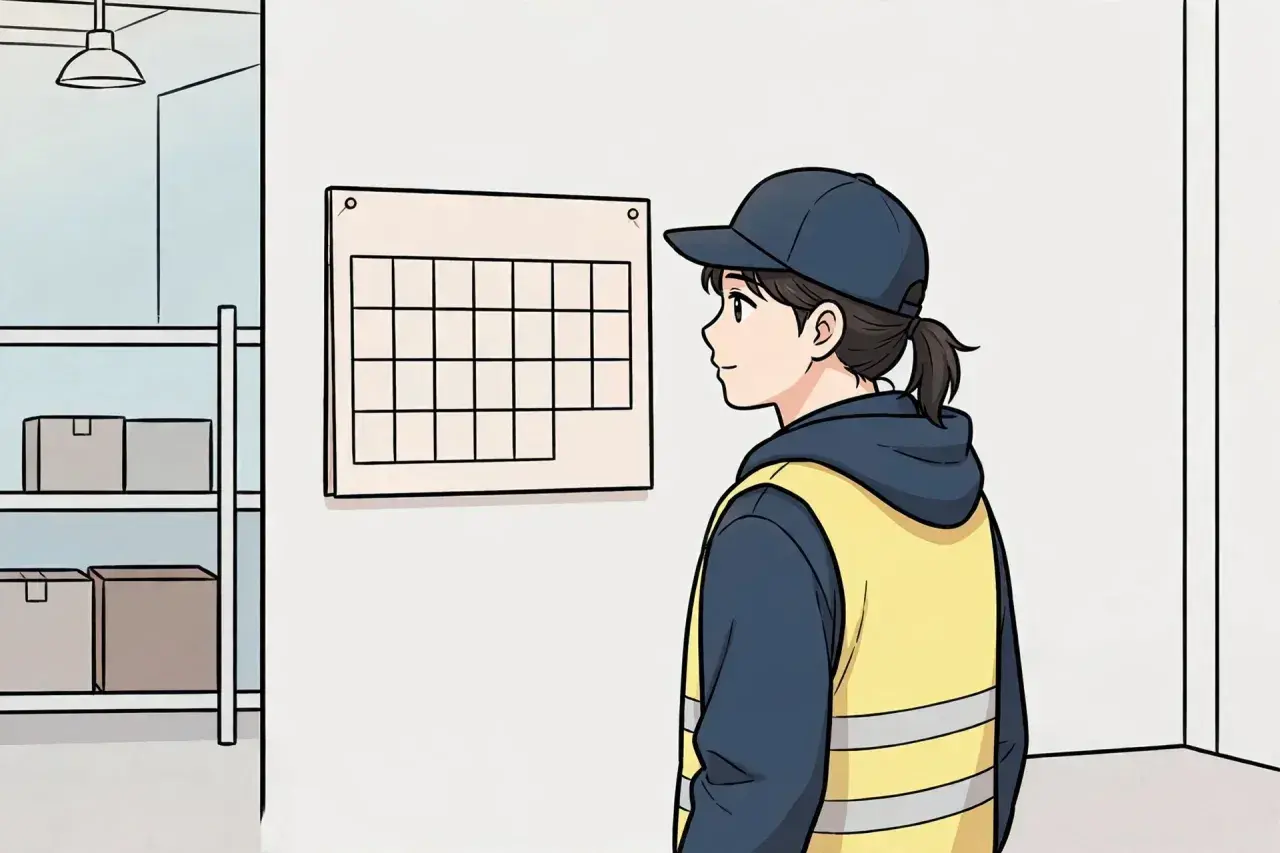
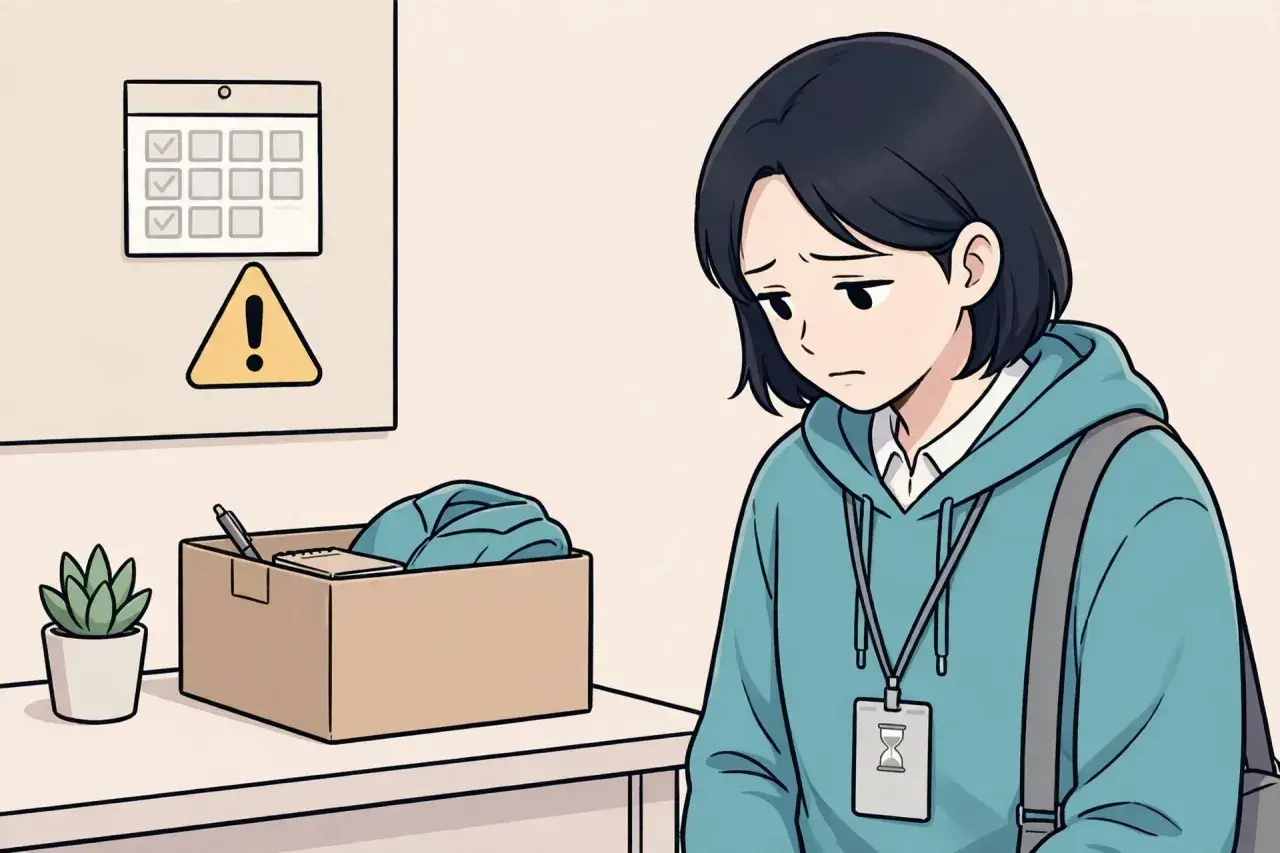
For two months, Daniel Park reported to a distribution warehouse before sunrise. His paperwork described him as a daily worker, and each shift was technically arranged one day at a time. In practice, the work had become part of his routine: same building, same supervisor, and a schedule that usually filled the week.
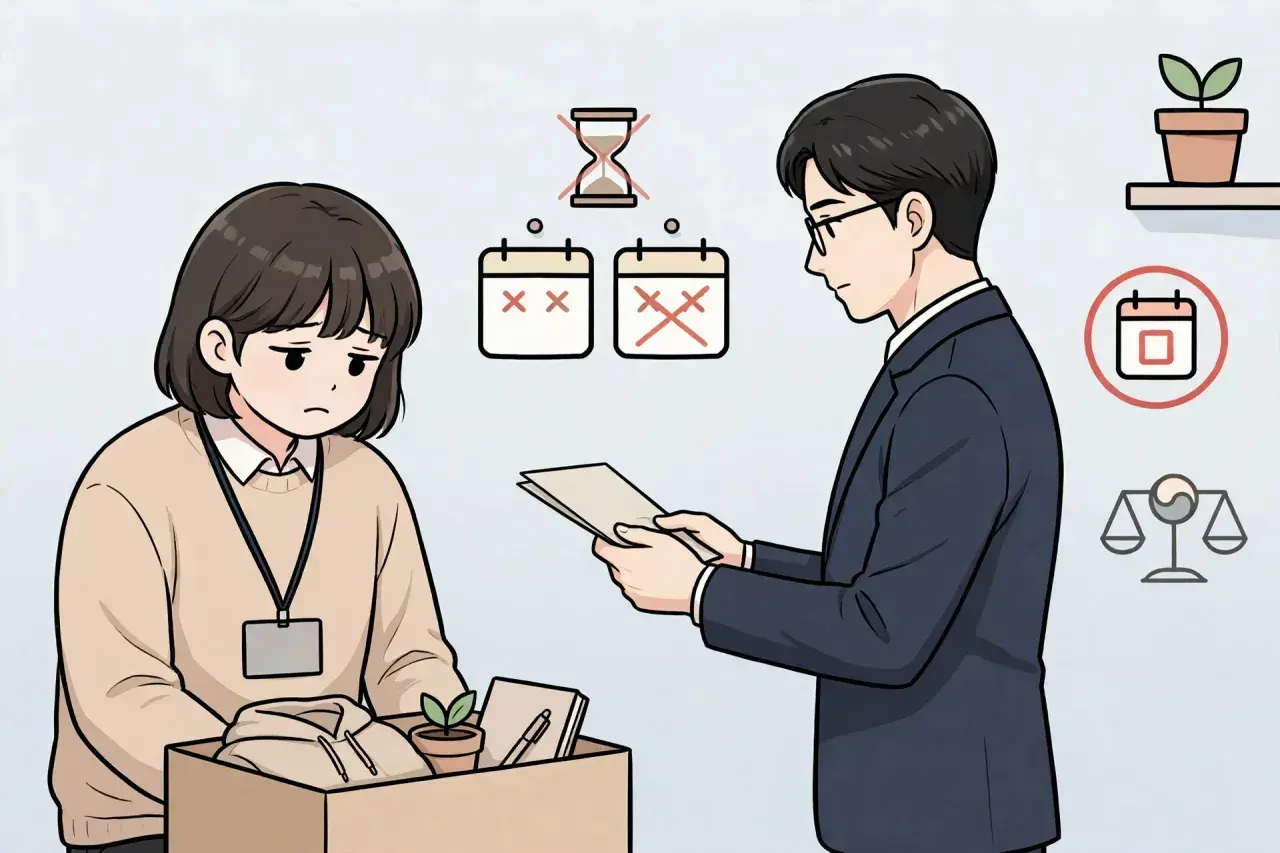
Then, without warning, the supervisor told Daniel that there would be no more shifts. Daniel had expected at least a month to find other work. When he objected, the company replied that a daily worker who had been employed for less than three months was not entitled to advance dismissal notice. Daniel wondered whether the law could draw that line without violating his constitutional right to work.
2. The Legal Question
Does exempting a daily worker with less than three months of continuous service from Korea’s advance-dismissal-notice rule violate the constitutional right to work?
3. What Korean Law Says
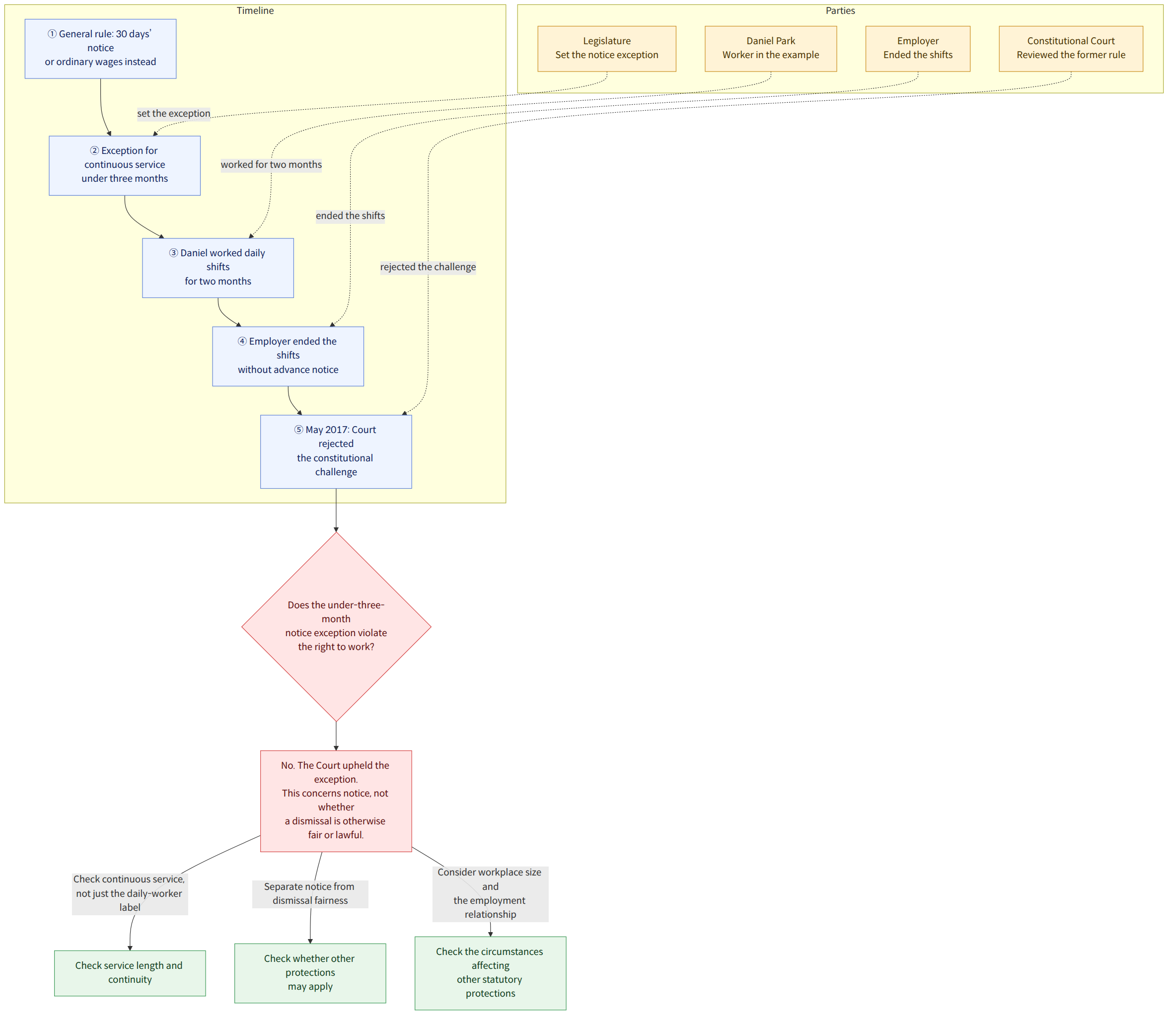
Korean labor law generally requires an employer planning to dismiss a worker to give 30 days’ notice or pay ordinary wages in lieu of that notice. The law has, however, recognized an exception for a worker whose period of continuous service is shorter than three months.
At the time of the constitutional challenge, the Labor Standards Act separately listed a daily worker who had not worked continuously for three months among those excluded from the notice requirement. The relevant rule has since been reorganized: the current statute states the under-three-month exception directly, rather than setting it out as a separate daily-worker category.
The basic rule is advance notice of dismissal—or payment in place of notice. A worker whose continuous service is under three months is an exception to that requirement.
The distinction matters because the notice rule addresses how much warning an employer must give, not whether every decision to end a job is fair or lawful. In particular:
- Notice and dismissal fairness are separate questions. An exception from advance notice does not, by itself, settle whether a dismissal was justified under other applicable protections.
- The length and continuity of service matter. Calling someone a daily worker is not necessarily the end of the analysis; the law’s threshold turns on continuous service.
- Other protections may depend on the circumstances. For example, the availability of certain statutory protections can depend on the size of the workplace and the nature of the employment relationship.
4. How Korean Courts Approach This
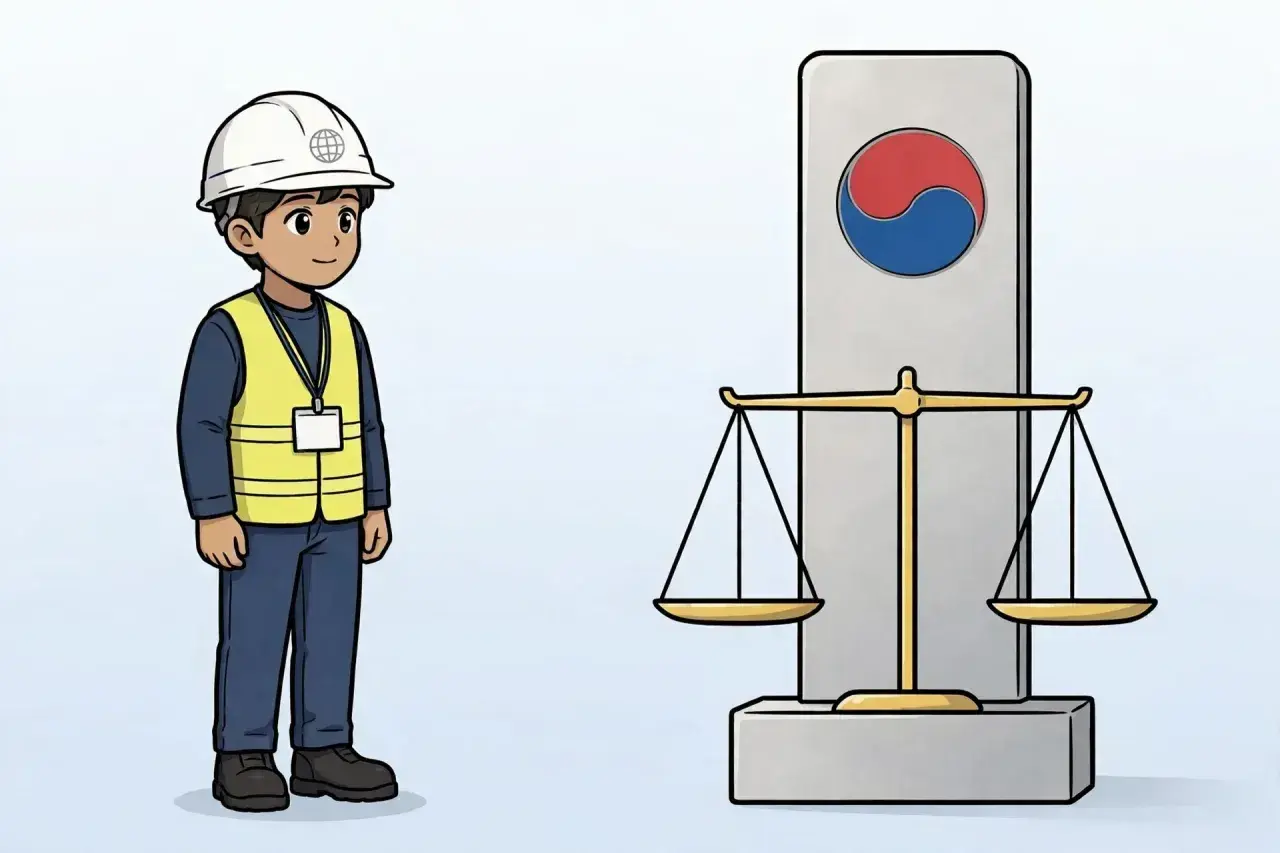
In May 2017, the Constitutional Court rejected a challenge to the former rule for daily workers with less than three months’ continuous service. Its reasoning began with the character of genuinely short-term work. Where employment is brief or arranged one day at a time, the Court considered it reasonable to find that a worker may not have the same expectation of continuing employment as someone in an established, ongoing position.
The Court also noted that a daily contract ordinarily ends when the agreed day’s work is complete. Advance notice is designed for a relationship expected to continue for a period of time; it does not fit every short, day-by-day engagement in the same way.
The legislature may draw practical lines in labor regulation, so long as its choice has a reasonable basis and does not plainly exceed its constitutional discretion.
The three-month period was treated as a minimum threshold for distinguishing temporary employment from a more established working relationship. The Court considered it reasonable for the law to use that period as a point at which a daily worker could be treated more like a regular employee for relevant statutory purposes. It therefore concluded that the exception did not violate the constitutional right to work.
5. Applying the Law to Daniel’s Case
The legal analysis follows several steps.
- Identify the kind of protection Daniel is claiming. Daniel was dismissed without 30 days’ warning. The immediate issue is whether he was entitled to advance notice or equivalent pay—not, by itself, whether the employer had a fair reason to end the relationship.
- Measure his continuous service. Daniel had worked for two months. On the facts described, he had not reached the statutory three-month threshold.
- Consider the daily nature of the arrangement. His shifts were organized on a day-by-day basis. That is the kind of short-term arrangement for which the notice exception was designed, according to the Court’s reasoning.
- Apply the constitutional standard. The exception has a rational connection to the difference between short-term engagements and longer-running employment. The Court found that choosing three months as the dividing line did not clearly exceed the legislature’s discretion.
- Keep the legal issues distinct. Daniel’s failure to qualify for advance notice does not automatically answer whether some separate dismissal protection applies to him. That would require additional facts, including the workplace’s size and the precise structure of his employment. But on the constitutional question he raised, the three-month exception stands.
If you are dealing with a similar issue, attorney Ji-sun Ahn of Ijun Law Firm can review the employer’s notice, the relevant workplace rules, and communications about the reasons and timing of the decision with you. These details can help clarify which options apply to your situation.
6. Conclusion: What Happened, and What Should You Do?
Daniel’s constitutional challenge would not succeed on these facts. With only two months of continuous service, he falls below the three-month threshold, and the Constitutional Court has held that this exception does not violate the right to work. The employer may therefore be excused from giving advance notice under this rule.
That does not mean the company’s decision is automatically lawful in every respect. The notice requirement is only one part of Korean labor law, and a worker may have a separate claim depending on the circumstances. Daniel should check whether his work was genuinely limited to separate daily contracts or had become continuous in practice, and whether other dismissal protections apply to his workplace.
For workers in a similar position:
- Keep records of shifts, schedules, messages, pay, and any promise of ongoing work; these can help establish how continuous the employment really was.
- Ask which rule the employer is relying on. A lack of notice and an allegedly unfair reason for dismissal are distinct issues.
- Seek prompt advice from a labor professional or the relevant labor authority, especially if your service is near or beyond three months or the employer’s account of your work history is disputed.