

1. A Human Story
Daniel Reed had spent months knocking on doors and speaking at neighborhood meetings. On election night, he won a seat on the city council by a narrow margin. He believed the result reflected his own work—and that the campaign had stayed within the rules.
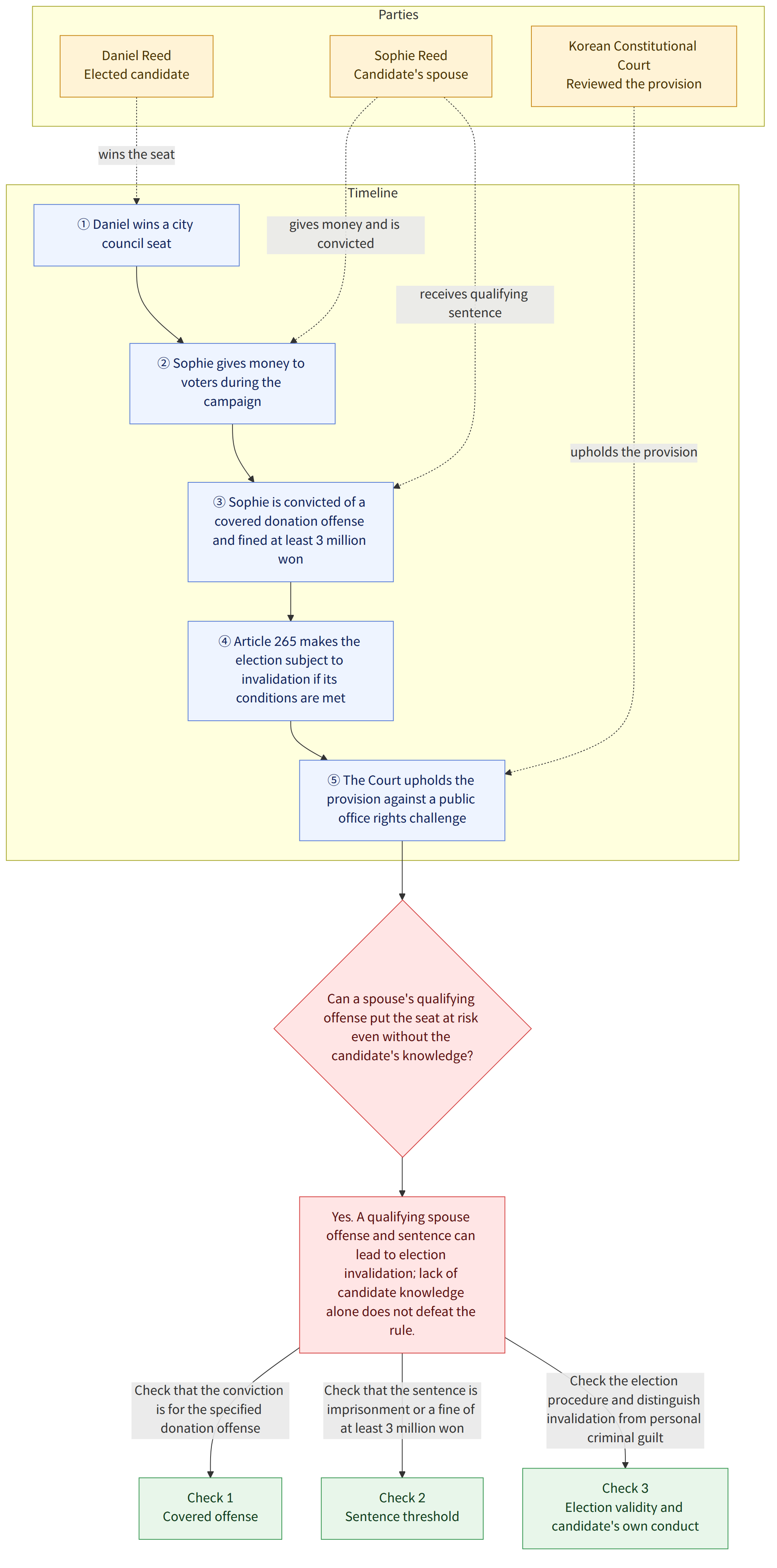
Then the investigation turned to his wife, Sophie. During the campaign, she had given money to several voters. Daniel said he had not known about it and had not authorized it. But Sophie was convicted of an unlawful donation-related election offense and received a fine of 3 million won or more. Under Korean election law, Daniel’s victory was now at risk, even though he had not personally handed anyone money.
2. The Legal Question
Can Korean law invalidate a candidate’s election because the candidate’s spouse was convicted of a prohibited donation offense and received a sufficiently serious sentence—even when the candidate says they had no knowledge of or involvement in the conduct? And does that consequence violate the candidate’s constitutional right to hold public office?
3. What Korean Law Says
The relevant provisions are in the Public Official Election Act. Article 257(1) penalizes specified unlawful donation activities, including conduct that improperly provides money or other benefits in connection with an election. Article 265 provides that an elected candidate’s election may be invalidated when the candidate’s spouse receives a qualifying sentence for the donation offense covered by that provision.
Under Article 265, a candidate’s election is subject to invalidation if the candidate’s spouse is sentenced to imprisonment or to a fine of 3 million won or more for the specified donation offense under Article 257(1).
The rule is consequential, but it is not the same as finding the candidate personally guilty of a crime. It attaches an election-law consequence to the spouse’s qualifying offense. In practical terms, the law treats the candidate and spouse as closely connected in the election context.
The constitutional question is whether this consequence goes too far. The right to hold public office is protected by the Korean Constitution, but it is not absolute. Restrictions may be imposed where they serve a legitimate public purpose and are not excessive in relation to that purpose.
Key points to keep in mind are:
- The spouse’s conduct must fall within the specified donation offense—not merely be embarrassing or politically damaging.
- The statutory sentence threshold matters: imprisonment or a fine of at least 3 million won.
- The consequence concerns the validity of the candidate’s election. It does not, by itself, establish that the candidate personally committed the spouse’s offense.
- Whether the statutory trigger has been met in a particular case depends on the facts and the applicable legal procedure.
4. How Korean Courts Approach This
The Korean Constitutional Court has upheld this provision against the claim that it improperly restricts a candidate’s right to hold public office. Its reasoning begins with the public interest: clean and fair elections are central to democracy, not a minor administrative preference.
The Court has reasoned that vote-buying is a serious election offense; that an election affected by unlawful campaigning cannot always be treated as legitimate; and that family members may sometimes play hidden or organized roles in a campaign. In that setting, treating a candidate and spouse as closely linked for election purposes is not necessarily unfair or excessive.
The Court has also accepted that the law need not provide a defense simply because the candidate claims to have exercised reasonable supervision or lacked knowledge. In other words, the statute can impose what is, in effect, a form of statutory responsibility without proof of the candidate’s personal fault for the purpose of determining whether the election stands.
That does not mean every act by a spouse automatically costs a candidate an election. The offense and sentence must meet the statutory conditions. But once they do, a candidate’s lack of personal involvement does not, by itself, defeat the rule.
5. Applying the Law to the Case
Daniel’s position can be assessed in several steps.
- Was there a covered offense? Sophie was convicted of an unlawful donation offense under the relevant part of Article 257(1). If her conduct had been some unrelated personal gift, Article 265 would not apply on that basis alone. In Daniel’s case, however, the conviction concerned prohibited election-related donations.
- Did the sentence meet the threshold? Sophie received a fine of at least 3 million won. That is the threshold identified in Article 265. A lesser fine would not satisfy this particular sentencing condition, though other legal consequences might still be possible.
- Does Daniel’s lack of knowledge change the result? He says it does: he did not approve the payments and did not know they were being made. Those facts may matter to whether Daniel himself committed any offense. But the constitutional rule at issue does not make his personal knowledge a necessary condition for the election consequence once the spouse’s qualifying offense and sentence are established.
- Is the consequence unconstitutional? Daniel can argue that losing his seat for something he did not do unfairly burdens his right to hold public office. The Constitutional Court’s approach, however, weighs that burden against the serious public interest in preventing vote-buying and protecting the legitimacy of elections. It has concluded that the statutory rule is not necessarily an excessive restriction.
So Daniel’s strongest point—that he was personally uninvolved—does not resolve the election question. The decisive legal facts are Sophie’s covered donation conviction and whether her sentence meets the statutory threshold under the applicable procedure.
If you are dealing with a similar issue, attorney Ji-sun Ahn of Ijun Law Firm can review the dates, the underlying agreement or decision, and records that show the circumstances of this case with you. These details can help clarify which options apply to your situation.
6. Conclusion: What Happened, and What Should You Do?
Daniel’s election does not survive merely because he says he knew nothing about Sophie’s conduct. Because she was convicted of the specified donation offense and received a fine of at least 3 million won, the statutory basis for invalidating his election is met. The constitutional challenge is unlikely to succeed: Korean constitutional law permits this consequence in light of the importance of fair elections and the gravity of vote-buying. That conclusion concerns Daniel’s seat; it does not, on its own, declare him criminally guilty of Sophie’s offense.
For candidates and campaign teams facing a similar risk:
- Set clear, written rules forbidding campaign staff and family members from giving voters money, gifts, or other benefits, and make sure everyone understands them.
- Keep records and escalate concerns immediately. Preserve messages, spending records, and instructions if a questionable payment is reported.
- Get Korean election-law advice promptly. The offense, sentence, timing, and procedural posture can all affect the outcome, so do not assume that lack of personal knowledge will protect the election result.

















