

A Human Story
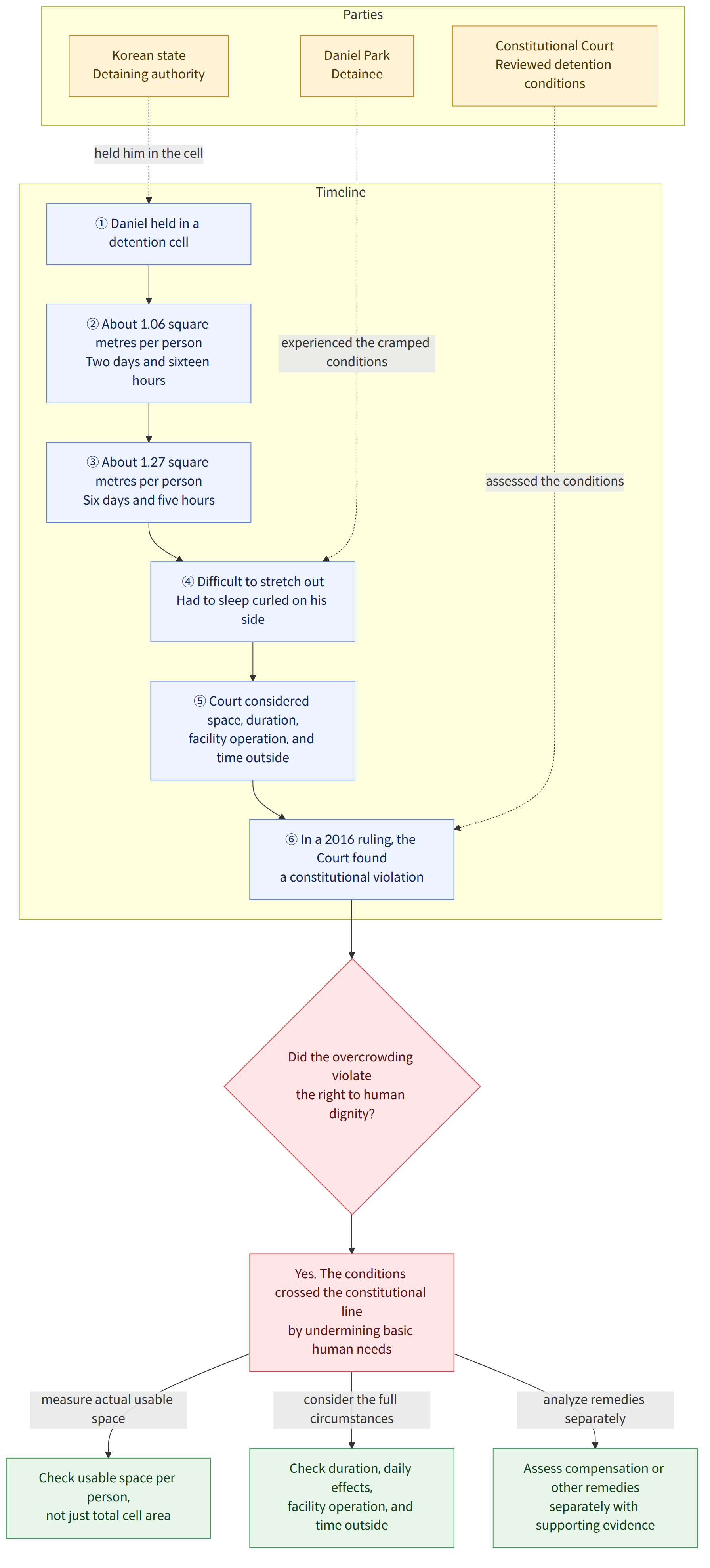
Daniel Park had expected his detention to mean locked doors, strict schedules, and little privacy. He had not expected that simply lying down would become a daily calculation. In the cell, the floor space available to each person was so limited that stretching out fully was difficult. At night, Daniel had to turn onto his side and curl himself into the narrow space left around him.
For one spell, Daniel spent two days and sixteen hours in a room where the usable space per person was about 1.06 square metres. Later, he spent six days and five hours in another period of confinement with about 1.27 square metres available to each person. Visits and exercise sometimes took him outside the room, but most of the time he had to manage the cramped space, the disrupted sleep, and the strain of not being able to move normally.
The Legal Question
Can the state’s decision to hold a detainee in a cell so crowded that ordinary movement and sleep become difficult violate the constitutional guarantee of human dignity? And, when assessing the conditions, must a court look only at the floor area, or consider the full circumstances of confinement?
What Korean Law Says
South Korea’s Constitution protects human dignity and worth. That protection does not disappear when a person is detained. Confinement necessarily limits some freedoms, but the government remains responsible for ensuring that detention does not deprive a person of the basic conditions needed for human existence.
Article 10 of the Constitution protects the dignity and worth of every person. The state may not treat a person merely as an object of its power or hold someone in conditions that deprive them of the basic necessities of human existence.
The constitutional issue is not decided by a single measurement in isolation. Relevant considerations include:
- the usable living space per person in the cell;
- the number of people held there and how the facility is operated;
- how long the person remained in those conditions;
- time spent outside the cell for activities such as visits or exercise; and
- the broader circumstances, including practical constraints on the correctional system.
Those factors provide context, but they do not excuse conditions that cross the constitutional boundary. If the space is so cramped that a person cannot manage basic needs such as resting or moving in an ordinary way, the conditions themselves may violate human dignity.
A finding of a constitutional violation does not, by itself, answer every question about compensation or other remedies. Those questions may require separate legal analysis and evidence.
How Korean Courts Approach This
Korean courts recognize that detention has a legitimate purpose and inevitably restricts some personal freedoms. But they distinguish those necessary restrictions from conditions that go beyond what confinement requires and undermine a person’s status as a human being.
The Constitutional Court has explained that overcrowding must be assessed in context: the court considers the available space, the facility’s overall operation, the duration of confinement, and how much time the detainee spent outside the cell. Yet context is not a licence for extreme crowding. Where the space is so small that even basic human needs cannot reasonably be met, the conditions may themselves exceed the limits of the state’s authority to punish or detain.
In a 2016 ruling, the Constitutional Court found a violation where the usable area per person was approximately 1.06 square metres for two days and sixteen hours, and 1.27 square metres for six days and five hours. The person was an adult man who could not comfortably stretch out and had to sleep on his side in a cramped position. The Court concluded that the conditions could cause serious physical and mental distress and deprive him of the conditions needed for basic personal activity.
Applying the Law to Daniel’s Case
Daniel’s claim would be assessed in several steps.
- Establish the actual space available. The important figure is the space each person could actually use, not simply the room’s total area. Daniel’s measurements—about 1.06 and 1.27 square metres per person—would be central evidence.
- Show what those measurements meant in daily life. Daniel’s difficulty stretching out and having to sleep curled on his side are relevant because they describe the effect of the space on basic movement and rest, rather than merely its size on paper.
- Consider how long the conditions lasted. The periods of two days and sixteen hours, and six days and five hours, matter to the overall assessment. The court would also consider whether Daniel was taken out of the cell for visits or exercise and for how long. Those periods are part of the picture, but they do not automatically make extremely cramped cell conditions acceptable.
- Assess the whole setting against the constitutional minimum. The government may point to the operation of the facility or limits on available resources. Such circumstances can be considered, but the state cannot rely on them to justify depriving someone of the basic conditions necessary to maintain human dignity.
On these facts, Daniel’s claim would be strong. The space was not merely uncomfortable: it was so restricted that normal stretching and sleep were difficult. The comparison with the Constitutional Court’s 2016 ruling is especially close. If Daniel could substantiate the measurements, duration, and lived conditions, a court could conclude that the state crossed the constitutional line by holding him in conditions incompatible with human dignity.
If your experience resembles Daniel’s, attorney Ji-sun Ahn of Ijun Law Firm can review the records you have—such as documents about cell occupancy, the dates and duration of confinement, or any medical notes—and help assess how they relate to the conditions you describe.
Conclusion: What Happened, and What Should You Do?
Daniel’s confinement did not become unconstitutional simply because his cell was unpleasant or because detention limited his freedom. The decisive facts were the exceptionally small usable area, the difficulty of basic movement and sleep, and the length of time he remained in those conditions. On that combination of facts, the constitutional analysis supports a finding that his treatment violated his right to human dignity.
For anyone facing similar conditions:
- Record the details as soon as possible: dates, cell occupancy, approximate usable space, sleeping conditions, and time spent outside the cell.
- Preserve available evidence: keep notices, applications, responses, medical records, or other documents that may help establish the conditions and their effects.
- Get advice on the specific record: a review of the available cell-condition evidence and relevant documents can help clarify what claim or remedy may be available in your circumstances.
















